

Test & Measurement


ESD testing equipment and calibration

28 October 2020 Test & Measurement

ESD stands for electrostatic discharge, and describes the transfer of electrostatic charge between two objects. The resulting discharge from an electron imbalance may be so small that the human body cannot feel it, nevertheless it can have serious consequences. In electronics manufacturing, pharmaceuticals, healthcare, ordnance manufacturing and storage, ESD incidents can often cause material, component, or system failures, which may prove costly and sometimes even dangerous.

The importance of testing

Since static charge cannot be seen and since the human body cannot always detect or feel harmful electrostatic discharges, regular testing and monitoring is the only way of knowing for sure whether your facility is safe or at risk.

The first step is to establish an ESD Protected Area (EPA), which is essentially a cordoned-off area and controlled environment where components and devices that are vulnerable to ESD damage are safely handled. Once you have identified an EPA and the equipment required to control static within this environment, you need to establish a documented testing and monitoring system which outlines the items to be tested, as well as the frequency. It is always advisable to keep a record of all tests conducted as well as the results so that you can refer back to it if necessary.

Types of testing equipment

There are various types of testers but the following are some of the most popular ones required by almost any EPA:

• Field meters: portable static detectors that measure the static of all moving objects. This is especially useful when setting up the EPA or when working on site, and helps determine objects and areas that are generating the most static.

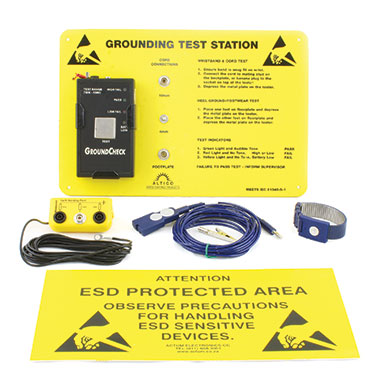
• Ground-check tester: this tester contains two probes that can be placed on either side of an object to measure its resistance. This is useful to determine whether you are operating with the correct ESD resistivity standards governing your industry and application.

• Footwear and wrist-strap testers: grounding forms a critical part of effective static control since movement is a major generator of static charge. Personnel grounding equipment, such as wrist straps and footwear, need to be monitored continuously while they are working directly with ESD-sensitive components.

Calibration of testing equipment

All testers need to be calibrated once a year to ensure that they are functioning within the correct test range and are compliant with ESD standards. Different industries and applications have different ESD compliance standards and so the equipment needs to measure within the correct static and resistivity ranges as well.


Credit(s)


Share this article:
Share via emailShare via LinkedInPrint this page

Further reading:

AI-ready rugged spectrum analysis for the field
Vepac Electronics Test & Measurement
The HAROGIC PXR Series is a rugged, benchtop-grade spectrum analyser and an AI-ready open platform in a single portable instrument.

Read more...
Digid announces its nanoscale temperature and force sensors are ready for mass deployment
Test & Measurement
Digid, a pioneer of nanoscale sensing technology, recently announced that its patented printed electronics fabrication technology has been fully qualified for volume production of temperature and force sensors as small as 1 µm long.

Read more...
Multichannel AWGs for GHz signal generation
Vepac Electronics Test & Measurement
Spectrum Instrumentation has introduced its new flagship Arbitrary Waveform Generators with a maximum of 6 channels at 10 GS/s or 12 channels at 5 GS/s output speed.

Read more...
100ZR evaluation added to test instruments
Tamashi Technology Investments Test & Measurement
Anritsu Corporation has added 100ZR coherent optical transceiver evaluation to its portable Network Master Pro MT1040A/MT1000A testers, enabling comprehensive communication performance testing for the next-generation 100ZR standard.

Read more...
Multichannel digitisers
Vepac Electronics Test & Measurement
Spectrum Instrumentation has released new flagship digitisers with 12-bit resolution and a maximum of 6 channels at 10 GS/s or 12 channels at 5 GS/s acquisition speed.

Read more...
Aligning clocks over large distances
ASIC Design Services Test & Measurement
SkyWire technology from Microchip makes it easier to align and compare clocks within nanoseconds across geographic locations.

Read more...
Scalable power solutions up to 3 kW
Accutronics Test & Measurement
GAIA Converter has introduced the MGDM-500/P power module with a new parallel option for scalable power solutions up to 3 kW.

Read more...
New technique for measuring DNA damage could improve cancer therapy
Test & Measurement
Scientists at the National Institute of Standards and Technology have developed a new technology for measuring how radiation damages DNA molecules.

Read more...
Precise DC power analysis
Conical Technologies Test & Measurement
The ITECH IT2705 DC power analyser is designed to help engineers and researchers capture it all, from the tiniest deep sleep currents to the highest peak operating loads.

Read more...
What is a JTAG connector?
Spectrum Concepts Test & Measurement
JTAG was originally created to test for common problems, but lately, it has become a way of configuring devices.

Read more...


While every effort has been made to ensure the accuracy of the information contained herein, the publisher and its agents cannot be held responsible for any errors contained, or any loss incurred as a result. Articles published do not necessarily reflect the views of the publishers. The editor reserves the right to alter or cut copy. Articles submitted are deemed to have been cleared for publication. Advertisements and company contact details are published as provided by the advertiser. Technews Publishing (Pty) Ltd cannot be held responsible for the accuracy or veracity of supplied material.


© Technews Publishing (Pty) Ltd | All Rights Reserved

