


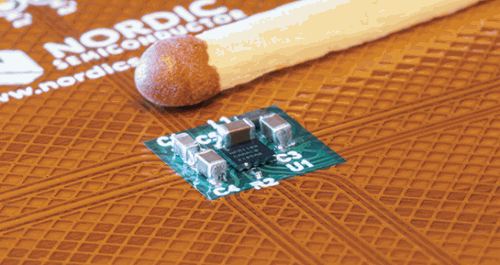
Nordic Semiconductor announced the launch of its first power management IC (PMIC), the nPM1100, which combines a USB-compatible input regulator with over-voltage protection, 400 mA battery charger and 150 mA DC/DC step-down (buck) voltage regulator in a 2,075 x 2,075 mm wafer level chip scale package (WLCSP).
The device ensures reliable power supply and stable operation for Nordic’s nRF52 and nRF53 Series multiprotocol systems-on-chip (SoC) and maximises application battery life. The product can also be used as a generic PMIC for any application using rechargeable lithium ion (Li-ion) or lithium polymer (Li-Po) batteries. Its compact form factor makes it ideal for advanced wearables, connected medical devices and other space-constrained applications.
Bluetooth Low Energy (Bluetooth LE) applications based on nRF52 and nRF53 Series SoCs and using rechargeable Li-ion/Li-Po batteries can take advantage of the nPM1100’s battery charger to bypass the first regulator stage of the SoCs. In addition, when used in this configuration the high efficiency of the nPM1100’s buck regulator reduces overall system power consumption while its 150 mA current capability increases the current available for other system components from approximately 10 mA to 100 mA.
Ultra-low quiescent current
The nPM1100 features an ultra-low quiescent current (IQ) of 700 nA, which can be further reduced to 470 nA in ‘ship mode’. Ship mode also disables the power output, removing the need for an external power switch and ensuring minimum impact on the battery lifetime of products in transit. The power management solution takes up as little as 23 mm2 of PCB area, including passive components (rising to 27 mm2 when optimised for performance).
The input regulator of the PMIC draws its power from either a 4,1 to 6,6 V USB input or from a 2,3 to 4,35 V connected battery input; it can supply a 3,0 to 5,5 V unregulated voltage to the application at up to 500 mA output current. The PMIC supports USB Standard Downstream Port (SDP), Charging Downstream Port (CDP) and Dedicated Charger Port (DCP) detection. The input regulator includes over-voltage protection for transient voltage spikes up to 20 V.
The PMIC’s JEITA-compliant battery charger will charge the application’s Li-ion/Li-Po battery with a resistor-selectable charge current from 20 to 400 mA and a selectable termination voltage of 4,1 or 4,2 V. The charger includes battery thermal protection and automatic selection from three charging modes: automatic trickle, constant current and constant voltage. The charger also features a discharge current limitation.
High-efficiency voltage regulator
The product’s highly efficient DC/DC buck voltage regulator runs at more than 90% efficiency down to below 100 µA load current. It takes its power from the input system regulator and provides up to 150 mA current at a selectable 1,8 V, 2,0 V, 2,7 V or 3,0 V regulated output voltage. The regulator features soft startup and automatic transition between hysteretic and pulse width modulation (PWM) modes. It also supports a forced PWM mode to ensure the cleanest power operation possible.
The nPM1100 requires no configuration software to operate as all settings are pin-configurable. The PMIC is compatible with all devices designed to operate within the output voltages and supply currents the chip can deliver. The product’s operating temperature range is -40°C to 85°C.
Evaluation kit
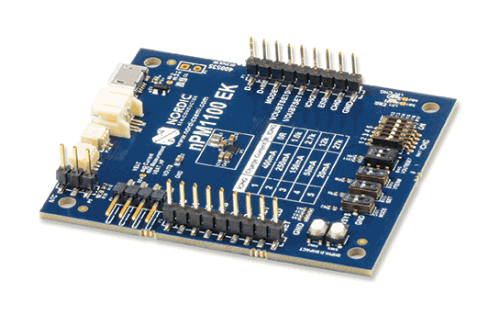
The new PMIC is accompanied by the nPM1100 Evaluation Kit (EK). The kit features switches for all selectable settings, buttons to enter and exit ship mode and connectors for batteries, USB and headers for all pins on the PMIC. The headers allow for overriding switches if software control configuration is required.
The EK allows for testing of the nPM1100 chip’s capabilities with existing applications without the need for creating custom hardware. The kit can be powered by USB via the on-board micro-USB port, from an external DC power supply through header pins, or from battery power via the battery connectors on one of the headers. The EK is designed for use with other Nordic development kits or to test out the PMIC’s functionality with non-Nordic products.
| Tel: | +27 21 555 8400 |
| Email: | sales@rfdesign.co.za |
| www: | www.rfdesign.co.za |
| Articles: | More information and articles about RF Design |






© Technews Publishing (Pty) Ltd | All Rights Reserved
 printer friendly version