Transponders in different frequency ranges are used in a variety of applications and technical sectors. Neosid offers RFID transponders and antenna devices for the following frequency ranges:
• LF - low frequency, 125/134,2 kHz.
• HF - high frequency/near-field communication (NFC), 13,56 MHz.
• UHF - ultra high frequency, 434/868/9xx MHz.
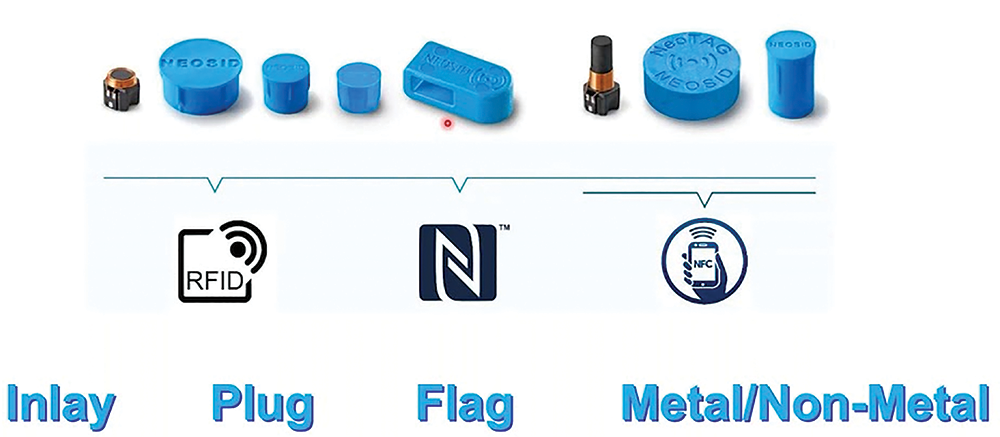
With NeoTAG, Neosid offers an extremely compact design that meets maximum range. The highly compact transponders withstand the most adverse conditions and have a remarkable reading range, even from within metallic environments.
A cleverly designed ferrite core optimises reading out from within a metallic environment at 13,56 MHz. The transponder is delivered with a read/write chip as standard and supplied in a surprisingly small housing (2,6 x 2,6 x 2,4 mm). That qualifies the compact NeoTAG components for a broad range of tasks that encompasses all industries in which small transponders with a far reading range are in demand.
The assembled RFID chip supports ISO IEC 15693 and as NFC Forum Type 5 tags, they are useable for NFC applications as well. NeoTAG HF transponders are in accordance with the directive for market availability of radio equipment (RED directive 2014/53/EU).
The plastic housing for these ‘plug-and-flag’ products is made from high-quality polyphthalamide (PPA) material. This thermoplastic synthetic material possesses high strength and demonstrates high resistance to mechanical loads, chemical substances and heat. Its high creep strength and low mechanical distortion make PPA a very popular material for use in demanding industries. Due to this PPA material’s high temperature stability of up to 280°C, NeoTAG transponders withstand use in high ambient temperatures.
For all supported RFID frequency ranges, Neosid offers a wide range of specially fitted transponder antennas that can be used in transponders as well as in RFID reader devices.
Low profile SMD antenna Altron Arrow
Telecoms, Datacoms, Wireless, IoT
The Havok PCS.06.A antenna, from Taoglas, is a low profile SMD LTE/cellular 4G/3G/2G embedded antenna designed for direct SMD mount on a device PCB.
Read more...Simplifying system design iCorp Technologies
Telecoms, Datacoms, Wireless, IoT
The FGMC63N tri-band MCU Wi-Fi 6E module from Quectel addresses offers integrated connectivity across 2,4 GHz, 5 GHz, and 6 GHz bands in a compact, highly optimised design.
Read more...Dragino’s connectivity catalogue Otto Wireless Solutions
Telecoms, Datacoms, Wireless, IoT
Where Wi-Fi demands frequent charging and covers tens of meters, and traditional cellular consumes too much power for battery-operated nodes, LoRaWAN threads the needle.
Read more...RF filters explained RFiber Solutions
Telecoms, Datacoms, Wireless, IoT
As RF environments become increasingly crowded, RF filters play a critical role in maintaining signal quality, improving system performance, and ensuring reliable operation.
Read more...Practical design strategies for 5G RF Design
Telecoms, Datacoms, Wireless, IoT
The Cavli CQM211 aims to provide a platform that combines strong 5G connectivity with onboard compute capability, as well as interface flexibility that suits both new designs and rapid migrations from earlier products.
Read more...An industry-first Android 16 smart module solution RF Design
Computer/Embedded Technology Telecoms, Datacoms, Wireless, IoT
The MeiG Smart SLM580 4G Smart Module features native support for Android 16 and covers core frequency bands in major countries and regions worldwide.
Read more...High performance RF signal conditioning RFiber Solutions
Telecoms, Datacoms, Wireless, IoT
The AM3269 from Mercury Systems is a high-performance RF preselector module designed to improve receiver sensitivity and signal integrity in demanding electronic warfare, signals intelligence, test, and communications applications.
Read more...RF filters explained RFiber Solutions
Telecoms, Datacoms, Wireless, IoT
As RF environments become increasingly crowded, RF filters play a critical role in maintaining signal quality, improving system performance, and ensuring reliable operation.
While every effort has been made to ensure the accuracy of the information contained herein, the publisher and its agents cannot be held responsible for any errors contained, or any loss incurred as a result. Articles published do not necessarily reflect the views of the publishers. The editor reserves the right to alter or cut copy. Articles submitted are deemed to have been cleared for publication. Advertisements and company contact details are published as provided by the advertiser. Technews Publishing (Pty) Ltd cannot be held responsible for the accuracy or veracity of supplied material.









 printer friendly version