For centuries, the construction industry used two simple tools to lay out building floor plans: a tape measure and a chalk line. The tape measure and marker process are slow and prone to human error that impacts schedules and budgets. Errors cause rework, which typically accounts for 10% of the cost of a construction project.
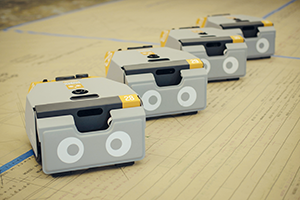
Dusty eliminates the conventional, labour-intensive process of physically transferring building plans onto the floor with a robot programmed at the job site to automate the same task. The Dusty FieldPrinter robot loads a digital version of the floorplan and then prints the layout on the ground for features such as walls, doors, plumbing and electrical chases. This is performed at speeds roughly five times faster than a human and to within one-sixteenth of an inch to specification.
Dusty’s FieldPrinter is a battery-powered mobile robot that operates for long periods in a variety of weather conditions. It includes many different electronic devices, including sensors, drive motors and motorised components, computationally-heavy processors and a printer – all of which have different operating voltage and current requirements. The core of the FieldPrinter is designed by OLogic using power components sourced from Vicor. After trying discrete power solutions for its robot, OLogic soon discovered the benefits of changing to a modular approach to building power delivery networks (PDNs) for robots and turned to Vicor. Vicor modules, such as the ZVS buck regulator, are extremely cost-efficient given the 200 to 300 W of power they deliver and their 97% efficiency.
“The parts we’ve been using most lately are the Vicor ZVS buck regulators,” said Ted Larson, CEO of Ologic. “We use them everywhere on mobile robots now. I don’t ever have to think about, ‘Oh, I need 5 or 10 amps at 12 volts, so I’m going to go build my own supply.’ I don’t ever think that way anymore.”
With a long battery life and state-of-the-art power conversion technology supplied by Vicor, Dusty’s robotics innovation is helping digitise the construction industry.
SoC with improved processing and efficiency Future Electronics
DSP, Micros & Memory
The nRF54L Series of 2,4 GHz SoCs from Nordic Semiconductor is an upgrade on the previous nRF52 Series and offers advanced Bluetooth connectivity, improved processing power and efficiency, and high security capabilities.
Read more...Low power liquid detection for smart systems Future Electronics
Test & Measurement
Microchip Technology’s MTCH9010 Liquid Detection Turnkey Device is a compact, low power sensing solution designed to simplify reliable liquid detection in modern electronic systems.
Read more...Batteries and ATEX: What you need to know Uniross Batteries
Power Electronics / Power Management
Choosing compliant batteries not only helps mitigate risk in hazardous areas, but it can also help developers decrease the certification phase and time-to-market.
Read more...40 W and 75 W railway DC/DC converter Brabek
Power Electronics / Power Management
RECOM has announced two new cost-efficient DC/DC converters for the rail market with an ultra-wide 11:1 input range to cover all nominal input voltages from 24 to 110 V DC.
Read more...High-precision current transducer
Power Electronics / Power Management
Danisense announces its new high-precision DP12IP current transducer designed for isolated DC and AC current measurement in demanding PCB-mounted power electronics applications.
Read more...Secure holder for protected 18650 batteries
Power Electronics / Power Management
Designed for protected 18650 batteries up to 70 mm long, the holder offers secure retention for portable, industrial, and embedded applications.
Read more...More room to scale Altron Arrow
Power Electronics / Power Management
With the latest STM32H5 lines from STMicroelectronics, you can now scale within the same platform, from a compact 1 Mbyte device to higher-memory MCUs for graphics-rich and feature-heavy designs.
Read more...1 GHz crossover MCU with Arm Cortex Cores Future Electronics
DSP, Micros & Memory
i.MX RT1170 Crossover MCUs, from NXP Semiconductor, are dual-core devices featuring an Arm Cortex-M7 and Arm Cortex-M4 for real-time microcontroller (MCU) performance and high integration for automotive, industrial and IoT applications.
Read more...Surface mount power amplifier for high-power applications RF Design
Power Electronics / Power Management
The GNA-63-5W+, from Mini-Circuits, is a GaN MMIC Power Amplifier (PA) designed for demanding RF applications requiring high efficiency, excellent linearity, and a compact footprint.
Read more...1200 V QSiC modules
Power Electronics / Power Management
SemiQ Inc has launched the QSiC Dual3, a family of 1200 V half-bridge MOSFET modules for motor drives in data centre cooling systems, grid converters in energy storage systems, and industrial drivers.
While every effort has been made to ensure the accuracy of the information contained herein, the publisher and its agents cannot be held responsible for any errors contained, or any loss incurred as a result. Articles published do not necessarily reflect the views of the publishers. The editor reserves the right to alter or cut copy. Articles submitted are deemed to have been cleared for publication. Advertisements and company contact details are published as provided by the advertiser. Technews Publishing (Pty) Ltd cannot be held responsible for the accuracy or veracity of supplied material.









 printer friendly version