Power Electronics / Power Management


Wind turbine designs and challenges

26 October 2022 Power Electronics / Power Management

At present there is a lot of talk worldwide regarding renewable energy, with wind power forming an integral part of the renewable energy landscape. There are currently two major wind applications clusters, each with its own challenge. Onshore wind turbines are typically located closer to the electric grid network. One key benefit of being onshore is having lower construction costs. Offshore solutions enable larger power-rated turbines, but generally have a higher construction cost and should be able to withstand harsher environmental conditions at high seas.

Power semiconductors are key components in a wind turbine to enable it to generate electricity and feed it into the grid. The power converter design calls for advanced technology, excellent functionality and superior reliability. The Infineon portfolio offers leading semiconductors in the wind market such as PrimePACK with IGBT5 .XT and EconoDUAL in 1700 V variants. In addition to the power semiconductors, Infineon also has a range of matching components for a comprehensive system solution.
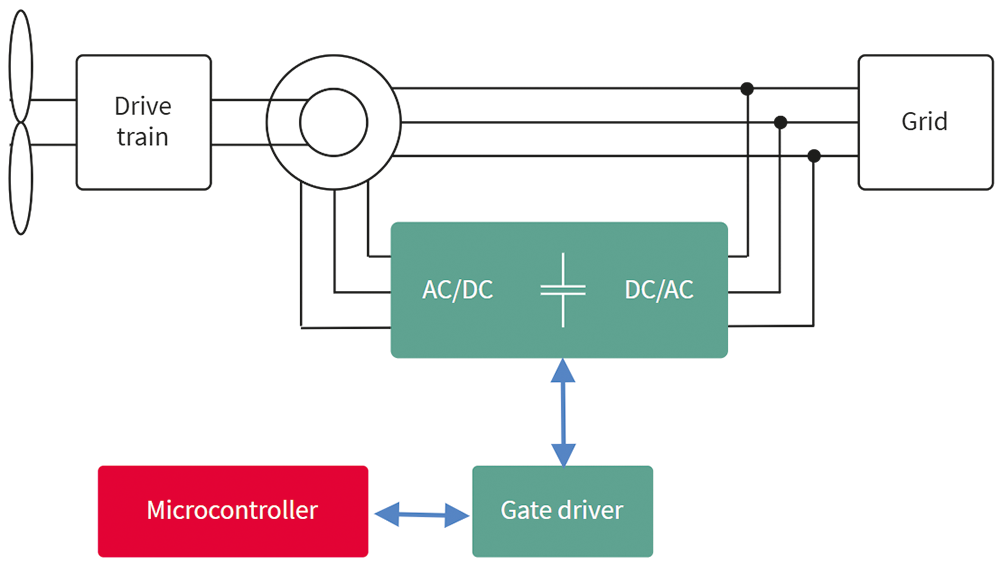
Doubly fed induction generators (DFIG) or partial converters are commonly used in the onshore turbines, where the rotor is connected to the grid through a back-to-back power converter. These speed-adjustable designs lower the overall costs but are limited to a power generation range of 1,5 to 6 MW.

In a DFIG converter, only up to one-third of the power flows through the power semiconductors in both directions. Infineon’s IGBTs support optimum performance even at the limits of the operating range, and its module enables the wind power converter to have a low voltage ride through (LVRT) capability, and help handle demanding cyclic requirements at a shallow output frequency of the generator side.

Infineon’s state-of-the-art power modules, such as the PrimePACK 3+, are ideally suited to DFIG wind converters. IGBT5 and interconnection technology .XT allow for a higher power density and extended lifetime.

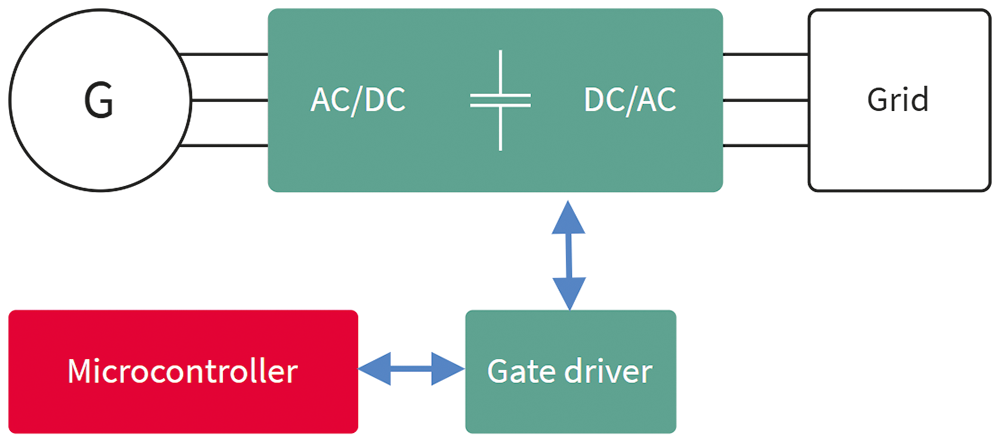
In a full converter wind turbine, the generator is fully decoupled from the grid by the converter and entire wind turbine power flow through the converter. Full converters for low-, medium- and high-speed generators provide maximum flexibility to meet low-voltage ride-through (LVRT) and other grid stability requirements. Full converters are available in the power range from 1 to 10 MW.

Infineon’s IGBTs enable modular and scalable power converter designs, thereby helping customers to realise larger power-rated wind turbines. The package families PrimePACK and EconoDUAL are an excellent choice for higher power ranges.


Credit(s)


Share this article:
Share via emailShare via LinkedInPrint this page

Further reading:

12 kW hybrid inverter
Power Electronics / Power Management
Sungrow recently unveiled its next-generation residential energy storage solution, expanding its power range from 5 kW to 12 kW with the introduction of the new MG12RL hybrid inverter.

Read more...
40 W and 75 W railway DC/DC converter
Brabek Power Electronics / Power Management
RECOM has announced two new cost-efficient DC/DC converters for the rail market with an ultra-wide 11:1 input range to cover all nominal input voltages from 24 to 110 V DC.

Read more...
Power modules for solid-state transformers
RS South Africa Power Electronics / Power Management
Microchip’s new 3,3 kV silicon carbide modules deliver the required thermal performance and efficiency for SSTs to increase power available for token generation.

Read more...
Solving South African power problems with locally built intelligence
Editor's Choice Power Electronics / Power Management
Smart metering infrastructure in South Africa remains patchy. The rollout has been slow, coverage is inconsistent, and for the most part, granular per-unit measurement simply does not exist.

Read more...
Wide range power module
Power Electronics / Power Management
The latest DC-DC modules from Würth Elektronik are characterised by high resilience to voltage transients on the 24 V bus and an extremely wide input-voltage range from 3,5 V to 38 V.

Read more...
Generating negative voltages from a positive supply
Altron Arrow Editor's Choice Passive Components
It is common for IoT devices, industrial sensors, meters, and medical equipment to require both a positive and negative voltage, and this article explains the options available to produce a negative rail from a positive rail supply.

Read more...
Addressing latency and signal integrity challenges
Altron Arrow DSP, Micros & Memory
Strengthening Microchip Technology’s data centre solutions portfolio, its XpressConnect retimers support high-bandwidth architectures, while helping reduce integration complexity.

Read more...
Precision timing in compact package
Altron Arrow Telecoms, Datacoms, Wireless, IoT
Designed for use in harsh environments, the EX-423 incorporates a four-point mounted quartz crystal structure that improves shock resistance and reduces g-sensitivity.

Read more...
Selecting primary batteries for maximum service life
Uniross Batteries Power Electronics / Power Management
Primary batteries play an important role in IoT applications. Designed for longevity, they have a high-energy capacity and are often used in standalone applications where charging is impractical or impossible.

Read more...
EMC limits and levels
Altron Arrow Editor's Choice Circuit & System Protection
As soon as electronics and electrical systems started interfering with each other, the world had to come to some consensus. Considering physics is universal and does not care about what country electrical/electronic products are used in, it should be the same everywhere, right? It is nearly there, but not quite.

Read more...


While every effort has been made to ensure the accuracy of the information contained herein, the publisher and its agents cannot be held responsible for any errors contained, or any loss incurred as a result. Articles published do not necessarily reflect the views of the publishers. The editor reserves the right to alter or cut copy. Articles submitted are deemed to have been cleared for publication. Advertisements and company contact details are published as provided by the advertiser. Technews Publishing (Pty) Ltd cannot be held responsible for the accuracy or veracity of supplied material.


© Technews Publishing (Pty) Ltd | All Rights Reserved