


Matter is a home automation connectivity standard. It has been designed with the main purpose of reducing fragmentation across IoT products from different vendors. This will transform the home automation landscape by achieving interoperability among smart home platforms.
Matter is an application layer that runs over Wi-Fi, Ethernet, and Thread. It uses Bluetooth LE for device commissioning. Although existing protocols offer different benefits, Matter allows these protocols to share the same application layer, thereby creating seamless communication. From the start, Matter will support Wi-Fi and Thread network layers for operational communications. For networks not directly supported like Zigbee and Z-Wave, Matter allows bridging so that communication can take place via the Matter network.
Besides home automation, Matter will also find use in applications such as LED bulbs, smart locks, commercial lighting, access control, and HVAC systems.
The key features of Matter are summarised in Table 1.
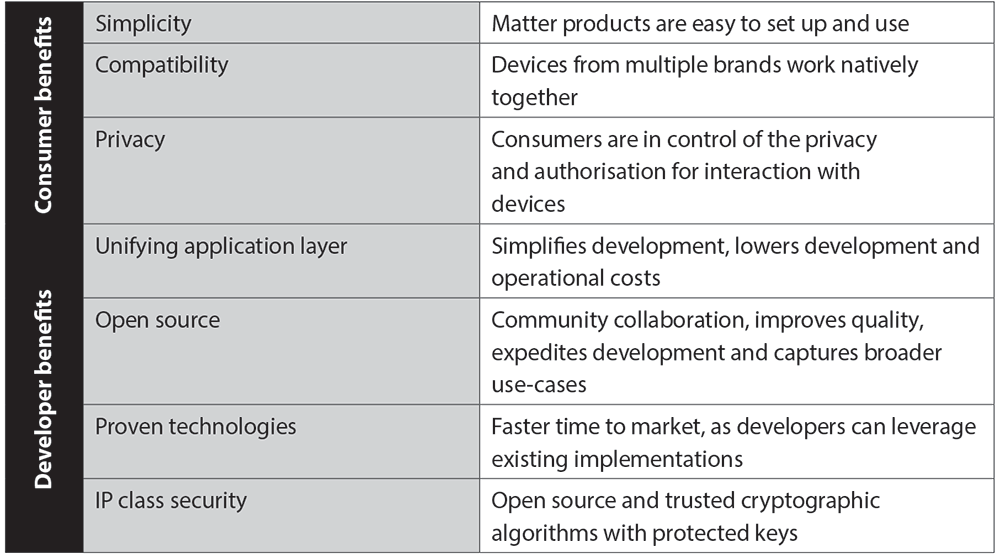 Table 1 – Key features of Matter.
Silicon Labs, one of the members of the Connectivity Standards Alliance (CSA) who was instrumental in launching the initiative, has released devices specifically targeting implementation of the Matter standard.
The EFR32MG family provide a gateway to using the Matter standard. The EFR32MG21 provides 1024 kB flash and 96 kB RAM and provides storage for OTA images on external flash. Use case for this device is as a Matter to Thread/Zigbee gateway, as it provides a concurrent
Thread/Zigbee and Bluetooth LE protocol connection.
The EFR32MG24 increases the amount of storage to 1536 kB flash and 256 kB RAM, allowing for internal OTA image storage. These devices can be used as a Matter Thread end device by implementing dynamic 802.15.4/Bluetooth LE SoC mode.
Wireless SoC enables convenience in smart home devices: LEEDARSON
When LEEDARSON needed to provide a full-featured smart home security system meeting rigorous industry certifications, it turned to Silicon Labs’ EFR32MG22 series. Part of the Wireless Gecko platform and providing integration of the Matter standard, LEEDARSON created the Security Kit Pro product line which provides innovation and cost-effective products, and ease of installation.
LEEDARSON required an open protocol like Zigbee or Z-Wave but also needed to accommodate proprietary protocols that are being used by some IoT brands. Silicon Labs became an obvious choice because of the stable, robust protocol stacks and wide selection of modules offered. Another important consideration was that Silicon Labs, being one of the driving forces behind the Matter standard, could help LEEDARSON overcome protocol barriers in the future by providing more integration among smart devices from different brands.
Security was also a top priority and Silicon Labs stood out in this area thanks to a security-first design philosophy backed by the company’s Secure Vault technology. This offers developers peace of mind when developing network-based solutions.
The SoC chosen uses a high-performance, low-power 76,8 MHz Arm Cortex-M33 core with integrated Trustzone. The unit provided an energy-efficient solution for applications using the Zigbee protocol, with multiprotocol support including Bluetooth LE provided. High-security features included secure debug, Secure Boot with Root of Trust, and secure loader.
| Tel: | +27 11 923 9600 |
| Email: | [email protected] |
| www: | www.altronarrow.com |
| Articles: | More information and articles about Altron Arrow |






© Technews Publishing (Pty) Ltd | All Rights Reserved
 printer friendly version