Liquid-to-air heat exchangers
14 June 2017
Circuit & System Protection
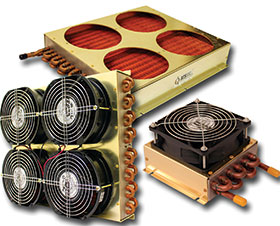
Advanced Thermal Solutions has released a new line of tube-to-fin, liquid-to-air heat exchangers. Made with the highest density fins to maximise heat transfer from liquid to air, the products allow the liquid to be cooled to very low temperatures.
The heat exchanger fins and tubes are made of copper and stainless steel to be suitable for a variety of fluids, including water, dielectric fluids and custom designed heat transfer fluids. Each of the seven heat exchanger sizes is available with or without a fan. ATS offers 49 options of heat exchangers to meet a variety of needs. Lengths range from 14,7 to 55,6 cm, widths from 14,7 to 35,6 cm, and heights from 4,6 to 6,6 cm. Tube diameters are available at 0,95 and 1,27 cm.
The heat exchangers have silver-solder brazed joints and have been internally cleaned and externally coated for corrosion protection. ATS pressure tests them and can customise them for different fans. They have heat transfer capacities up to 250 W per 1°C difference between the inlet liquid and the inlet air temperatures.
These heat exchangers can be used in a number of applications, including automotive, aerospace, medical, laser cooling, electronics cooling, compressor cooling, semiconductor processing and HVAC.
For more information contact Advanced Thermal Solutions, ats-hq@qats.com, www.qats.com
Further reading:
EMC limits and levels
Altron Arrow
Editor's Choice Circuit & System Protection
As soon as electronics and electrical systems started interfering with each other, the world had to come to some consensus. Considering physics is universal and does not care about what country electrical/electronic products are used in, it should be the same everywhere, right? It is nearly there, but not quite.
Read more...
Clearing the Static: The importance of cleaning in ESD control
Circuit & System Protection
The proper cleaning of ESD-safe areas and equipment such as workstations, floors, mats, trays, and tools using specialised antistatic cleaners is vital to prevent ESD damage.
Read more...
Safety relay for explosive areas
IOT Electronics
Circuit & System Protection
Phoenix Contact has expanded its safety portfolio with the new PSR-MC35-EXI safety relay module, specifically engineered for use in potentially explosive environments.
Read more...
Clearing the Static: Ensuring effective ESD control
Actum
Circuit & System Protection
To maintain reliable electrostatic discharge control, regular testing and accurate measurement are essential, with grounding products and ESD testing equipment being vital.
Read more...
Clearing the Static: The importance of ESD audits
Actum
Circuit & System Protection
An ESD audit is the first step in establishing an effective static control programme in the workplace, and will help identify vulnerable areas and potentially hazardous static zones that require improvement.
Read more...
EMI shielding materials application guide
Circuit & System Protection
TE Connectivity’s shielding solutions include electrically conductive elastomers, gaskets, knitted wire mesh, oriented wire, EMI shielding ventilation panels, shielded window, cable shielding and shielding components.
Read more...
Clearing the Static: ESD containers and packaging
Actum
Circuit & System Protection
Vacuum forming ESD
Electronic components can be damaged by electrostatic discharges. To protect against such damage, electronic assembly parts are often transported or stored in vacuum formed component
...
Read more...
Electrostatic discharge chairs
Actum
Circuit & System Protection
An ESD chair forms an integral part of grounding within the electrostatic discharge protected area to prevent potential damage to products.
Read more...
Conductive ESD footwear
Actum
Circuit & System Protection
Conductive ESD footwear is used in conjunction with other grounding devices, such as a wrist strap, cord, and ESD surface mats, to provide a continuous path to ground.
Read more...
Clearing the Static: The importance of cleaning in ESD control
Actum
Circuit & System Protection
To prevent Electrostatic Discharge (ESD) damage to sensitive electronic assemblies and components, all production, handling, packaging, and storage must take place in an ESD-protected environment.
Read more...









 printer friendly version