SIMCom, represented locally by Otto Wireless Solutions, has expanded its family of SIM7600, LTE Cat. 1 devices, and is due to unveil a new flagship product, which is expected to take the 4G market by storm.
Originally, the SIM7600E was released as a standalone device, supporting LTE Cat. 1, HSPA+, UMTS, EDGE and GPRS. The device also features a GNSS receiver, supporting GPS, GLONASS, Beidou and Galileo. As an all-encompassing solution, the SIM7600E ticked all the right boxes, except for one: its price.
Earlier this year, in response to the perception of an expensive price tag, the SIM7600E-L1C was released, and this module offers comparable features to the parent device, at a reduced price of about 10% below the original SIM7600E. The release of this device has seen significantly more customers move towards LTE Cat. 1, but mass adoption has still not taken place, because even at 10% cheaper, there are still many customers who are paying for features which they simply do not need, and will never use. Consequently, it is still considered an expensive module, particularly for clients who need LTE connectivity, and nothing more.
It is for this reason that the latest member of the family is expected to achieve mass adoption. The device deviates far away from the ‘classic norms’ of modules, and in so doing sets its sights firmly on mass adoption by tracking and telematics companies, as well as IoT companies.
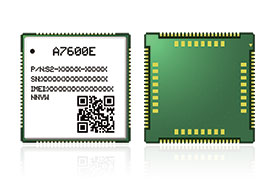
The new device is the A7600E. This is a pure communication module, with no GNSS features. The main innovation is that the device supports LTE Cat. 1, and if LTE connectivity is unavailable, falls straight back to EDGE/GPRS. There is no 3G/HSPA support. It is expected to have no voice capability.
By omitting 3G technology entirely, both hardware and licensing costs are entirely avoided, which sets the stage for the A7600E to be the first true low-cost LTE Cat. 1 module. Having a wide operating temperature (-40⁰C to +85⁰C) also makes the device extremely usable and attractive to a wide variety of potential customers, including, crucially, the vehicle tracking market.
Macom targets broadband radar with time delay MMIC RFiber Solutions
Telecoms, Datacoms, Wireless, IoT
Macom’s MADU FR1012 is a GaAs MMIC 1-bit true time delay device covering 4 GHz to 12 GHz, designed for broadband microwave systems where beam accuracy and signal integrity are critical.
Read more...Compact analogue phase shifter RF Design
Telecoms, Datacoms, Wireless, IoT
The Mini-Circuits JSPHS-150+ is a compact analogue voltage-controlled phase shifter designed for narrowband RF applications between 100 and 150 MHz.
Read more...Wireless connectivity expanded iCorp Technologies
Telecoms, Datacoms, Wireless, IoT
Espressif Systems has introduced two new members of its ESP32 wireless SoC family: the ESP32-E22, the company’s first Wi-Fi 6E connectivity chip, and the ESP32-H21, an ultra-low-power Bluetooth LE microcontroller aimed at coin-cell and battery-powered devices.
Read more...Integrated X-band radar front-end module RF Design
Telecoms, Datacoms, Wireless, IoT
Qorvo has introduced an X-band radar front-end solution that enables defence system designers to achieve higher performance without increasing size, weight or prime power.
Read more...Introducing Aurata CST Electronics
Telecoms, Datacoms, Wireless, IoT
Antenova has launched Aurata SR4L112: a compact, high efficiency embedded 4G/LTE antenna engineered for long, narrow PCB designs.
Read more...Multi-constellation GNSS module in a legacy-compatible footprint Altron Arrow
Telecoms, Datacoms, Wireless, IoT
Telit Cinterion has announced the SE869eK2L, a single-frequency L1 GNSS module designed to help device manufacturers upgrade legacy positioning designs with improved performance and cost efficiency, while preserving design continuity.
Read more...Quectel expands 5G portfolio iCorp Technologies
Telecoms, Datacoms, Wireless, IoT
Quectel expands 5G portfolio with new Qualcomm- and UNISOC-based modules.
Read more...Compact RTK design: More than just the receiver iCorp Technologies
Editor's Choice Telecoms, Datacoms, Wireless, IoT
In practice, engineers building compact RTK products keep discovering the same thing: the hardest component in the system is no longer the receiver. It is the antenna.
Read more...Microchip advances Space-Grade timing performance ASIC Design Services
Telecoms, Datacoms, Wireless, IoT
Microchip Technology has expanded its atomic clock portfolio with the radiation-tolerant Space CSAC-SA65, a Chip Scale Atomic Clock designed to deliver precise timing for space systems.
Read more...Channel emulator for 6 G and Wi-Fi 7/8 Concilium Technologies
Telecoms, Datacoms, Wireless, IoT
With 400 MHz instantaneous bandwidth and support for carrier frequencies up to 23,6 GHz, Vertex 6.0 is the industry’s first channel emulator designed for next generation 6 G and Wi-Fi 7/8 testing.
While every effort has been made to ensure the accuracy of the information contained herein, the publisher and its agents cannot be held responsible for any errors contained, or any loss incurred as a result. Articles published do not necessarily reflect the views of the publishers. The editor reserves the right to alter or cut copy. Articles submitted are deemed to have been cleared for publication. Advertisements and company contact details are published as provided by the advertiser. Technews Publishing (Pty) Ltd cannot be held responsible for the accuracy or veracity of supplied material.









 printer friendly version