


What do you now purchase by the kilowatt hour? The new supercapacitors replacing batteries. The new IDTechEx report, ‘Supercapacitor Markets, Technology Roadmap, Opportunities 2021-2041’, shows how supercapacitors have started to replace 10% of lithium-ion batteries and help kill lead-acid.
At route end, urban buses and light trains will charge in 20 seconds, and escape eye-watering battery replacement costs.
Lithium-ion batteries were selling at the billions of dollars a year level when they hit 100 Wh/kg. Aowei and Toomen newly sell supercapacitors with that compactness, with Nippon Chemicon and others next. Compared to batteries, supercapacitors are safer, tolerate overcharge and avoid complex battery management systems. Most are now non-flammable, non-toxic, incur no costly misery of controlled disposal, and provide lowest total cost of ownership – they waste 14% less electricity and grab twice the regenerative energy from cranes or trucks. Usage life is fourfold better, cycle life and power density tenfold, four times less kWh are needed for intense power cycling (deep discharge, not battery ‘sipping’).
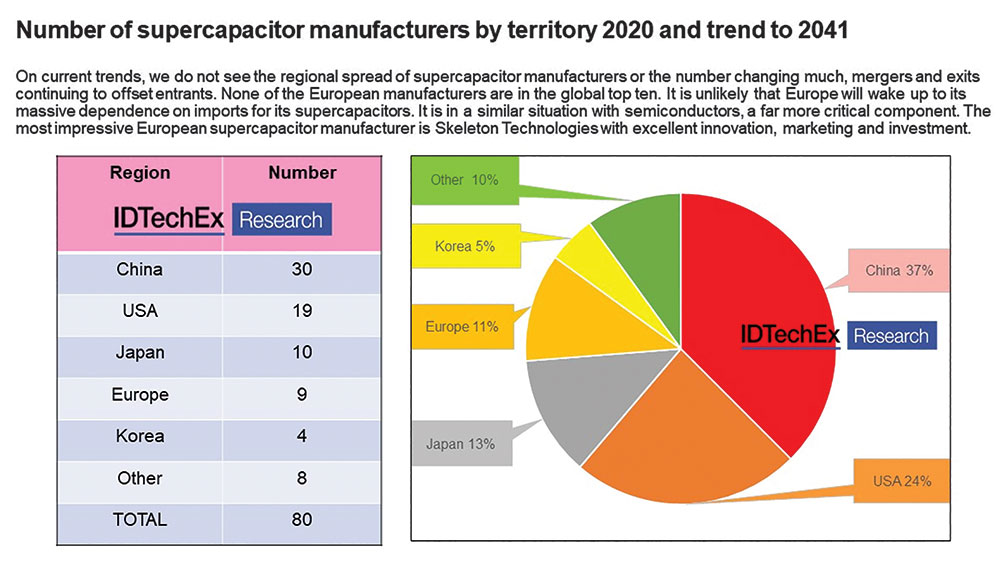 Number of supercapacitor manufacturers by territory.
The second breakthrough is Geely putting large peak-shaving ones in hybrid cars from 2021, with others following with a market potential of billions of dollars. The third breakthrough is new formats impractical with batteries, from a Lamborghini self-healing car with supercapacitor bodywork to a wearable sensor film with supercapacitor backing that stretches to fit and can be cut to size.
Improved supercapacitors and their variants enable huge opportunities in mini-grids, trains, trams, trucks, heavy off-road vehicles, tiny uninterruptable power supplies for IoT nodes using energy harvesting, and 1 MWh giants for hospitals and data centres. Already, they drive brain scanners, lift Maglev trains, power rail and laser guns, go into deep space and provide the only trustworthy backup for wind turbine blade adjustment, vehicle brakes, aircraft and bus doors. They variously operate well at anything from -40°C to sometimes 150°C, with even their ubiquitous 85°C meaning less or no cooling compared to batteries. Supercapacitors ideally fit the trend to safety, no toxigens, fastest charging and fit-and-forget.
‘Supercapacitor Markets, Technology Roadmap, Opportunities 2021-2041’ is the only post COVID-19 report on all the markets matched to the new technology roadmap, uniquely forecasting 20 years ahead by application and geography, quantifying market disruptions ahead.
The executive summary and conclusions are ideal for those with limited time: its 37 pages are mostly new infograms, forecasts, comparisons of sales and capability breakthroughs, with 23 primary conclusions. Readers can understand markets with ongoing growth and those that will peak, with value market forecasts by eight application sectors: cars, bus/truck, off-road, rail, energy, aerospace/ military, electronics, marine/other plus upside forecast and forecast by four global regions. Top ten manufacturers in sales order, manufacturer numbers by region, ongoing numerical impact of COVID-19, coming numerical impact of peak car, electric vs. losers, are also covered.
The introduction explains supercapacitors and their derivatives forecasting changes ahead. Tables compare these many emerging parameters with conventional capacitors and batteries, reveal where research emphasis is poorly matched to market potential and gives more on the 20-year legacy of COVID-19 on the car market.
Chapter 3 sees all 80 supercapacitor manufacturers critically appraised, not just a directory. Companies with large sales or breakthrough products get special attention, such as Evans Capacitor with a recent $7 million order and unique virtuosity. View ten columns over 53 densely packed pages based on global visits, interviews, original photographs, and much original data. See split by country, capacitor size, technologies, time, where China is leading/ lagging progress in technology or application, high margin vs. commoditised.
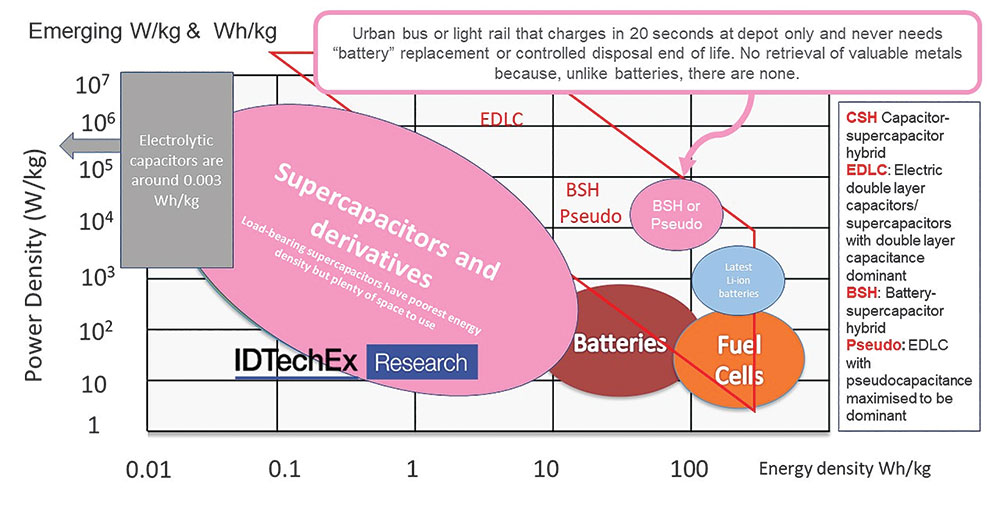 Increasing energy density challenges batteries
Chapter 4 reveals ‘Supercapacitors in aerospace and military applications’ from radar to ordnance, air surveillance, to aircraft safety. Chapter 5 does the same for ‘Supercapacitors in on- and off-road vehicles and rail systems’ including mining, logistics and other vehicles and cranes adopting large capacitor banks for power surges in and out. It is followed by Chapter 6, ‘Supercapacitors in the energy sector’. Here are the latest advances in tidal, wave and airborne wind energy harvesting, ocean platform surge absorption, and uninterruptible power supplies favouring supercapacitors. The report ends with three appendices giving important research chosen in the European Union, Japan and New Zealand.
Supercapacitor improvement and market roll-out is now moving fast, with major advances and disruptions coming in the next twenty years. That PhD-level analysis is only available in the new IDTechEx report, ‘Supercapacitor markets, technology roadmap, opportunities 2021-2041’.
IDTechEx is hosting a free webinar on the topic of supercapacitors on 3 September entitled ‘Supercapacitors Turn the Corner’. The webinar, presented by Chairman of IDTechEx Dr Peter Harrop, will be broadcast at three times (2 am, 10 am and 5 pm BST).






© Technews Publishing (Pty) Ltd | All Rights Reserved
 printer friendly version