


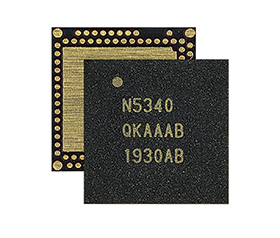
Nordic Semiconductor’s nRF5340 high-end multiprotocol system-on-chip (SoC) became the first member of its next generation of nRF5 Series SoCs. The nRF5340 builds on Nordic’s proven and globally adopted nRF51 and nRF52 Series multiprotocol SoCs while introducing a flexible, dual-processor hardware architecture with advanced security features. The nRF5340 supports major RF protocols including Bluetooth 5.1/Bluetooth Low Energy (Bluetooth LE), Bluetooth mesh, Thread and Zigbee.
The nRF5340 is designed for extended operating temperatures up to 105°C, which together with its multiprotocol support and advanced security features makes it ideally suited for professional lighting and industrial applications. Furthermore, the SoC meets the demands of next-generation sophisticated wearables with its high-performance application processor matched to a generous 512 KB of RAM. The QSPI peripheral is augmented to interface with external memory at 96 MHz and a 32 MHz High Speed SPI peripheral is integrated to interface with displays and complex sensors.
The chip incorporates Arm CryptoCell-312, Arm TrustZone technology and Secure Key Storage for the highest level of security. With Arm CryptoCell-312 the most common Internet encryption standards are hardware accelerated and Arm TrustZone provides system-wide hardware isolation for trusted software by creating secure and non-secure code execution areas on a single core. The nRF5340’s combined security features enable advanced root-of-trust and secure firmware updates while protecting the SoC from malicious attack.
The nRF5340 is based around dual Arm Cortex-M33 processors, a high-performance application processor running up to 128 MHz (510 CoreMark) with dedicated 1 MB Flash and 512 KB RAM and a fully programmable, ultra-low-power network processor running at 64 MHz (238 CoreMark) with dedicated 256 KB Flash and 64 KB RAM.
The powerful application processor is very efficient (65 CoreMark/mA), has an 8 KB 2-way associative cache, is DSP and floating-point capable and offers voltage and frequency scaling options. The application processor integrates the Arm Cryptocell-312, Arm TrustZone and Secure Key Storage advanced security features, plus a wide range of interface peripherals including NFC, USB, QSPI and High Speed SPI.
The fully programmable network processor is even more efficient (101 CoreMark/mA) and is optimised for low power during radio operation and low duty-cycle sensor data collection. Programmable access to the network processor offers optimal implementation of proprietary 2,4 GHz protocols, ensuring portability from the nRF51 and nRF52 Series.
The nRF5340 incorporates a power-optimised, multiprotocol 2,4 GHz radio with a transmit current of 3,2 mA (0 dBm Tx power, 3 V, DC-DC) and receive current of 2,6 mA (3 V, DC-DC). Sleep current is as low as 1,1 µA. The SoC features dynamic multiprotocol support enabling concurrent Bluetooth LE and Bluetooth mesh/Thread/Zigbee operation for provisioning/commissioning and interaction with a mesh network from a smartphone using Bluetooth LE.
The radio is capable of all Bluetooth 5.1 direction finding features. The nRF5340 operates over a 1,7 to 5.5 V supply voltage range, allowing supply from rechargeable batteries and USB. The SoC integrates XTAL load capacitors for both 32 MHz and 32,762 kHz crystals, lowering by four the number of external components required compared with Nordic’s nRF52 Series.
The nRF5340’s software development kit, the nRF Connect SDK, offers a complete solution that integrates the Zephyr RTOS, a Bluetooth LE protocol stack, application examples and hardware drivers. The nRF Connect SDK is publicly hosted on GitHub, offers source code management with Git and comes with free Segger Embedded Studio IDE support.
Nordic also launched the nRF5340 PDK, an affordable, single-board preview development kit for the nRF5340. The nRF5340 PDK makes all of the nRF5340’s features and GPIOs available to the developer and comes with an on-board Segger J-Link debugger for programming and debugging the SoC.
| Tel: | +27 21 555 8400 |
| Email: | sales@rfdesign.co.za |
| www: | www.rfdesign.co.za |
| Articles: | More information and articles about RF Design |






© Technews Publishing (Pty) Ltd | All Rights Reserved
 printer friendly version