

News


RFID market research explores 2021 and what to expect for the future

28 February 2022 News Telecoms, Datacoms, Wireless, IoT

Despite a 5% drop in the global RFID market in 2020 compared to 2019 due to the impact of Covid-19, the market has recovered well in 2021. According to the newly released RFID market research report from IDTechEx, ‘RFID Forecasts, Players and Opportunities 2022-2032’, the global RFID market is estimated to be valued at $11,6 billion in 2021, rising to $12,2 billion in 2022. This market comprises RFID labels, cards, fobs and any other form factors, as well as tags, readers and software/services for both passive and active RFID.
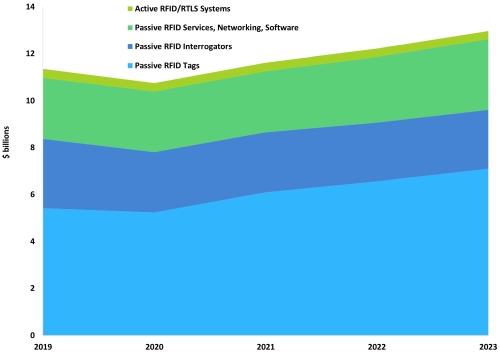

Covid has had a detrimental influence on many aspects of our lives, yet has also speeded up the digital transition. In the UHF sector, for example, IDTechEx has observed the retail apparel business, the largest RFID application sector in terms of tag numbers, adopting RFID at a quicker rate. The market research firm says retail apparel alone will require over 20 billion RFID labels in 2022 – albeit there is still some way to go, with RFID accounting for just roughly 26% of the entire addressable market for apparel in 2022.

Besides the retail apparel industry's success, there are also plenty of other industries that are gaining traction. Other retail sectors besides apparel, such as footwear, cosmetics, fragrance, electronics and supply chain and logistics, as well as the food industry, such as quick-service restaurants, have also received solid interest and investment. In the HF sector, contactless card sales remain the strongest, driven mostly by contactless payment, transportation and secure access applications, with 2,6 billion cards demanded in 2021.

IDTechEx predicts that this trend will continue in the short- to medium-term. In the LF sector, animal tagging (such as pigs, lambs and pets) continues to be significant since it is still a legal obligation in many regions, with 640 million tags being used in this sector in 2021. According to the report, a total of 28,4 billion passive RFID tags will be sold in 2021, up from 23,8 billion in 2020, representing a double-digit growth rate. Most of this expansion is due to passive UHF RFID labels. However, in 2021, UHF (RAIN RFID) tag sales by value will be just 30% of HF tag sales (including NFC), owing to the higher price point of HF tags used for security (such as payments, access, etc.) versus the cheaper, largely disposable UHF (RAIN) tags used for tagging items.

Although the RFID industry continues to expand, there are still obstacles to overcome, particularly in certain markets. Chip shortages will be a problem in the immediate term. It has been observed that the chip shortage is causing supply to fall short of demand, resulting in price increases. On the other hand, education and standardisation will be the two most important issues to address in order to achieve widespread RFID adoption in the mid to long term.

Educating businesses about the capabilities of RFID (including its advantages and limitations) and how a business can implement RFID to improve its corporate efficiency is important. In terms of standardisation, take the pharmaceutical industry and the food industry as an example: the big market opportunities in these two industries arise in item-level lagging, however, this is unlikely to happen until government mandates are in place.




Share this article:
Share via emailShare via LinkedInPrint this page

Further reading:

Engineering in a world that cannot assume connectivity
Technews Publishing Editor's Choice News
Across industrial automation, networking, and defence systems, engineers are rediscovering the importance of resilience and autonomy in an increasingly connected world.

Read more...
IOT secures major industry partnership
IOT Electronics News
IOT Electronics has announced a new strategic partnership with Powell Electronics, becoming an Official Authorised Reseller in South Africa.

Read more...
Successful Proteus training conference
Dizzy Enterprises News
Dizzy Enterprises recently hosted two hands-on Proteus Training Conferences, bringing together electronics professionals, designers, and enthusiasts to explore the latest capabilities of the Proteus Design Suite from Labcenter Electronics.

Read more...
Designing IoT devices for deterministic LPWAN environments
Editor's Choice Telecoms, Datacoms, Wireless, IoT
Built on Ultra Narrow Band communication technology, the Sigfox network focuses on low power, wide area M2M connectivity rather than maximising data throughput.

Read more...
Hitachi reinvents asset management solution
News
Hitachi Energy, in collaboration with Microsoft, is accelerating the digital transformation of essential infrastructure - from electricity networks and transportation corridors to heavy industrial operations - by reinventing how critical assets are managed and maintained.

Read more...
Mycronic releases mixed Q4 results
News
Mycronic reported mixed Q4 results for the year ended January to December 2025, while delivering record full year order intake and net sales.

Read more...
Quectel’s RG255C-NA and RM255C-GL accelerate 5G RedCap adoption
iCorp Technologies Editor's Choice Telecoms, Datacoms, Wireless, IoT
Quectel’s RG255C-NA and RM255C-GL modules represent a strategic move into this fast-growing segment, delivering Sub-6 GHz 5G connectivity optimised for mid-tier IoT applications.

Read more...
SDRs – Which RF architecture should you choose?
RFiber Solutions Editor's Choice Telecoms, Datacoms, Wireless, IoT
There are several common methods of implementing SDR architectures. This paper discusses which is best when meeting a specific need.

Read more...
AGOA: Businesses should diversify or face significant exposure
News
Cross-border payments platform Verto has called on South African and African businesses to accelerate their transition toward a “post-AGOA” trade strategy following President Donald Trump’s signing of a one-year extension to the African Growth and Opportunity Act (AGOA).

Read more...
European components distribution growing
News
European electronic components distribution returned to growth in the fourth quarter of 2025, according to newly released figures from DMASS Europe.

Read more...


While every effort has been made to ensure the accuracy of the information contained herein, the publisher and its agents cannot be held responsible for any errors contained, or any loss incurred as a result. Articles published do not necessarily reflect the views of the publishers. The editor reserves the right to alter or cut copy. Articles submitted are deemed to have been cleared for publication. Advertisements and company contact details are published as provided by the advertiser. Technews Publishing (Pty) Ltd cannot be held responsible for the accuracy or veracity of supplied material.


© Technews Publishing (Pty) Ltd | All Rights Reserved