Matter is an open-source, interoperability standard, which is maintained by the Connectivity Standards Alliance (CSA). Designed for smart homes and smart buildings, Matter ensures seamless interactions between connected devices across different IP technologies. End users no longer have to worry about device interoperability, as Matter ensures connected objects from multiple brands can work together seamlessly, while ensuring data privacy.
Matter is an application layer which addresses many applications in an open-source delivery and certification infrastructure, allowing wide adoption.
The roles of connected devices in a Matter network
In smart homes, connected devices run based on Wi-Fi or Thread technologies, and each device has a specific role within the Matter network.
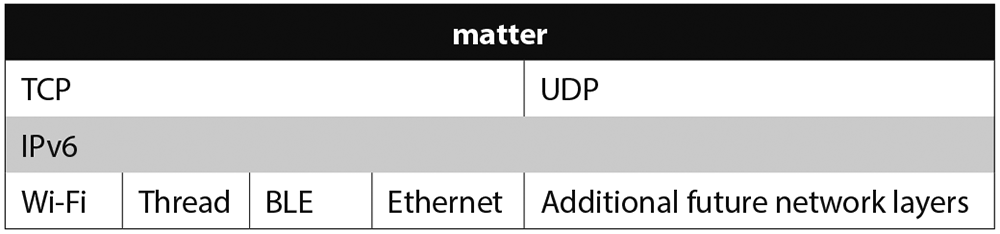
All of these devices support a connectivity technology within Wi-Fi, Ethernet, or Thread as network communication protocol. They also need to support Bluetooth LE technology, to allow users to commission a new device onto the existing network:
• End devices: connected objects serving a final application, such as lights or door locks.
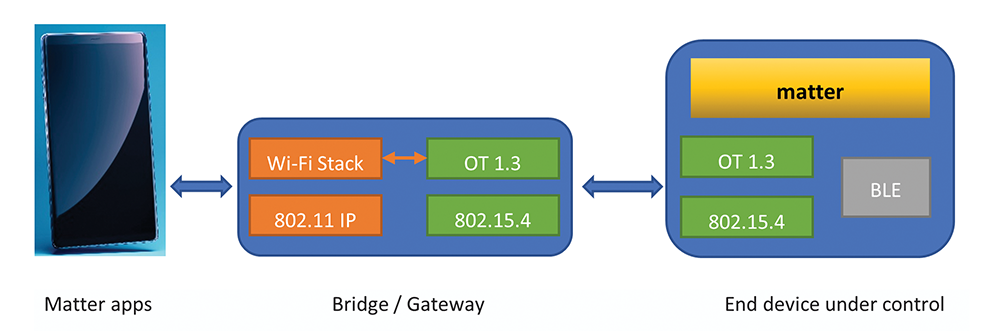
• Router/Bridges: objects such as gateways route the data from an end device, transferring it from one protocol to another (Wi-Fi to Thread for example).
• Controllers: devices, such as smartphones or tablets, used to commission an end device into a Matter network (controllers support Bluetooth LE).
Matter can be bridged to non-Matter technologies via a bridge/gateway shown in figure 1.
Many IoT products support Zigbee, and will now also enable support for Matter. The supporting infrastructure requires a solution that can bridge the communication between Matter-based and Zigbee-based devices. The bridge usually integrates high-performance MCUs with Ethernet capability to link connectivity products.
The dual-core STM32H7 MCU has the right features to address this role, as it can embed the Matter layer and translate it into the Zigbee protocol and vice versa.
STMicroelectronics’ STM32WB wireless MCU is also suitable for running in Matter networks and supporting Matter in connected objects. Features of this SoC include:
• Multi-protocol capabilities: STM32WB can run Bluetooth LE and Thread in concurrent modes, which is necessary for device commissioning.
• A large memory with 1 Mbyte of Flash and 256 Kbytes of RAM to support application layer and connectivity stacks.
• Quad-SPI peripheral to extend the memory size externally with execution in place.
• Over-The-Air firmware updates, whatever the application and the connectivity stack.
More room to scale Altron Arrow
Power Electronics / Power Management
With the latest STM32H5 lines from STMicroelectronics, you can now scale within the same platform, from a compact 1 Mbyte device to higher-memory MCUs for graphics-rich and feature-heavy designs.
Read more...Multi-constellation GNSS module in a legacy-compatible footprint Altron Arrow
Telecoms, Datacoms, Wireless, IoT
Telit Cinterion has announced the SE869eK2L, a single-frequency L1 GNSS module designed to help device manufacturers upgrade legacy positioning designs with improved performance and cost efficiency, while preserving design continuity.
Read more...Compact SSI family for industrial automation Altron Arrow
Passive Components
Infineon Technologies has introduced the ISSI20BxxF Solid State Isolator (SSI) family, bringing solid-state isolation technology into high-volume applications traditionally served by photovoltaic isolators (PVIs), photovoltaic relays (PVRs), and electromechanical relays (EMRs).
Read more...Rev 2.0 PolarFire FPGA ethernet sensor bridge Altron Arrow
Computer/Embedded Technology
Smaller, multi-camera platform enables scalable Ethernet architectures for NVIDIA Edge AI systems, while lowering power, cost and integration complexity.
Read more...Universal IR receiver module Altron Arrow
Telecoms, Datacoms, Wireless, IoT
Vishay Intertechnology has introduced a new series of infrared (IR) receiver modules for IR remote control applications, which feature a wide modulation frequency acceptance from 30 kHz to 68 kHz.
Read more...Low profile SMD antenna Altron Arrow
Telecoms, Datacoms, Wireless, IoT
The Havok PCS.06.A antenna, from Taoglas, is a low profile SMD LTE/cellular 4G/3G/2G embedded antenna designed for direct SMD mount on a device PCB.
Read more...Accelerate development of physical AI deployments Altron Arrow
DSP, Micros & Memory
With Avocado OS now available on the HummingBoard RZ-V2N-
AIoT and SolidSense AIoT V2N from SolidRun, teams can move from prototype to deployed fleet in weeks.
Read more...Universal NFC device Altron Arrow
DSP, Micros & Memory
Delivering high-end performance in a compact 4 x 4 mm package, the multipurpose NFC reader from ST Microelectronics, enables the convenience of contactless interaction and features for various end applications.
Read more...Compact direct Time-of-Flight 3D LiDAR module Altron Arrow
AI & ML DSP, Micros & Memory
The VL53L9 from STMicroelectronics is the first direct Time-of-Flight (dToF) 3D LiDAR all-in-one module in ST’s portfolio, offering a resolution of 2,3K zones, wide field of view, on-chip processing, 100 frames per second, and sensing range from 5 centimeters to 9 meters.
Read more...SoC brings scalable edge AI to life Altron Arrow
AI & ML
The NXP i.MX 937 applications processor is optimised for performance without excessive power draw and bridges the gap between entry-level chips and high-end processors.
While every effort has been made to ensure the accuracy of the information contained herein, the publisher and its agents cannot be held responsible for any errors contained, or any loss incurred as a result. Articles published do not necessarily reflect the views of the publishers. The editor reserves the right to alter or cut copy. Articles submitted are deemed to have been cleared for publication. Advertisements and company contact details are published as provided by the advertiser. Technews Publishing (Pty) Ltd cannot be held responsible for the accuracy or veracity of supplied material.









 printer friendly version