


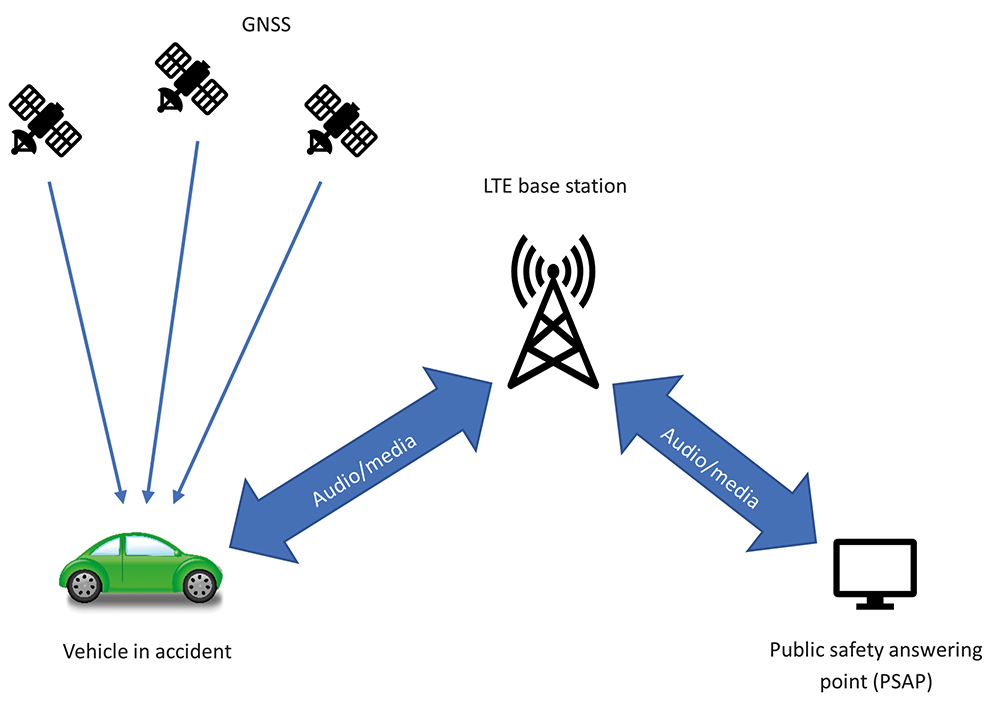
The eCall, an automatic car emergency call system, is becoming a crucial part of the car environment, and since March 2018, it has been mandatory for all new homologated car models in the EU. It has already been a couple of years since the last standardisation and adoption of eCall technology – which is based on 2G and 3G cellular technologies. With the evolution of cellular technologies and wide deployment of 4G and 5G, the Next Generation eCall (NGnbsp;eCall) will ensure a much faster and reliable transfer of Minimum Set of Data (MSD).
NG eCall is built on LTE, which ensures a much faster and more reliable MSD transfer. Speech communications are not interrupted during MSD transmission, and it is easy to add enhancements such as transmitting more than 140nbsp;bytes in an IP network. It would also be possible to transfer additional media such as video from dash cameras, text from speech, or remote control of car features like sounding the horn, flashing the lights, locking/unlocking doors, or disabling the ignition. Therefore, as a safety system, eCall must be highly reliable and correctly transmit MSD data.
As this emergency call provides lifesaving services, it needs to be tested thoroughly. Anritsu’s test unit can be used to demonstrate the process of making the emergency call from the In-Vehicle system into the cellular LTE network, with the transfer of MSD over SIP signalling and a bi-directional end-to-end voice call between the passenger and operator of the Public Service Answering Point (PSAP). The In-Vehicle system represents the device under test, a unit developed by one of the market leaders. The PSAP is emulated by Anritsu Signalling Tester/Base Station simulator MD8475B and Anritsu eCall Test solution MX703330E. The process for making emergency calls is based on Voice over LTE (VoLTE) technology, where IP Multimedia Subsystem (IMS) and Session Initialisation Protocol (SIP) are used to establish the voice call. All necessary data is then transferred quickly to help emergency services provide fast and effective intervention.
Fast transfer of data is crucial in the connected car concept and autonomous driving. Multi-access edge computing (MEC) is a key element to achieve necessary communication KPIs in the form of throughput, utilisation, latency, jitter, and packet loss. Solutions from Anritsu can solve these measurement headaches.
| Tel: | +27 11 315 5500 |
| Email: | sales@coral-i.com |
| www: | www.coral-i.co.za |
| Articles: | More information and articles about Coral-i Solutions |






© Technews Publishing (Pty) Ltd | All Rights Reserved
 printer friendly version