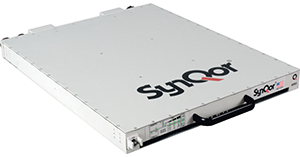
SynQor has announced the new rugged, 270 V DC input, high power, compact, military grade inverter (MINV-4000-1U-270). The new 4000 W 115/230 V AC output inverter combines a low mass with an easy-to-use design for military, airborne, naval, and mobile high-reliability applications, being designed to withstand extreme electrical, shock, vibration, and environmental conditions.
The inverter draws power from a standard 270 V DC power supply and delivers a fully isolated, well-conditioned, pure-sinusoidal AC output. Compliant with a wide range of military standards, this inverter is designed for applications where output power, space, weight, and reliability in harsh environments are a major concern.
The MINV inverter is also flexible and supports parallel and N+M redundant configurations of up to 32 units for high power and/or high-reliability requirements. Multiple MINV units can be arranged to deliver complex multi-phase power schemes like three-phase and split-phase (doubling line-to-line output voltage and total output power).
The new MINV-4000-1U-270 has an SNMP Ethernet base module that allows configuration via a user-friendly web interface and real-time remote monitoring. Other options include the wide range of AC output characteristics (115 or 230 Vrms at 50, 60 or 400 Hz); a floating ground option for aerospace and naval applications; and an electronic AC output breaker that allows users to build fault-tolerant, dependable, redundant, high-output power solutions.
Setting a new benchmark for high-power DC load testing Conical Technologies
Test & Measurement Power Electronics / Power Management
The new ITECH IT8900G/L high-speed, high-power DC electronic load offers a powerful combination of speed, scalability, precision and high-power density.
Read more...RF filters explained RFiber Solutions
Telecoms, Datacoms, Wireless, IoT
As RF environments become increasingly crowded, RF filters play a critical role in maintaining signal quality, improving system performance, and ensuring reliable operation.
Read more...High performance RF signal conditioning RFiber Solutions
Telecoms, Datacoms, Wireless, IoT
The AM3269 from Mercury Systems is a high-performance RF preselector module designed to improve receiver sensitivity and signal integrity in demanding electronic warfare, signals intelligence, test, and communications applications.
Read more...RF filters explained RFiber Solutions
Telecoms, Datacoms, Wireless, IoT
As RF environments become increasingly crowded, RF filters play a critical role in maintaining signal quality, improving system performance, and ensuring reliable operation.
Read more...Quality batteries are critical for IIoT Uniross Batteries
Power Electronics / Power Management
Batteries intended for use in industrial operations must indeed offer complete reliability under extreme environmental conditions, resistance to vibration and harsh environments.
Read more...12 kW hybrid inverter
Power Electronics / Power Management
Sungrow recently unveiled its next-generation residential energy storage solution, expanding its power range from 5 kW to 12 kW with the introduction of the new MG12RL hybrid inverter.
Read more...40 W and 75 W railway DC/DC converter Brabek
Power Electronics / Power Management
RECOM has announced two new cost-efficient DC/DC converters for the rail market with an ultra-wide 11:1 input range to cover all nominal input voltages from 24 to 110 V DC.
Read more...Power modules for solid-state transformers RS South Africa
Power Electronics / Power Management
Microchip’s new 3,3 kV silicon carbide modules deliver the required thermal performance and efficiency for SSTs to increase power available for token generation.
Read more...Solving South African power problems with locally built intelligence
Editor's Choice Power Electronics / Power Management
Smart metering infrastructure in South Africa remains patchy. The rollout has been slow, coverage is inconsistent, and for the most part, granular per-unit measurement simply does not exist.
Read more...Wide range power module
Power Electronics / Power Management
The latest DC-DC modules from Würth Elektronik are characterised by high resilience to voltage transients on the 24 V bus and an extremely wide input-voltage range from 3,5 V to 38 V.
While every effort has been made to ensure the accuracy of the information contained herein, the publisher and its agents cannot be held responsible for any errors contained, or any loss incurred as a result. Articles published do not necessarily reflect the views of the publishers. The editor reserves the right to alter or cut copy. Articles submitted are deemed to have been cleared for publication. Advertisements and company contact details are published as provided by the advertiser. Technews Publishing (Pty) Ltd cannot be held responsible for the accuracy or veracity of supplied material.









 printer friendly version