


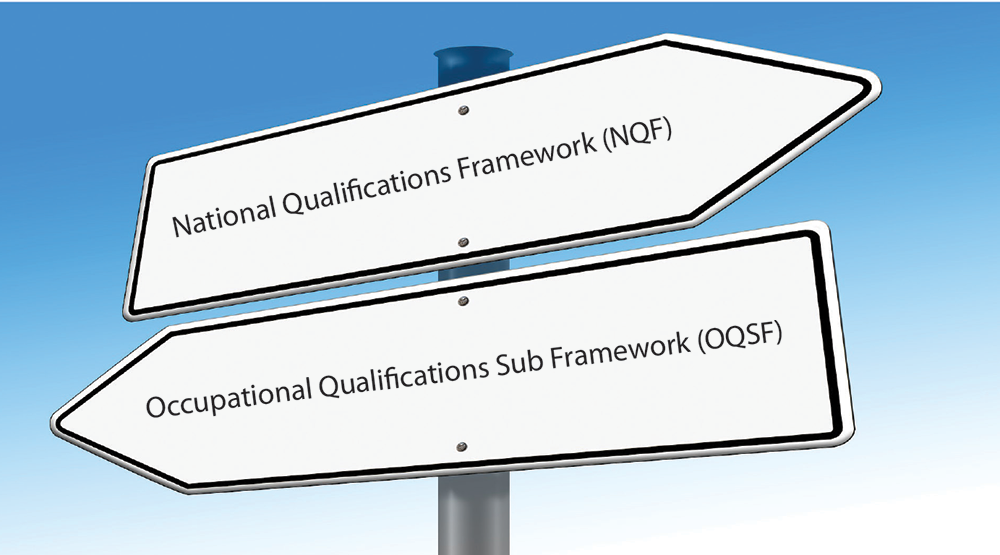
South Africa is at a crossroads of a significant educational and vocational transition, as it shifts from the National Qualifications Framework (NQF) to the Occupational Qualifications Sub Framework (OQSF) managed by the Quality Council for Trades and Occupations (QCTO).

The CEO of the QCTO, Vijayen Naidoo, has declared that the transition is imminent, and that existing qualifications will not be re-registered. Long anticipated, but now undeniable, this shift carries substantial implications for various industries, employers, and training providers now referred to as Skills Development Providers.
Once readily available under the NQF, qualifications soon slated for discontinuation in the OQSF framework will present a challenge for companies accustomed to providing specific training programmes. The repercussions extend beyond individual learning journeys and move to the business world, impacting B-BBEE scorecards. This makes it vital for organisations to reassess their training portfolios to ensure alignment with the new OQSF framework, or to seek suitable alternatives for discontinued qualifications, skills programmes, or short courses. Here, training partners will have a critical role to play in facilitating this transition.
Impending deadlines and consequences of qualification displacement
One of the most critical challenges in this shift is the misalignment between existing NQF qualifications and the available programmes in the OQSF. Several vital qualifications, such as generic management levels four and five, and process manufacturing level four, lack equivalents in the QCTO. This creates a dilemma for organisations that had planned to enrol learners in these programmes, as the deadline for new enrolments is set for
The implications of missing this deadline are profound, and learnerships and qualifications that were once standard may no longer fit within the QCTO implementation strategy. This has a cascading impact on workforce planning, learner progression, and an organisation’s skills development scorecard. Failure to adapt to the new landscape in time could result in penalties, negatively impacting a company’s overall scorecard and its ability to achieve its skills development goals.
The importance of initiative-taking strategies and contingency planning
The looming deadline is no longer a technicality or a possibility; it is a call to action. Organisations must concede that the threat of the transition has become a reality, which means that ignoring it is no longer an option. Even as the question arises as to whether the government will extend the deadline, re-register a few qualifications, or allow for continued use of existing learnerships, the ensuing uncertainty can only highlight the need for an initiative-taking approach.
In the face of such uncertainty, having a Plan B is non-negotiable. Organisations must explore alternative pathways within the QCTO, even if they deviate from their traditional areas of focus. For instance, if a preferred qualification has no QCTO equivalent, considering alternative programmes within the available options becomes the only choice. It may be an office management qualification for manufacturing employees, however, in the absence of suitable alternatives to the generic management level four and five or the process manufacturing qualification, this may be the only viable lifeline to ensuring continued skills development.
Seizing opportunities and mitigating risks
The teach-out provision, allowing learners to complete their learnerships until
Toward a robust workforce and economic growth
While the transition may impact every sector, the degree of impact varies. It is essential for organisations across industries to recognise that this is not likely to be a seamless process. Delays, uncertainties, and changes in decision making will be part of the transition.
Managing the risks of this shift is now crucial for all involved. The QCTO plays a vital role in ensuring a skilled workforce, driving economic growth for South Africa’s national development. Its efforts to standardise, develop, quality assure, and promote lifelong employability are essential for building a resilient and adaptable workforce that can navigate the challenges and opportunities of the fourth industrial revolution and beyond.
The unavoidable shift to transformation
The transition from NQF to OQSF in South Africa is a reality that cannot be ignored, and the 30 June 2024 deadline marks a point of no return in this journey. Organisations must act now, either by enrolling learners in existing programmes, or by exploring alternative pathways within the QCTO. The time for complacency is over; the time for strategic action is now.






© Technews Publishing (Pty) Ltd | All Rights Reserved
 printer friendly version