Perimeter security with a defence-in-depth strategy is a typical solution for many facilities when viewed under the new light of global terrorism and sabotage. Perimeter defences include fences, barriers, guards and security patrols. A strategy of defence-in-depth for critical infrastructure facilities typically places several layers of sensitive intrusion detection sensors in an illuminated buffer zone between an outer perimeter fence and actual facility equipment. Such intrusion detection devices include infrared imaging cameras, short-range radars and laser radar (LIDAR, or LADAR).
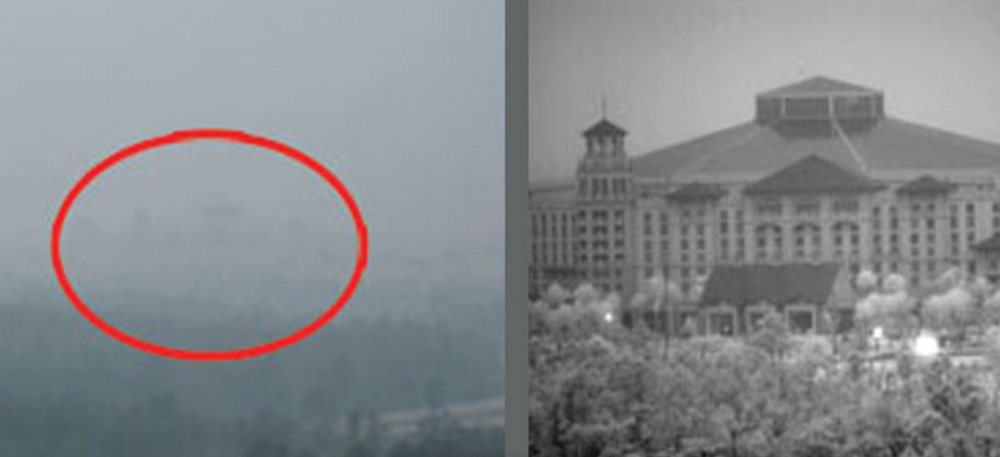
The most effective perimeter-intrusion detection systems use multiple technologies to increase the probability of rapid detection and low false alarm rates under a range of atmospheric and lighting conditions. Sensors Unlimited’s short wave infrared (SWIR) cameras offer considerable benefits at facilities where atmospheric condition such as rain, fog and mist are common. These conditions typically blind visible cameras, but Sensors Unlimited’s InGaAs SWIR technology is capable of seeing through all but the most severe conditions, to provide highly accurate images. These SWIR cameras also provide exceptional low-light performance, essentially providing high-quality images in all but total blackout conditions.
What is SWIR?
Sensing in the SWIR range (wavelengths from 0,9 to 1,7 microns) has only recently been made practical by the development of Indium Gallium Arsenide (InGaAs) sensors. Sensors Unlimited, part of UTC Aerospace Systems, is the pioneer in this technology and is advancing the capability of SWIR sensors. Founded in 1991 to create lattice-matched InGaAs structures, Sensors Unlimited Incorporated (SUI) quickly grew, as the telecom industry recognised the exceptional capabilities of this remarkable material.
The company has continued to push InGaAs technology forward, today producing not just single-point light-sensing diodes, but InGaAs one-dimensional linear arrays and two-dimensional focal plane array cameras. But why use SWIR?
Firstly, a basic fact: light in the SWIR band is not visible to the human eye. The visible spectrum extends from wavelengths of 0,4 microns (blue, nearly ultraviolet to the eye) to 0,7 microns (deep red). Wavelengths longer than visible wavelengths can only be seen by dedicated sensors, such as InGaAs. But, although light in the shortwave infrared region is not visible to the eye, this light interacts with objects in a similar manner as visible wavelengths. That is, SWIR light is reflective light; it bounces off objects much like visible light. As a result of its reflective nature, SWIR light has shadows and contrast in its imagery.
Images from an InGaAs camera are comparable to visible images in resolution and detail; however, SWIR images are not in colour. This makes objects easily recognisable, and yields one of the tactical advantages of the SWIR, namely object or individual identification.
That makes InGaAs interesting, but what makes it useful? Well, InGaAs sensors can be made extremely sensitive, literally counting individual photons. Thus, when built as focal plane arrays with thousands or millions of tiny point sensors, or sensor pixels, SWIR cameras will work in very dark conditions. Night vision goggles have been around for several decades and operate by sensing and amplifying reflected visible starlight, or other ambient light, in what are called image intensification (I-Squared) tubes. This technology has worked well for direct-view night vision goggles. But when an image needs to be sent to a remote location, there is no practical method which does not introduce reliability and sensitivity limitations. Because all SUI’s SWIR sensors convert light to electrical signals, they are inherently suitable for standard storage or transmission techniques.
Using SWIR at night has another major advantage. An atmospheric phenomenon called night sky radiance emits five to seven times more illumination than starlight, nearly all of it in the SWIR wavelengths. So, with a SWIR camera and this night radiance, often called nightglow, we can see objects with great clarity on moonless nights.
There are other sensors constructed from materials like mercury cadmium telluride (HgCdTe) or indium antimonide (InSb) that can be very sensitive in the SWIR band. However, to increase their signal-to-noise ratio to usable levels, these cameras must be mechanically cooled, often to extremely low temperatures. However, similar sensitivity can be achieved at room temperatures using an InGaAs sensor. Essentially, InGaAs cameras can be small and use very little power, but give big results.






© Technews Publishing (Pty) Ltd | All Rights Reserved
 printer friendly version