Quad-Apollo MxFE reference design
28 February 2026
Design Automation
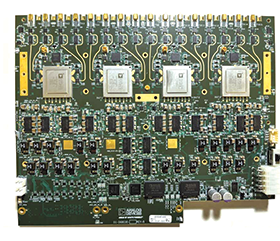
The Quad-Apollo MxFE reference design exemplifies a complete, high-performance platform for every-element direct-RF sampling digital beamforming using Analog Devices’ Apollo mixed-signal front-end technology. The reference board integrates four synchronised MxFE devices to implement a 16-transmit, 16-receive channel X-band subsystem, demonstrating a scalable and phase-coherent architecture suitable for advanced phased-array systems.
The design addresses the key system challenges associated with multi-chip RF converter deployments, including deterministic timing, precise clock distribution and multi-device synchronisation. By achieving phase-aligned sampling and transmission across all channels, the platform enables true digital beamforming, multi-beam operation and adaptive nulling across wide instantaneous bandwidths. Uniform element spacing, optimised for half-wavelength operation at approximately 12 GHz, supports accurate spatial sampling and repeatable beam patterns.
The reference board integrates all major signal-chain functions required for system-level evaluation, including RF front-end conditioning, low-noise amplification, broadband filtering with bypass options, multichip clocking, triggering and comprehensive power management. Overall, the Quad-Apollo MxFE reference design serves as a practical blueprint for building high-channel-count RF systems in applications such as phased-array radar, electronic warfare and advanced communications.
For more information, visit http://bit.ly/4tfOUca
Further reading:
AMD Vivado Design Suite 2026.1
Design Automation
AMD Vivado Design Suite 2026.1 is here and features a new tiered licensing model for greater flexibility, new device support, major NoC and QoR improvements, and ease-of-use enhancements for designing with AMD Versal adaptive SoCs.
Read more...
Advanced STM32 debugging in VS Code
Design Automation
Once an STM32 project is running in VS Code, the IAR C-SPY Debug extension adds a professional-grade analysis layer that scales with project complexity.
Read more...
Accelerate development of AI-enabled embedded systems
Design Automation
ADI’s CodeFusion Studio (CFS) is a modern embedded software development platform aimed at accelerating the creation of AI-enabled embedded systems.
Read more...
Introducing STM32CubeMX2
Altron Arrow
Design Automation
STMicroelectronics has launched STM32CubeMX2, a new evolution of its popular configuration and code generation tool for STM32 microcontrollers.
Read more...
AI assistant for STM32 developers
Design Automation
The STMicroelectronics STM32 Sidekick is an AI-driven assistant fully integrated into the STM32 ecosystem designed to streamline embedded development using STM32 microcontrollers.
Read more...
Connected without limits: An engineering perspective on Altron Arrow’s wireless ecosystem
Altron Arrow
Editor's Choice Design Automation
Wireless connectivity is no longer a supporting technology, but rather, a core design consideration that underpins modern electronic systems across industries.
Read more...
Next-gen robotic systems initiative
EBV Electrolink
Design Automation
EBV Elektronik recently introduced MOVE – Driving Robotics Forward, a new initiative designed by EBV Elektronik‘s Embedded Solutions team to support the development of next-generation robotic systems.
Read more...
Reference design for NB-IoT plus GNSS
Altron Arrow
Design Automation
ST Microelectronics’ STDES-ST87M01IGN is a reference design for the ST87M01 NB-IoT + GNSS module, implemented on a 2-layer FR4 PCB (90 x 60 x 1,6 mm).
Read more...
ST welcomes STM32Cube AI Studio
Design Automation
STMicroelectronics has introduced STM32Cube AI Studio, a new desktop software environment designed to simplify the deployment of artificial intelligence on STM32 microcontrollers.
Read more...
NeoCortec introduces new NeoGW software
Design Automation
This is a powerful multiplatform open-source solution designed to streamline integration between the NeoMesh network and upper-level systems, whether deployed in the cloud or on-premise environments.
Read more...









 printer friendly version