EMI shielding materials application guide
29 June 2026
Circuit & System Protection
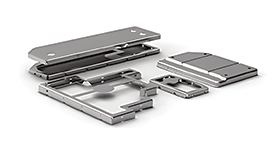
Electromagnetic interference shielding is a technique used to reduce the coupling of unwanted electromagnetic energy into or out of electronic systems. EMI can originate from external sources, such as radio transmitters, motors, or switching power supplies, or from within the system itself, where high-speed digital circuits and RF components generate emissions that interfere with sensitive analogue or digital circuitry.
EMI shielding works by enclosing a circuit or system within a conductive or magnetic material that attenuates electromagnetic fields. Conductive materials, such as copper, aluminium, or nickel-coated plastics, reflect and absorb electric field components, while magnetic materials, such as ferrites or specialised alloys, are more effective at attenuating low-frequency magnetic fields. The effectiveness of a shield depends on factors including material properties, thickness, continuity, grounding, and the frequency of the interfering signal.
TE Connectivity has released an application guide to explore the broad range of shielding solutions and determine which solution fits your application. The company’s shielding solutions include electrically conductive elastomers, gaskets, knitted wire mesh, oriented wire, EMI shielding ventilation panels, shielded window, cable shielding and shielding components.
To download the application guide, visit https://bit.ly/49FWBAz
Further reading:
The effect of seasonal changes on ESD performance in South Africa
Actum
Editor's Choice Circuit & System Protection Manufacturing / Production Technology, Hardware & Services
Electrostatic discharge performance is influenced by several environmental factors, with relative humidity being one of the most important. This is particularly relevant in South Africa, where seasonal changes can result in significant differences in humidity levels.
Read more...
EMC limits and levels
Altron Arrow
Editor's Choice Circuit & System Protection
As soon as electronics and electrical systems started interfering with each other, the world had to come to some consensus. Considering physics is universal and does not care about what country electrical/electronic products are used in, it should be the same everywhere, right? It is nearly there, but not quite.
Read more...
Clearing the Static: The importance of cleaning in ESD control
Circuit & System Protection
The proper cleaning of ESD-safe areas and equipment such as workstations, floors, mats, trays, and tools using specialised antistatic cleaners is vital to prevent ESD damage.
Read more...
Safety relay for explosive areas
IOT Electronics
Circuit & System Protection
Phoenix Contact has expanded its safety portfolio with the new PSR-MC35-EXI safety relay module, specifically engineered for use in potentially explosive environments.
Read more...
Clearing the Static: Ensuring effective ESD control
Actum
Circuit & System Protection
To maintain reliable electrostatic discharge control, regular testing and accurate measurement are essential, with grounding products and ESD testing equipment being vital.
Read more...
Clearing the Static: The importance of ESD audits
Actum
Circuit & System Protection
An ESD audit is the first step in establishing an effective static control programme in the workplace, and will help identify vulnerable areas and potentially hazardous static zones that require improvement.
Read more...
Clearing the Static: ESD containers and packaging
Actum
Circuit & System Protection
Vacuum forming ESD
Electronic components can be damaged by electrostatic discharges. To protect against such damage, electronic assembly parts are often transported or stored in vacuum formed component
...
Read more...
Electrostatic discharge chairs
Actum
Circuit & System Protection
An ESD chair forms an integral part of grounding within the electrostatic discharge protected area to prevent potential damage to products.
Read more...
Conductive ESD footwear
Actum
Circuit & System Protection
Conductive ESD footwear is used in conjunction with other grounding devices, such as a wrist strap, cord, and ESD surface mats, to provide a continuous path to ground.
Read more...
Clearing the Static: The importance of cleaning in ESD control
Actum
Circuit & System Protection
To prevent Electrostatic Discharge (ESD) damage to sensitive electronic assemblies and components, all production, handling, packaging, and storage must take place in an ESD-protected environment.
Read more...









 printer friendly version