



[Sponsored] The global memory shortage in 2026 reflects a structural imbalance between supply and demand across DRAM and NAND. Unlike previous cycles driven by consumer electronics, the current constraint is tied to sustained infrastructure demand from AI systems. For engineering teams in South Africa, this is already translating into longer lead times, reduced component availability and increased design risk. At a technical level, the issue is not only insufficient supply. It is also about how memory is consumed and prioritised across the semiconductor ecosystem, reshaping allocation, pricing and long-term availability for industrial and embedded applications in the region.
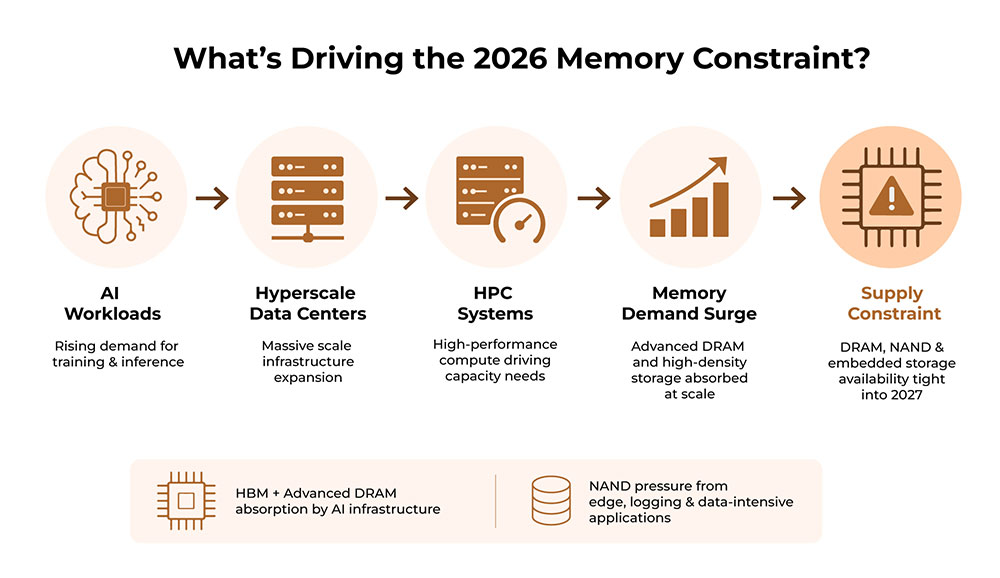
AI infrastructure has introduced a new class of memory intensive workloads. Training and inference systems require large DRAM capacity per node, high bandwidth memory integrated with accelerators, and fast storage layers that sustain continuous data movement. These requirements exceed those of conventional enterprise systems. As a result, memory manufacturers have redirected production capacity toward high performance segments such as HBM and DDR5 designed for hyperscale data centres. This shift reduces the availability of commodity DRAM and NAND used in embedded and industrial systems, creating a fragmented supply environment for regional markets like South Africa under current semiconductor market conditions.
Supply cannot respond quickly due to structural limitations in semiconductor manufacturing. Building new fabrication capacity requires several years and substantial capital investment. The transition toward advanced memory technologies introduces additional complexity. High bandwidth memory relies on three-dimensional stacking and advanced packaging, which reduces effective throughput compared to conventional memory. Yield optimisation and thermal constraints further limit scalability. NAND production is also under pressure as manufacturers push toward higher layer counts and more complex architectures. These transitions introduce short term inefficiencies in output, resulting in supply growth that remains below historical norms and reinforces shortage conditions across the industry.
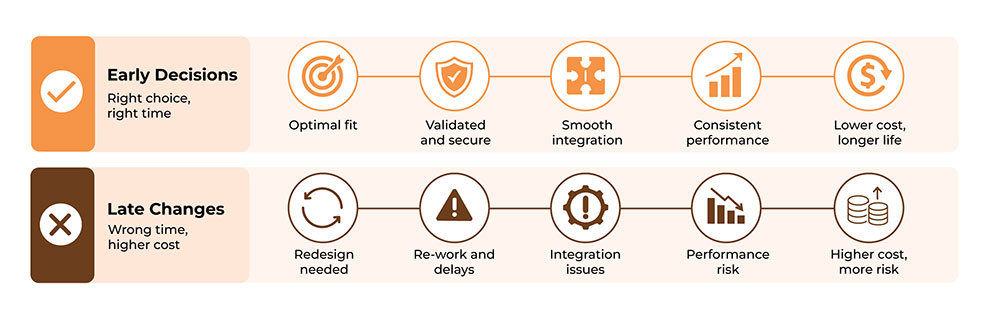
For South Africa, the implications are amplified by the structure of the local electronics ecosystem. The market depends heavily on imported semiconductors, while demand continues to grow across energy, telecommunications, industrial automation and mining. In these sectors, memory plays a central role in system performance, data handling and operational continuity. One immediate impact is increased volatility in the bill of materials. Memory components that were previously stable are now subject to allocation and uncertain delivery timelines, forcing engineers to consider alternative components late in the design cycle and increasing validation effort within projects.
There is also a mismatch between component lifecycle and system lifecycle. Industrial deployments in South Africa often operate for more than a decade, while memory components follow shorter production cycles with rapid generational turnover. This creates maintenance challenges when replacement parts are no longer available or when redesign becomes necessary to accommodate newer technologies. At the system level, memory constraints influence architecture decisions. In many applications, especially in remote or infrastructure-heavy environments, limited DRAM capacity restricts real-time analytics, data processing, and the deployment of advanced workloads at the edge, where resources remain constrained.
In response to these constraints, engineering approaches are evolving toward tiered memory architectures. Instead of relying solely on DRAM, systems distribute workloads across multiple layers. DRAM is reserved for latency-critical operations, while NAND-based storage is used for capacity, buffering, and persistence. This approach allows systems to operate within the limits of available DRAM, while maintaining functional performance. Modern solid-state storage plays a key role in this transition, providing high throughput and relatively low latency compared to traditional storage, enabling data-intensive systems to extend effective working capacity through caching, buffering and fast persistent storage, without replacing DRAM for latency-critical operations.
Exascend’s storage portfolio is aligned with these requirements, offering industrial and enterprise SSD solutions designed for sustained performance and reliability. These include NVMe and SATA architectures that support high throughput and consistent operation under continuous workloads. High endurance NAND configurations support write intensive applications, while controller design and firmware are intended to support predictable behaviour under sustained workloads. These characteristics are critical in South African environments where systems must operate reliably under vibration, temperature variation, and continuous usage across sectors such as mining, energy infrastructure and industrial automation.
Swissbit complements this architecture at the embedded and industrial edge. Its portfolio focuses on industrial flash storage and embedded memory solutions, including eMMC, SD, microSD and managed NAND solutions designed for long lifecycle deployments. Swissbit technologies emphasise data integrity, firmware stability and controlled component management, ensuring predictable behaviour over extended operational periods. In environments where system uptime and data retention are critical, such as transportation, energy systems and industrial control, these characteristics are essential for maintaining reliability and compliance across the full system lifecycle.
Another important aspect is lifecycle management. Both Exascend and Swissbit support controlled bill of materials structures and extended product availability, which are essential for long term deployments. This reduces risk associated with component obsolescence and supports continuity in system design and maintenance. In a constrained market, access to components must be combined with engineering support. As an authorised distributor for both Exascend and Swissbit across South Africa, McKinsey Electronics aligns component selection with system requirements, ensuring that memory and storage technologies are integrated based on workload characteristics, endurance needs, and environmental conditions.
Controlled sourcing through authorised channels provides improved visibility into availability and reduces exposure to allocation-driven volatility. It also ensures traceability and continuity of documentation, which are increasingly important in regulated and high-reliability sectors. Lifecycle planning extends beyond initial design to include strategies for long-term availability, component continuity and alignment with system lifecycles. This requires coordination between engineering and sourcing functions, particularly in markets where supply conditions remain uncertain.
The 2026 memory shortage represents a shift in how memory is produced, allocated, and integrated into electronic systems. For South Africa, the impact extends beyond pricing or availability and affects how systems are designed, validated, and maintained over time. Addressing this challenge requires system-level thinking and adoption of tiered memory Exascend and Swissbit provide product categories that can support this transition, while McKinsey Electronics provides the engineering and sourcing framework required to maintain system resilience despite ongoing global constraints.
For more information visit McKinsey Electronics,






© Technews Publishing (Pty) Ltd | All Rights Reserved
 printer friendly version