29 June 2026Editor's Choice
Telecoms, Datacoms, Wireless, IoT
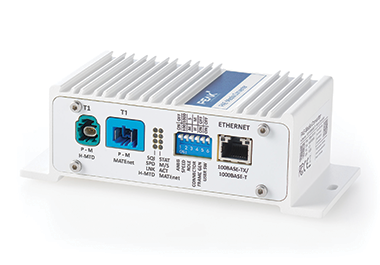
HMS Networks has introduced its first-ever Automotive Ethernet product under the PEAK brand, entering a new era of IVN communication. The PAE-Media Converter is a robust and compact device designed to connect Automotive Ethernet (100BASE-T1 or 1000BASE-T1) with standard Ethernet (100BASE-TX or 1000BASE-T) networks. As a media converter, it enables automotive engineers to simplify development, testing, and validation workflows within the 100 Mbit/s and 1000 Mbit/s domains.
Kristofer Koch, product manager, HMS Networks.
Unique features for automotive testing
The PAE-Media Converter addresses crucial market challenges in automotive development and validation with three core innovations. It enables realistic fault simulation by allowing physical interruption of the Automotive Ethernet link. This can be triggered directly on the device or via an API, supporting reproducible and controlled test scenarios.
“We empower engineers with simple and powerful tools. With our unique physical link interruption functionality, we enable them to create real fault conditions in test scenarios without unplugging the device, saving time and wear,’’ explains Kristofer Koch, product manager at HMS Networks. At the same time, the device combines H-MTD and MATEnet connector support in one unit, reducing hardware complexity, investment risks, and enabling faster setups.
“With only one device we cover the two de facto connection standards in the market – with no additional adapters needed,’’ says Koch. In terms of useability, the PAE-Media Converter provides what engineers enjoy: true plug-and-play operation with optional API control and a selectable (via DIP switch) dual-speed conversion (100/1000BASE-T1). The benefit of this hardware-only configuration is that engineers can start immediately without software, while still having the flexibility to integrate the device into automated test environments.
Figure 1. PEAK’s PAE-Media Converter.
Designed for practical engineering use
The PAE-Media Converter comes with a robust aluminium housing (145 x 61 x 46 mm), and an extended operating temperature range from -40°C to 85°C that ensures reliable performance in testing environments. For intuitive on-device diagnostics, LED indicators provide direct feedback on link status, signal quality, and errors. This enables fast diagnostics without additional tools and supports efficient troubleshooting during development and testing.
Flexible integration and automation
The media converter easily integrates into existing Ethernet environments. It connects directly to standard tools, enabling immediate use in development and analysis workflows. An integrated frame generator supports link validation and wiring tests.
Available accessories include H-MTD and MATEnet cables for Automotive Ethernet connections, as well as a DIN rail adapter for integration into test benches and industrial setups. These components enable quick adaptation to different environments and reduce setup effort.
“Automotive Ethernet, especially within the 100/1000 Mbit/s domains, is a key technology for software-defined vehicles”, says Koch, highlighting PEAK’s strategic move into this emerging market. “With our strong background in CAN, PEAK has long been a proven expert in in-vehicle communication. With the addition of Automotive Ethernet, we are now extending this expertise to cover the full IVN landscape. For engineers, this means one reliable partner across both technologies. With the PAE-Media Converter, we provide a first simple yet powerful tool, to bridge development and testing environments – with a lot more to come.”
Key technical features of the PAE-Media Converter:
• Conversion between
100BASE-T1/1000BASE-T1 and 100BASE-TX/1000BASE-T.
• Dual-speed support with hardware selection via DIP switches.
• Integrated support for H-MTD and MATEnet connectors.
• Power supply via USB-C (5V) or 6 to 36 V DC.
• Robust aluminium housing with IP20 protection.
• Extended operating temperature range from -40°C to 85°C.
• Hardware-based configuration without software.
• LED diagnostics for link status, signal quality, and errors.
• Integrated frame generator for link validation.
• Controlled link interruption for testing scenarios.
• Optional USB API for automation and system integration.
Solving South African power problems with locally built intelligence
Editor's Choice Power Electronics / Power Management
Smart metering infrastructure in South Africa remains patchy. The rollout has been slow, coverage is inconsistent, and for the most part, granular per-unit measurement simply does not exist.
Read more...Lesley Havenga: Building partnerships for Africa’s electronics future
Editor's Choice News
As Würth Electronik expands its footprint across South Africa and the broader sub-Saharan region, Havenga’s blend of manufacturing expertise, supply chain knowledge, and people-centred leadership appears well suited to the task.
Read more...Generating negative voltages from a positive supply Altron Arrow
Editor's Choice Passive Components
It is common for IoT devices, industrial sensors, meters, and medical equipment to require both a positive and negative voltage, and this article explains the options available to produce a negative rail from a positive rail supply.
Read more...EMC limits and levels Altron Arrow
Editor's Choice Circuit & System Protection
As soon as electronics and electrical systems started interfering with each other, the world had to come to some consensus. Considering physics is universal and does not care about what country electrical/electronic products are used in, it should be the same everywhere, right? It is nearly there, but not quite.
Read more...Sigfox SA powers smart connectivity
Editor's Choice Telecoms, Datacoms, Wireless, IoT
Sigfox South Africa is carving out a unique role, delivering low-power, wide-area network connectivity designed specifically for Internet of Things applications.
Read more...Seeing through the noise RF Design
Editor's Choice Telecoms, Datacoms, Wireless, IoT
How Adaptive Long Coherent Integration (ALCI) delivers superior measurement and positioning performance where conventional receivers fall short.
Read more...PEAK unveils next level CAN software Industrial Data Xchange (IDX)
Telecoms, Datacoms, Wireless, IoT
With the release of its PCAN-Explorer 7, PEAK delivers a major update that adds full support for CAN XL, multiple symbol files per connection, Python scripting, and flexible licensing including floating licenses.
Read more...Case Study: Turning data into insight Hamamatsu Photonics UK
Editor's Choice Opto-Electronics
Hamamatsu Photonics’ InGaAs PIN photodiode detector has proven consistent, reliable, and robust for more than a decade, helping Axetris to deliver stable, repeatable measurements.
While every effort has been made to ensure the accuracy of the information contained herein, the publisher and its agents cannot be held responsible for any errors contained, or any loss incurred as a result. Articles published do not necessarily reflect the views of the publishers. The editor reserves the right to alter or cut copy. Articles submitted are deemed to have been cleared for publication. Advertisements and company contact details are published as provided by the advertiser. Technews Publishing (Pty) Ltd cannot be held responsible for the accuracy or veracity of supplied material.










 printer friendly version