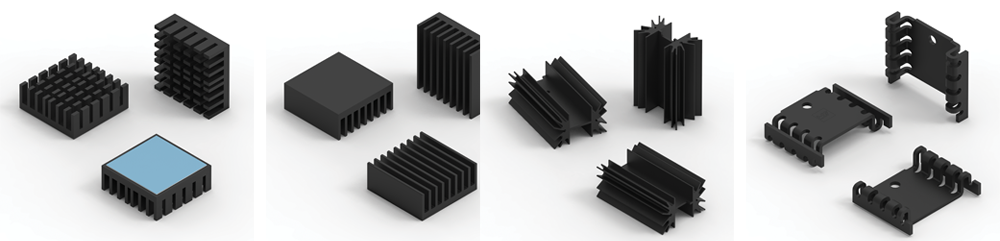
Würth Elektronik has launched a comprehensive heat sink portfolio, divided into three specialised product groups. The WE-HTO heat sinks are designed for THT-TO packages like the TO-220 and TO-247. WE-HIC includes classic finned heat sinks for components with flat surfaces, such as CPUs or DC/DC converters. The WE-HTOI and WE-HICI variants are supplied from the factory pre-coated with thermal interface material. This eliminates the air gap between the component and the heat sink, thus maximising cooling performance. As a special service, Würth Elektronik provides technical support, detailed heat-sink characteristics, simulation options, as well as customer-specific modifications.
The WE-HTO heat sinks are available in various shapes and with different surface structures to enable tailored cooling performance. These include variants with curved sheet metal and with cooling fins, which dissipate more heat through their increased surface area. In addition, matching M3 screws, nuts, and insulating sleeves for mounting on the WE-HTO and WE-HTOI heat sinks can also be ordered.
WE-HIC is available in two variants; with continuous or interrupted fins. The design with continuous fins is designed for applications in which the airflow is aligned with the fins. The variant with interrupted fins, however, is ideal when airflow in the installation environment cannot be clearly defined. Heat sinks for ICs are available in sizes ranging from 20 × 20 to 40 × 40 mm.
Harnessing Leakage Inductance Würth Electronics South Africa
Passive Components
Würth Electronics has expanded its WE-MCRI product series with the new 1090HL variant (HL = High Leakage), a coupled inductor specifically designed to improve the performance of SEPIC, ZETA and Cuk converters.
Read more...Quick and easy shielding Würth Electronics South Africa
Electronics Technology Manufacturing / Production Technology, Hardware & Services
Würth Elektronik expands its EMC product portfolio with nanocrystalline WE-FNCS sheets.
Read more...Space saving SMD common-mode chokes Electrocomp
Passive Components
TDK Corporation presents the EP21 series of flat-wire double chokes designed for common-mode EMI filtering and available in an SMD format with dimensions of only 23,8 x 17,7 mm and heights ranging from 21,6 to 22,3 mm
Read more...Highly rugged GAPS and HAPS proximity sensors IOT Electronics
Passive Components
Now available through Powell Electronics are the GAPS (General Aerospace Proximity Sensors) and HAPS (Harsh Application Proximity Sensors) proximity sensors from Honeywell.
Read more...Understanding EMI Filters and their applications Vepac Electronics
Passive Components
Electromagnetic Interference (EMI) Filters are essential for maintaining electromagnetic compatibility (EMC), allowing multiple devices to function together without interference.
Read more...SMT flat-wire inductor
Passive Components
Würth Elektronik introduces its new WE-SFIA series of flat-wire inductors in 2010, 2013, and 2016 packages.
Read more...Compact SSI family for industrial automation Altron Arrow
Passive Components
Infineon Technologies has introduced the ISSI20BxxF Solid State Isolator (SSI) family, bringing solid-state isolation technology into high-volume applications traditionally served by photovoltaic isolators (PVIs), photovoltaic relays (PVRs), and electromechanical relays (EMRs).
While every effort has been made to ensure the accuracy of the information contained herein, the publisher and its agents cannot be held responsible for any errors contained, or any loss incurred as a result. Articles published do not necessarily reflect the views of the publishers. The editor reserves the right to alter or cut copy. Articles submitted are deemed to have been cleared for publication. Advertisements and company contact details are published as provided by the advertiser. Technews Publishing (Pty) Ltd cannot be held responsible for the accuracy or veracity of supplied material.









 printer friendly version