Tips for detecting counterfeit components
17 October 2012
Manufacturing / Production Technology, Hardware & Services
Bob Willis
In an ideal world, components would only be purchased from the original producer, a franchised distributor or an approved non-franchised source. However, this is not an ideal world. With the majority of components being counterfeited falling in the $1 to $10 range, this is a problem for all.
A simple approach to minimise counterfeit components passing through goods receipt to production is to create a component reference database so that reference components and images of known good components can be used for future comparison.
The following should be considered by engineers for inclusion in their company database. Reference component details should be obtained when a component is known to be going obsolete, on long lead times, difficult to obtain or found to be in circulation as a counterfeit product. Using a spreadsheet provides a simple way of storing data and links to other information.
Where components are being used in existing products or being considered in new products that are single source or subject to long lead times, they should be added to the component database. Where components are considered to be high risk, are knowingly purchased from a new source or the supplier has not been previously qualified, reference samples must be obtained for review and possible testing.
A golden board assembly is often held in manufacture as a reference for build quality or as an inspection reference and could be used by goods receipt staff. This is an ideal solution for OEM and also provides confidence for contract assembly staff as a working product is always the best reference.
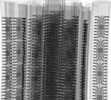
X-ray inspection is a very powerful tool to examine a component or a batch of components without taking them out of their protective packaging. X-ray allows the lead frames, die size, bond wire type and package type to be identified. Figure 1 shows components inspected without opening the sealed MSD bags.
Figure 1. Components can be inspected by X-ray without removing them from their MSD packaging.
A guide to inspection of plastic ICs can be conducted by production staff after some hands-on training and a reference guide can be created for counterfeit avoidance with samples such as those in Figure 2.
Figure 2a. Genuine sample with pronounced moulding nodules.
The surface of the component body should be inspected: all surfaces should have a similar surface appearance and reflect light in a similar manner. If a surface has been modified/ground to remove previous marks there will be a difference in the surface, particularly around the markings. Figure 2b shows how the sharply defined moulding nodules have been flattened.
Figure 2b. Counterfeit component with ground-down surface.
Any modification to the surface may change the appearance of surface features like moulding marks, laser marks and pin dimple indicators when compared with reference samples. In Figure 3, the surface of the plastic is as produced with sharp edges to the mould contours and no scratching on the surface of the mould contours.
Figure 3. Genuine component shows sharp edges to the mould contours and no scratching on the surface.
A reference source/photo guide should be compiled of existing qualified manufacturers’ logos, packing labels, SMT reel labels and outer packing labels for use at goods receipt inspection. This may take time to compile but the sooner one starts, the better future problems are prevented.
Manufacturers should select and appoint an independent laboratory to conduct component testing when specialist tests may be required for independent verification. It makes sense that when someone is needed on call for support, company approval and financial issues have already been sorted in advance.
For more information visit www.bobwillisonline.com
Further reading:
Soldering day highlights
Manufacturing / Production Technology, Hardware & Services
JAPAN UNIX has published a new event report and highlight video from their UNIX SOLDERING DAY 2026 in Hungary. This event reflects on their commitment to supporting manufacturers not only through soldering automation systems, but also through technical education, live demonstrations, hands-on training, and practical engineering know-how.
Read more...
Clearing the Static: Electrostatic Discharge
Actum
Manufacturing / Production Technology, Hardware & Services
A cordless ESD (Electrostatic Discharge) wrist strap does not work by grounding the person in the same way as a traditional wired wrist strap. Instead, it works by reducing or balancing the static charge on your body so that you are less likely to discharge electricity into sensitive electronic components.
Read more...
Engineering trust in South Africa’s SMT sector
ZETECH ONE
Manufacturing / Production Technology, Hardware & Services
From a small Johannesburg start-up to a trusted SMT technology partner, Zetech One has spent four decades helping South African electronics manufacturers improve production quality, efficiency and reliability.
Read more...
The new reality of PCB material supply
Jemstech
Editor's Choice Manufacturing / Production Technology, Hardware & Services
How resilient manufacturing strategies are helping OEMs navigate a changing global supply chain.
Read more...
Streamlining Device Programming with the AutoBee-D1
Vepac Electronics
Manufacturing / Production Technology, Hardware & Services
The AutoBee-D1 desktop automated programmer is designed to simplify the programming of devices, while delivering consistent accuracy, high throughput and reduced manual intervention.
Read more...
Zero PFAS die attach paste
Testerion
Manufacturing / Production Technology, Hardware & Services
With silver price volatility increasing and sustainability requirements accelerating across semiconductor assembly, MacDermid Alpha Electronics Solutions introduces ATROX CD 560-1, a zero per- and polyfluoroalkyl substance (PFAS) alternate silver filler die attach paste.
Read more...
Precision jet printing for advanced PCB designs
MyKay Tronics
Manufacturing / Production Technology, Hardware & Services
Mycronic’s BA 01 small dot ejector delivers unmatched precision in solder paste jet printing for advanced PCB designs.
Read more...
Strengthening local electronics manufacturing through investment and innovation
Microtronix Manufacturing
Editor's Choice Manufacturing / Production Technology, Hardware & Services
Microtronix South Africa cements its commitment to local manufacturing with ongoing investments in production capacity, skills development, and job creation.
Read more...
Polypropylene pole-top boxes support smarter, more secure electricity networks
Manufacturing / Production Technology, Hardware & Services Enclosures, Racks, Cabinets & Panel Products
As South Africa accelerates the rollout of smart prepaid electricity metering, innovative enclosure technology from Power Process Systems (PPS) is helping utilities improve network security, reduce electricity theft and protect critical electrical infrastructure.
Read more...
200 W of power in a space-saving design
Vepac Electronics
Manufacturing / Production Technology, Hardware & Services
The Hakko FX-972 Soldering Station delivers high-performance soldering in a compact package, making it suitable for a wide range of soldering applications.
Read more...













 printer friendly version