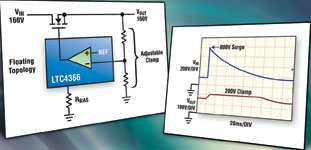
Linear Technology’s LTC4366 is an over-voltage protection controller for electronic systems. Operating from 9 V to greater than 500 V, the device utilises an adjustable floating topology to enable very high-voltage operation independent of the voltage rating of its internal circuitry.
Two internal shunt regulators coupled with the external voltage-dropping resistors generate the LTC4366’s internal supply rails. The maximum operating voltage is set by the breakdown of the external resistors and MOSFETs. The device was said to be the first product of its kind to protect, for example, a 12 V circuit from a 500 V transient without the need for additional protection components.
The chip monitors the voltage at its output and reacts quickly to input supply over-voltage by controlling the gate of an N-channel MOSFET. It regulates the output to a user-defined voltage during an over-voltage transient, allowing the load to remain operational while the over-voltage is dropped across a MOSFET. An adjustable fault timer ensures safe shutdown if the fault persists.
The LTC4366 is ideal for harsh industrial, automotive and avionic applications where systems must continue operating reliably through severe over-voltage events. High-voltage applications include protecting from motor transients, coupled over-voltage, incorrect input supplies or power supply failures.
Microchip expands maXTouch M1 touchscreen controller Altron Arrow
DSP, Micros & Memory
Microchip Technology has again expanded its maXTouch M1 family of touchscreen controllers, now covering free-form widescreen format displays up to 42 inches down to small compact screens in the 2 to 5 inch range.
Read more...ToF sensor with 6 m range Altron Arrow
Test & Measurement
Specifically designed for long-range, multitarget measurements, the VL53L4CX from ST Microelectronics provides very accurate distance measurements up to 6 m with excellent results over short distances.
Read more...Microchip expands its Arm Cortex-M0+ portfolio Altron Arrow
DSP, Micros & Memory
PIC32CM PL10 MCUs feature a rich set of Core Independent Peripherals, 5 V operation, touch capabilities, integrated toolsets, and safety compliance.
Read more...More room to scale Altron Arrow
Power Electronics / Power Management
With the latest STM32H5 lines from STMicroelectronics, you can now scale within the same platform, from a compact 1 Mbyte device to higher-memory MCUs for graphics-rich and feature-heavy designs.
Read more...Multi-constellation GNSS module in a legacy-compatible footprint Altron Arrow
Telecoms, Datacoms, Wireless, IoT
Telit Cinterion has announced the SE869eK2L, a single-frequency L1 GNSS module designed to help device manufacturers upgrade legacy positioning designs with improved performance and cost efficiency, while preserving design continuity.
Read more...Compact SSI family for industrial automation Altron Arrow
Passive Components
Infineon Technologies has introduced the ISSI20BxxF Solid State Isolator (SSI) family, bringing solid-state isolation technology into high-volume applications traditionally served by photovoltaic isolators (PVIs), photovoltaic relays (PVRs), and electromechanical relays (EMRs).
Read more...Rev 2.0 PolarFire FPGA ethernet sensor bridge Altron Arrow
Computer/Embedded Technology
Smaller, multi-camera platform enables scalable Ethernet architectures for NVIDIA Edge AI systems, while lowering power, cost and integration complexity.
Read more...The effect of seasonal changes on ESD performance in South Africa Actum
Editor's Choice Circuit & System Protection Manufacturing / Production Technology, Hardware & Services
Electrostatic discharge performance is influenced by several environmental factors, with relative humidity being one of the most important. This is particularly relevant in South Africa, where seasonal changes can result in significant differences in humidity levels.
Read more...Universal IR receiver module Altron Arrow
Telecoms, Datacoms, Wireless, IoT
Vishay Intertechnology has introduced a new series of infrared (IR) receiver modules for IR remote control applications, which feature a wide modulation frequency acceptance from 30 kHz to 68 kHz.
Read more...Low profile SMD antenna Altron Arrow
Telecoms, Datacoms, Wireless, IoT
The Havok PCS.06.A antenna, from Taoglas, is a low profile SMD LTE/cellular 4G/3G/2G embedded antenna designed for direct SMD mount on a device PCB.
While every effort has been made to ensure the accuracy of the information contained herein, the publisher and its agents cannot be held responsible for any errors contained, or any loss incurred as a result. Articles published do not necessarily reflect the views of the publishers. The editor reserves the right to alter or cut copy. Articles submitted are deemed to have been cleared for publication. Advertisements and company contact details are published as provided by the advertiser. Technews Publishing (Pty) Ltd cannot be held responsible for the accuracy or veracity of supplied material.









 printer friendly version