


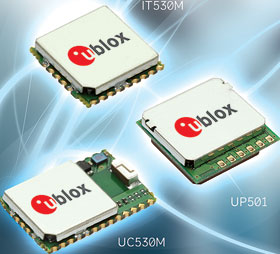
u-blox has expanded its GPS portfolio with the UP501 GPS antenna module and two new modules featuring parallel GPS/GLONASS operation.
The IT530M is a surface-mount, parallel GPS/GLONASS receiver which complements the company’s line of recently announced u-blox 7 multi-GNSS modules, allowing it to address all positioning and navigation requirements.
The IT530M’s parallel operation can enhance position availability in areas of adverse reception or at high latitudes. In contrast, the u blox 7 module family supports sequential GPS or GLONASS reception, bringing down power consumption to the absolute minimum. This gives designers the choice of selecting the receiver most appropriate for their application.
The IT530M features a small footprint, low power consumption and sophisticated interference suppression, ensuring maximum performance even in GPS-hostile environments. As it is the result of u-blox’ recent acquisition of Fastrax, the 9,6 x 9,6 mm module is pin-compatible with Fastrax’ IT530 modules, which allows for easy upgrade from existing designs.
Featuring enhanced integration, the new UC530M adds a built-in antenna to a parallel GPS/GLONASS module. The antenna module is easily embeddable in space-restricted environments thanks to its tiny footprint of only 9,6 x 14,0 x 1,95 mm. Its highly integrated SMT design reduces the need for external components and minimises manufacturing costs.
With high sensitivity (-165 dBm in tracking) and very low power consumption (typically only 66 mW average), the UC530M can be directly connected to a lithium battery, eliminating costly voltage regulators. Advanced low-power modes are also supported along with three days self-assistance support.
Additional functionality in the UC530M includes a logger function which stores location information in internal memory. With a typical log interval of 15 seconds, log capacity can be up to 16 hours.
The integrated antenna of the UC530M exhibits significantly better radiation efficiency than small patch antennas and performs well against larger and heavier patch antennas. Its circular radiation pattern brings flexibility to hardware designs.
Optional connectivity to an external antenna extends the applicability of the module to a wider range of devices, from handheld computers to asset tracking systems. The module is drop-in compatible with the UC530 GPS antenna module announced in June 2012.
Finally, the new UP501 GPS receiver module with embedded GPS antenna enables high-performance navigation in the most stringent applications and solid fix even in harsh GPS visibility environments. It is ideally suited for navigation systems, asset tracking devices and battery operated consumer products, such as personal navigation devices, handheld computers, cameras and sports accessories.
The UP501 is also an ideal receiver for GPS mouse applications, due to its compact design and easy interfacing. Extremely high acquisition sensitivity enables fast position fix in harsh urban canyons or blocking environments, eliminating the need for an external antenna.
An internal backup battery (optional) allows very fast TTFF even when the module has been completely powered off by the host system. This enables efficient customisable power save modes without compromising TTFF performance. The fix rate is configurable up to 10 Hz by user commands, making the module ideal for highly dynamic applications.
For more information contact Andrew Hutton, RF Design, +27 (0)21 555 8400, sales@rfdesign.co.za, www.rfdesign.co.za
| Tel: | +27 21 555 8400 |
| Email: | sales@rfdesign.co.za |
| www: | www.rfdesign.co.za |
| Articles: | More information and articles about RF Design |






© Technews Publishing (Pty) Ltd | All Rights Reserved
 printer friendly version