Battery-free devices harvest energy from RF signals
9 October 2013
News
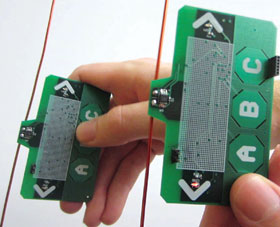
Engineers at the University of Washington have created a new wireless communication system that allows devices to exchange information by reflecting or absorbing pre-existing radio frequency signals, enabling them to interact with users and communicate with each other without using batteries. The new technique, which the researchers are calling ‘ambient backscatter’, takes advantage of the TV and cellular transmissions that already surround us, and could enable a network of devices and sensors to communicate with no power source or human attention needed.
“We can repurpose wireless signals that are already around us into both a source of power and a communication medium,” said lead researcher Shyam Gollakota, a UW assistant professor of computer science and engineering. “It’s hopefully going to have applications in a number of areas including wearable computing, smart homes and self-sustaining sensor networks.”
Smart sensors could be built and placed permanently inside nearly any structure, then set to communicate with each other. For example, sensors placed in a bridge could monitor the health of the concrete and steel, then send an alert if one of the sensors picks up a hairline crack. The technology can also be used for communication – text messages and emails, for example – in wearable devices, without requiring battery consumption.
The researchers tested the ambient backscatter technique with credit card-sized prototype devices placed within several feet of each other. For each device the researchers built antennas into ordinary circuit boards that flash an LED light when receiving a communication signal from another device.
Groups of the devices were tested in a variety of settings, including inside an apartment building, on a street corner and on the top level of a parking garage. These locations ranged from less than 800 metres away from a TV tower to about 10,5 kilometres away.
It was found that even the devices farthest from a TV tower were able to communicate with each other. The receiving devices picked up a signal from their transmitting counterparts at a rate of 1 kilobit per second when up to 75 cm apart outdoors and 45 cm apart indoors. This is enough to send information such as a sensor reading, text messages and contact information.
Further reading:
Rooibos heads to space
News
A South African scientific initiative linking agriculture and space research has officially launched today with the Rooibos in Space programme at Parklands College’s Innovation Centre in Cape Town.
Read more...
From the editor's desk: Local can be international
Technews Publishing
Editor's Choice News
Welcome to the July 2026 issue of
Dataweek. As you can see from this introduction,
Dataweek’s regular editor, Peter Howells, is on extended leave and I am filling the void in his editor’s column – hopefully without being too boring.
Read more...
Landis+Gyr EMEA introduces new company name: EYKON
News
EYKON is the new company name of Landis+Gyr EMEA, formerly part of the Landis+Gyr Group. The company supports electricity, gas, water and thermal utilities in managing increasingly complex networks, improving operational efficiency and enabling more sustainable use of resources.
Read more...
Yamaha Robotics will show visitors to EFX
Manufacturing / Production Technology, Hardware & Services News
Yamaha Robotics will show visitors to EFX 2026, the Expo for Electronics Manufacturing, in Stuttgart from 6-8 October 2026, how advanced surface-mount automation helps companies grow their business and increase productivity.
Read more...
From the editor's desk: The art of measuring the truth
Technews Publishing
Editor's Choice News
All electronic measurements are a lie. The trick is making the lie as small as possible.
Read more...
TSE has relocated
News
The Technology Station in Electronics (TSE) has entered a new chapter with its relocation from the CSIR campus to TUT-owned building at Ditsela Place in Hatfield.
Read more...
Innovative MyLegrand app
RS South Africa
News
Legrand SA is set to launch the MyLegrand mobile application, a digital platform designed to strengthen engagement across its professional network.
Read more...
Kulani Energy acquires critical assets from Optipower
News
Kulani Energy preserves engineering, procurement, and construction capability and positions a wholly women-owned firm at the forefront of South Africa’s grid expansion.
Read more...
From Cape Town to Johannesburg
News
Würth Elektronik South Africa has taken a significant step forward with its recent relocation from Cape Town to Johannesburg, marking a new phase of growth and ambition for the company.
Read more...
Lesley Havenga: Building partnerships for Africa’s electronics future
Editor's Choice News
As Würth Electronik expands its footprint across South Africa and the broader sub-Saharan region, Havenga’s blend of manufacturing expertise, supply chain knowledge, and people-centred leadership appears well suited to the task.
Read more...









 printer friendly version