Constantly increasing bandwidth requirements in all areas of communication and computing are putting greater and greater demands on networking I/O equipment, and current edge-mount copper or fibre interfaces are at their limits.
Embedded parallel-optics have evolved to meet these demands. High-performance routers, switches and computers have already utilised this technology for a decade. It is used in a wide field of applications today: in links between nodes of supercomputers or switches in international Internet gateways as well as data centres and central offices.
Embedded opto-electrical modules, optical engines, utilise parallel-optics transmitter and receiver arrays. For optimum signal integrity, thermal management, I/O consolidation and EMI/ESD, the opto-electrical modules are directly mounted close to the processors at the PCB. Parallel-optic links can complement electronic signalling in parallel lanes like XAUI and PCIe.
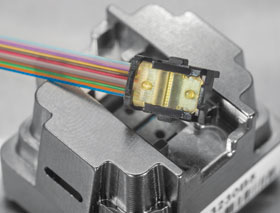
Rosenberger’s PRIZM Light Turn technology is designed to overcome distance and bandwidth limitations of PCB copper strip lines. In addition to its small form factor enabling increased board component and card edge I/O densities, it offers greater energy efficiency and EMI immunity. Improved thermal management and lower PCB design complexity are possible, which in turn can help to lower latency, power usage and cost per gigabit.
Available designs include bare ribbon connector to bare ribbon connector; bare ribbon connector to bare MT ferrule; 1 to 4 bare ribbon connectors to MTP connectors 12, 24, 36, 48 fibre; and round jacketed cable connector to round jacketed cable connector.
Clearing the Static: Electrostatic Discharge Actum
Manufacturing / Production Technology, Hardware & Services
A cordless ESD (Electrostatic Discharge) wrist strap does not work by grounding the person in the same way as a traditional wired wrist strap. Instead, it works by reducing or balancing the static charge on your body so that you are less likely to discharge electricity into sensitive electronic components.
Read more...Connectivity solutions for hydrogen technologies Hiconnex
Interconnection
As the production distribution and utilisation of hydrogen continue to scale, connectivity becomes a key enabler for efficient energy transmission, data communication, and system control.
Read more...Mixed-density Combo-D connectors Hiconnex
Interconnection
Positronic’s SCBM connector series is a rugged, high-performance family of mixed-density D-sub connectors engineered for demanding environments.
Read more...Same Sky expands rectangular connector portfolio Future Electronics
Interconnection
The portfolio includes male pin headers, female pin headers, and box headers, giving engineers the flexibility to select the most appropriate connector style for their specific design requirements.
Read more...Rugged USB-C for modern designs
Interconnection
Same Sky has expanded its USB Type-C connector portfolio to meet the growing demand for faster data transfer and higher power delivery in modern electronic designs.
Read more...Designing with PCIe Spectrum Concepts
Editor's Choice Interconnection
PCI Express has become the backbone of modern high-performance systems with each new generation promising higher bandwidth, but that performance comes with a cost.
Read more...Robust single-pole power connectivity Hiconnex
Interconnection
Designed for cable-to-cable and cable-to-equipment use, Radiall’s single-pole power connector support current ratings from 250 A to 750 A and operating voltages up to 1000 V AC or DC.
Read more...M12 push-pull connectors IOT Electronics
Interconnection
Phoenix Contact’s M12 push-pull connectors with internal locking set a new benchmark for fast, secure, and space-saving connectivity in industrial automation.
Read more...Versatile outdoor waterproof connectors Vepac Electronics
Interconnection
The LP-20 outdoor waterproof connector series offers a versatile range of rugged, circular connectors with 2, 3, 4, 5, 7, 8, 9, 12 and 14-pin configurations.
Read more...Comprehensive range of data connectors IOT Electronics
Interconnection
Phoenix Contact’s comprehensive range of data connectors provides reliable connection solutions for modern networked applications across industrial, infrastructure, and commercial environments.
While every effort has been made to ensure the accuracy of the information contained herein, the publisher and its agents cannot be held responsible for any errors contained, or any loss incurred as a result. Articles published do not necessarily reflect the views of the publishers. The editor reserves the right to alter or cut copy. Articles submitted are deemed to have been cleared for publication. Advertisements and company contact details are published as provided by the advertiser. Technews Publishing (Pty) Ltd cannot be held responsible for the accuracy or veracity of supplied material.









 printer friendly version