



If you didn’t already know this, I’m sorry to be the one to have to tell you: if you bought your car within the last two years, it’s probably contaminated. In fact, if it was sold new after 1 September 2012 in South Africa, it’s pretty much guaranteed to be covered in spots. Or rather, dots. Microdots, to be exact; and they were put there at the orders of your own government.
Rest assured, though, that they are quite benign – beneficent, even, as their purpose is to prevent your car from being stolen, or at least identify it in the event of its theft. The National Road Traffic Act mandates the application of these microdots to every new vehicle sold within South Africa’s borders.
Before examining microdot technology under the microscope, it’s important to understand why it’s around in the first place, and why it is considered so effective that it was passed into law.
Stolen parts, street smarts and upstarts

With the aim of thwarting criminals, it helps to have inside knowledge about how they operate. Indeed, the man behind Recoveri, Philip Opperman, is no stranger to the law. But rest assured, the only hard time he ever served was on the right side of the bars, having fulfilled several roles in various precincts over the course of his career in the South African Police Service.
So how did this ex-cop become the CEO of one of the leading South African microdot suppliers and a pioneer of their adoption? Like most innovations, it started with identifying an unfulfilled need, as Opperman explains: “Around the turn of the century, South Africa started experiencing a sharp rise in the incidence of vehicle hijacking. Knowing from my training and years of experience that visible policing is often the most effective method of preventing crime, I started wondering how to apply this to tackling the hijacking epidemic.”
The nature of this particular crime poses serious challenges, chief among them the ubiquity of the objects of these criminals’ desire and their inherent mobility. Perhaps the key to tackling the problem, then, would be to erode the market for hijacked cars. Easily said, but that is a big market, and with it come big problems.
The best solution to a big problem, as any electronic engineer well knows, is often to think small. In this case, really small.
Contaminated goods
Once again drawing on his knowledge of law enforcement practices, Opperman looked to the example of dye staining cash upon its theft to render it visually detectable and, ultimately, worthless to the thieves. The same concept applies equally to any object, so in theory a similar solution should be applicable to any valuable asset.
The problem is, most people who have their vehicles hijacked or stolen would quite frankly rather not have it back at all, than drive around in a dye-stained caricature of their precious wheels. “So how do you contaminate the asset enough to cut off the market,” poses Opperman, “while keeping it looking aesthetically pleasing to the owner?”
The answer he came up with was to make the ‘contamination’ invisible to the owner’s eye. Working after hours and with no technical background, Opperman started studying and experimenting on every aspect, from the printing and application of the microdots to the completion of the MBA that would ultimately serve him in setting up and nurturing his own business.
Finally, in 2002, Opperman founded Recoveri. He was also part of the working group that wrote the SABS standard (SANS 534) which mandates the fitment of microdots to new vehicles.
Putting the ‘micro’ in ‘microdot’
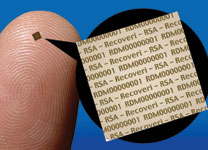
Measuring about 1 mm by 1 mm square, Recoveri’s microdots are printed with a tiny variation of the QR (quick response) codes that have become so commonplace in recent years. Between fifteen and twenty thousand of these are typically applied throughout a vehicle and its component parts, spread far enough apart so that they are not easily visible. While many are on conspicuous parts of the vehicle to make them easier for the police to detect, fitment centres must also apply them to a number of random areas to keep thieves guessing.
In this way, and because they are so difficult to see with the naked eye, it is impractical for a thief to find each microdot and remove it in order to ‘clean’ the vehicle or other asset. Besides, the microdots are applied with an adhesive that makes it necessary to use a special tool to remove them. This adhesive is formulated with an ultraviolet (UV) base so that law enforcement agencies can immediately determine if an asset is tagged by simply passing a UV light over it. Even if a tagged vehicle were to be stripped for parts, since each major part is microdotted, it can be identified and matched to the vehicle it came from.
Through trial and error, Opperman developed the printing process and adhesive behind Recoveri’s microdot solution himself, and enough of the backend software to prove the concept. Once that was accomplished, all that was needed to take the business into full swing was the right personnel. Recoveri currently employs 23 staff at its head office in Edenvale on the East Rand of Johannesburg, and has appointed around 100 fitment centres nationally, with the number growing daily.
Of course, with roughly 400 000 vehicles being registered in South Africa per annum, a database is required to keep track of those that are tagged with Recoveri’s microdots – as well as all the other assets they are being applied to, which includes everything from jet skis to home theatre systems, office equipment and locally manufactured electronic equipment.
Since the police rely on the integrity of the information in this database and because it must be accessible by them remotely, it is housed on a secure hosted server. Recoveri’s customers can also access their own information in the database using bespoke software with multiple layers of security.
Fitment centres authorised by Recoveri are ‘dotted’ across the country for applying the company’s microdots to vehicles, and a range of products is available for purchase by members of the public. These include DIY kits containing microdots (500, 1000 or 3000), warning stickers, applicator, step-by-step instructions and free database registration, as well as UV torches, handheld microscopes to see the dots clearly and tools to remove them.
Financial dynamite in tiny packages
Recoveri is enjoying exponential growth thanks to the reputation it has earned through its philosophy of providing products of the utmost quality. While microdots will continue to be at the company’s core, it has grown in confidence enough to broaden its horizons, most notably with the imminent introduction of a GPS tracking solution.
Opperman also highlights electronics manufacturers as targets for further growth, as microdots are perfectly suited to manage warranties, for example. In fact, they already are used for this purpose, with high-value electronics being marked with things like client-specific serial numbers. When a warranty is claimed, it can be validated against the microdot number.
Microdot technology itself is highly mature and it’s hard to imagine ways in which it might advance. Shrinkage is not really viable for most applications because it’s usually desirable for the microdot to be visible to the naked eye – just not too visible.
The most likely avenue forward is to incorporate other technologies into a microdot solution, for example by integrating a passive RFID circuit. It might be some time, though, before techniques like printed electronics have advanced to the point where something like this can be done on such a tiny scale.
Despite the prevailing technological limits, Opperman continues to look for ways to push Recoveri’s technology into the future, and is optimistic that an ‘intelligent’ microdot is not too far off. The company is also conducting research into microdot readers that could automate detection.
Despite the fact that microdot legislation ensures consistent demand and something of a captive market, it is still a competitive game, played by several players, for high stakes. Opperman is confident, though, that his clear business strategy and strong technical team will ensure that this ex-cop will steal the show.
For more information contact Philip Opperman, Recoveri, +27 (0)11 453 0868, philip@recoveri.net, www.recoveri.net






© Technews Publishing (Pty) Ltd | All Rights Reserved
 printer friendly version