Four reasons for X-ray inspection of surface mount devices
25 February 2015
Manufacturing / Production Technology, Hardware & Services
Vision inspection systems can find visible defects on PCBs, but these systems can only check the surface for errors, not the hidden solder joints of components like BGAs and flip chips. X-ray inspection can provide critical verification of the integrity of hidden solder joints on surface-mount devices.
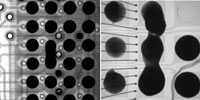
Figure 1. Solder ball shorts.
The following are four of the most common examples of faults that X-ray inspection is best suited to detecting.
1. Solder ball shorts
Solder ball shorts, or solder bridges, can be easily detected with an X-ray image, as shown in Figure 1.
2. Solder ball voids
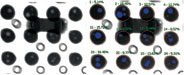
Figure 2. BGA void image with auto void calculation.
Ball-void inspection is used for BGA/CSP inspection along with solder ball bridge inspection.
Modern X-ray inspection systems can perform auto ball-void calculations (Figure 2).
Figure 3. BGA void location.
Not only is the size of the BGA voiding area important, the location of the BGA void is also important (see Figure 3), especially if the voiding area is close to the PCB pad area, because there is a possibility that this voiding area could cause a micro-crack.
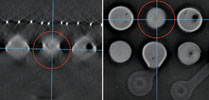
Figure 4. Solder ball open.
3. Solder ball open / micro cold solder
Solder ball attachment to the PCB pad is a critical inspection criterion. A high-resolution and high-magnification X-ray inspection system is required to detect a solder ball open defect. The X-ray image in Figure 4 shows a solder-ball open where the copper pad is separated below the solder ball.
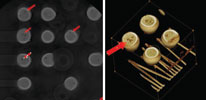
Figure 5. Solder ball open caused by small solder ball.
3D CT can assist with clear visualisation of open patterns. Figure 5 shows a solder ball open caused by the solder ball being too small. The image on the left shows a Y-Z slice image, indicating that the solder ball is smaller than the other ones. The image on the right shows an X-Y slice, indicating that the PCB pad (dark area) is not surrounded by a solder ball (white edges).
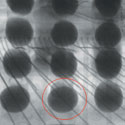
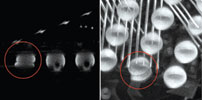
Figure 6. Cold solder – optical image.
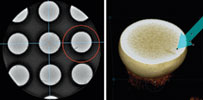
Micro cold-solder joints can also be visualised with 3D CT, as illustrated in Figures 6 and 7.
Figure 7. Cold solder – non-destructive 3D CT image.
4. Solder ball crack
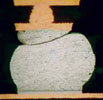
Using oblique CT technology, a solder ball crack can be visualised. Figure 8 shows a 10 micron solder ball crack.
Figure 8. Solder ball crack.
For more information contact Igmar Grewar, Quamba Technologies, +27 (0)83 417 4294, [email protected], www.quamba.co.za
Further reading:
Soldering day highlights
Manufacturing / Production Technology, Hardware & Services
JAPAN UNIX has published a new event report and highlight video from their UNIX SOLDERING DAY 2026 in Hungary. This event reflects on their commitment to supporting manufacturers not only through soldering automation systems, but also through technical education, live demonstrations, hands-on training, and practical engineering know-how.
Read more...
Clearing the Static: Electrostatic Discharge
Actum
Manufacturing / Production Technology, Hardware & Services
A cordless ESD (Electrostatic Discharge) wrist strap does not work by grounding the person in the same way as a traditional wired wrist strap. Instead, it works by reducing or balancing the static charge on your body so that you are less likely to discharge electricity into sensitive electronic components.
Read more...
Engineering trust in South Africa’s SMT sector
ZETECH ONE
Manufacturing / Production Technology, Hardware & Services
From a small Johannesburg start-up to a trusted SMT technology partner, Zetech One has spent four decades helping South African electronics manufacturers improve production quality, efficiency and reliability.
Read more...
The new reality of PCB material supply
Jemstech
Editor's Choice Manufacturing / Production Technology, Hardware & Services
How resilient manufacturing strategies are helping OEMs navigate a changing global supply chain.
Read more...
Streamlining Device Programming with the AutoBee-D1
Vepac Electronics
Manufacturing / Production Technology, Hardware & Services
The AutoBee-D1 desktop automated programmer is designed to simplify the programming of devices, while delivering consistent accuracy, high throughput and reduced manual intervention.
Read more...
Zero PFAS die attach paste
Testerion
Manufacturing / Production Technology, Hardware & Services
With silver price volatility increasing and sustainability requirements accelerating across semiconductor assembly, MacDermid Alpha Electronics Solutions introduces ATROX CD 560-1, a zero per- and polyfluoroalkyl substance (PFAS) alternate silver filler die attach paste.
Read more...
Precision jet printing for advanced PCB designs
MyKay Tronics
Manufacturing / Production Technology, Hardware & Services
Mycronic’s BA 01 small dot ejector delivers unmatched precision in solder paste jet printing for advanced PCB designs.
Read more...
Strengthening local electronics manufacturing through investment and innovation
Microtronix Manufacturing
Editor's Choice Manufacturing / Production Technology, Hardware & Services
Microtronix South Africa cements its commitment to local manufacturing with ongoing investments in production capacity, skills development, and job creation.
Read more...
Polypropylene pole-top boxes support smarter, more secure electricity networks
Manufacturing / Production Technology, Hardware & Services Enclosures, Racks, Cabinets & Panel Products
As South Africa accelerates the rollout of smart prepaid electricity metering, innovative enclosure technology from Power Process Systems (PPS) is helping utilities improve network security, reduce electricity theft and protect critical electrical infrastructure.
Read more...
200 W of power in a space-saving design
Vepac Electronics
Manufacturing / Production Technology, Hardware & Services
The Hakko FX-972 Soldering Station delivers high-performance soldering in a compact package, making it suitable for a wide range of soldering applications.
Read more...









 printer friendly version