


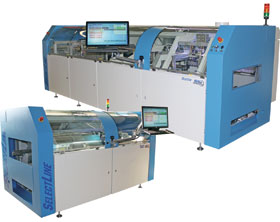
With the SelectLine, SEHO has developed a selective soldering system featuring miniwave processes.
Its design provides high precision and solder joint quality, as well as a high degree of flexibility since no changeover is required to dynamically process a variety of assemblies with short cycle times. This flexibility is underlined by the modular machine concept: fluxer, various preheat modules and soldering modules may be equipped individually and, depending on requirements, can be configured to a complete manufacturing line.
Selective soldering systems from SEHO are equipped with a micro drop jet fluxer that maximises precision while minimising flux consumption. Up to three nozzle heads that are installed on the high-precision XY axis system ensure defined flux application in the smallest areas. Therefore, throughput can be increased significantly when processing panels. As an alternative, two different flux types that are controlled via software can be used simultaneously.
The preheat area of the SelectLine can be configured individually by length and type, and uses quartz heating elements that can be activated individually to ensure an effective heat transfer to the PCB’s bottom side, with high energy efficiency. If needed, additional infrared heaters can be installed for topside heating. Controlled via the software, both preheating systems are matched to guarantee reproducible temperature profiles.
In case of processing high mass assemblies, the preheat module may also be equipped with convection heating, ensuring complete and effective heat transfer with homogeneous temperature distribution within the preheat zone. To keep assemblies at the same temperature level during long soldering cycles, topside heating may also be integrated in the soldering area. Of course, all heating circuits can be monitored and a touchless pyrometer can be installed for precise control of the preheat temperature profile.
The system’s electromagnetic soldering unit boasts exceptionally stable and precise wave height and employs a dual solder pot concept called Twin-Select, whereby two electromagnetic soldering units are installed on separate Z axes and can be programmed independently. This permanently provides two different solder alloys, eliminating changeover times.
Additionally, the Twin-Select concept can reduce cycle times substantially if the soldering units are equipped with solder nozzles that have different diameters. Connectors, for example, can be soldered in one pass using a larger solder nozzle while fine structures on the same assembly are soldered with a small solder nozzle.
Typically, to increase production volume, additional soldering modules need to be added, or the machine has to be equipped with a dual conveyor to allow parallel processing of boards. These measures, of course, result in large investments in equipment. To mitigate this, SEHO has patented the intelligent Synchro software feature that coordinates the soldering process for two PCBs in such a way that the total throughput is nearly doubled without the need for significant investment.
The same soldering program is loaded for both soldering units synchronously, working in an infinite loop. The assemblies can enter the soldering area independently and are not linked to the same cycle. In this way, cycle times can be reduced by nearly 50%. Soiled solder nozzles are known to drastically affect the reproducibility of soldering processes. SelectLine gets around this with automatic ultrasonic cleaning for wetted miniwave solder nozzles.
Automatic Z-height correction recognises warped assemblies caused by previous thermal or mechanical load, and automatically calculates correct Z values for all points of the soldering program. Flux quantity control guarantees flux deposition with utmost precision and is exactly dosed, and in the preheat area a touchless pyrometer control as well as monitoring of all heating circuits ensure reproducible temperature profiles.
Another innovation from SEHO is the machine communication software mcServer. The selective soldering process becomes transparent and can be traced completely. In addition, it also meets the requirements of Industry 4.0. This software feature allows comprehensive control of the soldering process with real-time access to all connected machines that are installed in different production sites worldwide. Additionally, it is possible to directly link to cameras that are integrated in a machine.
The mcServer software collects, analyses and archives all information about the machine and production processes using a straightforward user interface. With its specific serial number, the entire process for a single PCB can be traced. Production statistics, user statistics or AOI statistics can be generated as easily as comprehensive reports for documentation. Using appropriate interfaces, every machine can be integrated into nearly each specific MES/ERP system for superordinate control of the process.
For more information contact Igmar Grewar, Quamba Technologies, +27 (0)83 417 4294, [email protected], www.quamba.co.za






© Technews Publishing (Pty) Ltd | All Rights Reserved
 printer friendly version