


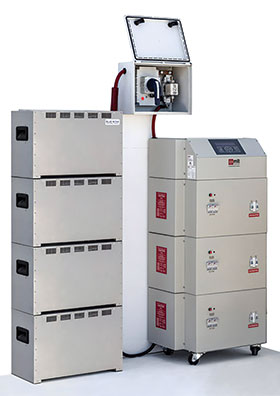
South African firm Reutech and newly formed BlueNova have launched a LiFeYPO4 (lithium iron yttrium phosphate) battery that hits the same price level as equivalent lead-acid batteries.
The collaboration sees Reutech providing volume production and distribution with BlueNova adding customised solutions to special projects with Reutech project execution assistance.
According to James Verster, ex-CEO of Reutech and now heading business development at Blue Nova, the continuously growing energy storage market in southern Africa is desperate to find batteries that can handle daily cycling requirements and high temperatures and that will last for more than 10 years.
Lithium-Ion batteries have proven to be the horse to back for these applications, but the problem up to now was the cost – which BlueNova is claiming to have tackled. “We intend to put the batteries in the user’s hand at below $550/kWh,” said Verster. “These batteries are guaranteed to last more than 10 years which translates into a fixed cost of energy storage of R2,50/kWh for the next ten years. This is unheard of in the world of lead-acid batteries where users pay more than R5/kWh (replaced once) over 10 years.”
Concerning safety issues, lithium-Ion technology for batteries has evolved over many years into cost effective variants now available for building solutions. “The LiFeYPO4 variant of Li-Ion batteries are the safest of them all and over the past 15 years of testing not a single case of an exploding cell has been recorded,” Verster stated. “They have been shot with nails and bullets, thrown into fires, torn open (crash simulation) and short circuited. Not once has a thermal runaway occurred.”
These LiFeYPO4 batteries have a usable energy storage capability of more than 100 Wh/kg which means they weigh less than 25% of the lead-acid equivalent. “It’s quite astounding when you see one guy carrying a 4 kWh LiFePO4 battery at 40 kg when he used to lug six 30 kg deep cycle lead acid batteries around to get the same performance and then having to replace those lead acid batteries every 2 to 3 years or so”, said Verster.
LiFeYPO4 batteries actually perform better at 40°C than at 25°C and will not degrade at high temperatures as is the case with lead-acid. When lead-acid batteries are charged by solar energy systems they sometimes do not get fully charged. This causes them to lose capacity and results in earlier replacements. There is no such problem with LiFeYPO4 batteries, according to Verster. “You can partially charge them for days and when you give them a full charge they will deliver full capacity every time,” he said.
“The LiFeYPO4 batteries have a charge and discharge efficiency of more than 95%. This means you only lose 5% of the energy when you cycle the battery. Lead-acid batteries will lose 20% to 30% more energy in heat than LiFeYPO4 batteries which implies you need more solar panels or diesel or electricity to charge the lead-acid battery for the same energy delivered to the load. When optimising your power sources this will result in major savings.”
The batteries do not leak, they do not give off any gas, they do not have to be refilled and they require zero maintenance for the life of the battery. No sulphation occurs when the batteries are not cycled and a self-discharge rate of <2% per month means the batteries can be stored for years without having to recharge them. They are 100% environmentally friendly and can be completely recycled when disposed of.
The BlueNova LiFeYPO4-based energy storage solutions come with an integrated Battery Management System (BMS) which protects the batteries from abuse. The BMS will prevent over-charging and over-discharging and it will limit the maximum current going into and out of the battery. The BMS offers a Bluetooth interface to a smartphone which allows the user to see performance parameters and the state of charge of the battery. The larger versions of the LiFeYPO4 solutions are fitted with a serial interface that allows the inverter / charger to communicate with the battery.
BlueNova designs storage solutions with LiFeYPO4 cells that range from 40 Ah to 10 000 Ah. There are more than 10 different sizes in the range which allow for the provision of energy storage solutions from 3 kWh to 8 MWh. Solutions range from 12 V to 800 V d.c. and specifically focus on replacing lead-acid batteries in southern Africa.
“We see a big need for these storage solutions in residential, industrial and even utility scale applications”, Verster explained. “Solutions have been supplied and tested at Reutech facilities already and multiple enquiries are currently being processed.”
Verster reckons that LiFeYPO4 batteries will take over from lead-acid like LED lights took over from old, low-efficiency incandescent light bulbs. “We’ve reached the tipping point and soon most lead-acid batteries will be replaced with this very exiting alternative technology,” he concluded.
For more information contact James Verster, BlueNova, +27 (0)21 777 7172, jamesv@bluenova.co.za.






© Technews Publishing (Pty) Ltd | All Rights Reserved
 printer friendly version