


Today’s ‘always connected’ world demands reliable, high-performance, energy efficient wireless connectivity. RF communication is essential for the successful operation of mobile and cordless phones, tablets, gaming consoles and set-top boxes. In the automotive arena wireless plays a role in everything from tyre pressure monitoring and remote entry to navigation and infotainment. And RF communications play a pivotal role in the control of multicopters (drones), thus ensuring safe operation.
The key to successfully addressing the requirements of these applications lies in selecting the most appropriate RF components. This article outlines the growing demand for RF communications, looks at factors to consider when specifying discrete components such as transistors and diodes, and introduces technologies that help engineers to implement stable, robust and reliable communications in their designs.

Discrete RF – the heart of wireless connectivity
It has been estimated that over 50 billion devices will be connected by 2020. Data traffic is at an all-time high, driven by personal communications and the machine-to-machine communications of the Internet of Things (IoT). Data volumes continue to grow rapidly as wireless data rates reach 1 Gbps, with video and data streaming becoming more prevalent.
As we become more reliant on wireless, we also become more demanding regarding performance and system availability – network stability and reliability are crucial. With an estimated market size of 345 million Euros, discrete RF components are fundamental to delivering the stable and reliable communications that are at the heart of applications in the consumer, industrial, communications and automotive sectors.
Among the most essential RF discretes are PIN diodes, Schottky diodes and RF transistors. When selecting these devices engineers need to consider a variety of criteria such as performance, system sensitivity, interference immunity and efficiency. While component performance certainly plays an important role, so do size and versatility. As end products get smaller, the availability of high-performance devices in a variety of package types is key. This allows designers to achieve the required design in the all-too-small space available.
Quality and reliability of components are also important selection criteria, especially in applications that are expected to operate continually outdoors or in the harsh conditions found in factories or vehicles.
PIN diodes
PIN diodes are similar to conventional diodes, but they have an intrinsic layer between the PN layers. This non-doped region increases the separation and reduces the capacitance – especially when compared with a conventional diode – bringing significant advantages in RF switching applications.
PIN diodes can be used in areas such as power and high voltage, and are commonly found in RF designs. When forward biased, the PIN diode behaves like a resistor, and when reverse biased it becomes an open circuit. These unique properties allow PIN diodes to be used as a variable resistor in variable attenuators or as an RF switch. PIN diodes are also implemented in RF protection circuitry.
PIN-diode switches are found in mobile applications (consumer handset and base stations) as well as WLAN devices, set-top boxes and automotive entertainment systems. When used as an attenuator, they are most commonly found in automotive infotainment applications.
When specifying PIN diodes, one of the primary considerations is the insertion loss, which is proportional to RF, the forward series resistance. RF is usually specified in milliwatts for a given bias current and, ideally, RF should be as low as possible. As always, however, there is a trade-off. In this case, as RF decreases, so the capacitance CT increases. A low value of CT is a significant determining factor in the broadband isolation properties of a PIN diode.
To ensure signal integrity, the linearity of the PIN diode is an important parameter in many applications – as is the switching time – especially where a fast switching time is needed for combined RX-TX antenna circuits.
Given the space constraints in today’s applications, designers will look for suppliers that offer a wide variety of package types, allowing choice where the PCB layout is constrained. Condensed packaging can be further achieved by packaging multiple PIN diodes in a common package.
Schottky diodes
Schottky diodes are characterised by a low forward voltage drop of around 0,2 V and their fast switching speed. The low voltage drop makes them popular in power applications as well as RF, while the fast switching speed brings significant benefits over conventional PN diodes in RF applications. Schottky diodes are commonly used in detector circuits, especially in mobile handsets, WLAN devices and base stations. They are also used as mixing elements in set-top boxes and other similar applications.
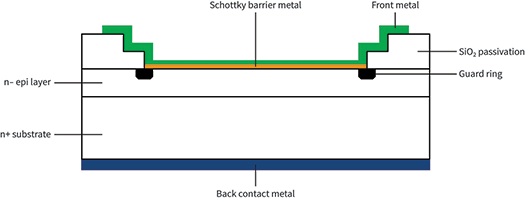
Schottky diodes are low barrier N-type silicon devices and consist of a deposited metal layer on N-type material. However, breakdown and leakage effects can occur due to the strong electric fields at the edges of the metallised area. These issues can be overcome by diffusing a guard ring of P+ semiconductor along with an oxide layer around the edge of the plate.
When specifying Schottky diodes the leakage current is a primary consideration. This is proportional to the forward resistance RF. The overall efficiency of the diode is important, especially in portable devices where battery power is at a premium. Designers should also pay close attention to the signal distortion and linearity of the diode to ensure that signals are reproduced faithfully.
RF transistors
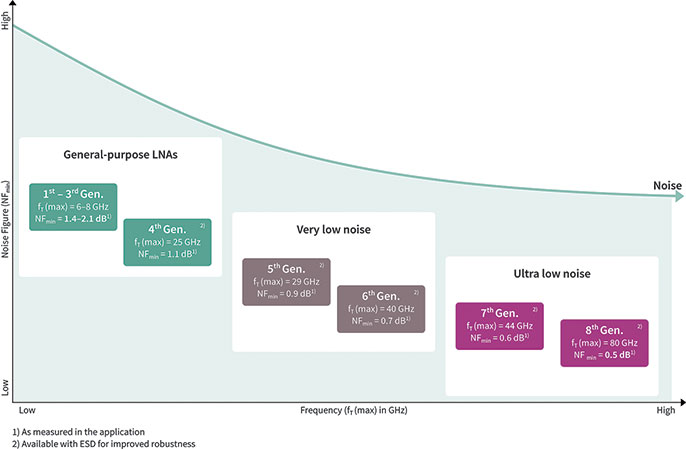
Heterojunction bipolar transistors (HBT) feature performance parameters that make them ideal for use as single- and dual-band low noise amplifiers (LNA) in RF applications. They are typically classified as low frequency (<5 GHz) and medium frequency (up to 14 GHz).
LNAs are widely used in RF applications and, as such, RF transistors are found in satellite communications, navigation systems, mobile and fixed connectivity (e.g. WiMAX) and Wi-Fi systems. They are also fundamental to the remote control of multicopters.
When specifying RF transistors there are a number of areas to consider. As the fundamental role of an RF transistor is to amplify signals, the gain (Gmax) of the device is crucial. Device efficiency is also likely to be important, especially in battery-powered applications.
The noise figure (NF) is a crucial parameter – this characterises the degradation in signal to noise ratio (SNR) of a practical amplifier compared to a theoretically perfect (lossless and noiseless) amplifier. NF is simply the ratio of SNR at the input of the amplifier to the SNR at the output.
The fundamental semiconductor technology will have a significant impact on the overall suitability for a given application. Silicon germanium (SiGe), for example, offers a number of benefits over GaAs alternatives, including better efficiency due to a lower VCE and, in general, SiGe devices have better noise figures.
Compared to SiGe devices SiGe:C (silicon germanium carbide) bipolar devices show similar excellent noise and linearity performance, with the additional benefit that ESD protection can be integrated directly into the transistor, thereby significantly increasing device robustness.
‘State-of-the-art’ RF discrete
Infineon’s family of RF discretes for complementary wireless designs has some good examples of how these technologies have evolved in recent years. In the case of PIN diodes, for example, the BA592 achieves an insertion loss (RF) of 360 mW while the BAR63 boasts a 0,23 pF value for CT. If space is critical in an application, then the BAR90 is available as a quad pack in an ultra-miniature TSSLP8 package. The performance of Infineon’s PIN diode range makes them an ideal choice for antenna switching applications, while their AEC qualification also assures suitability for demanding automotive applications.
When it comes to Schottky diodes, multiple in-package configurations are available including common anode or cathode, as well as series and parallel configurations. The BAT15 series offers a number of configurations, including dual and quad options, with a CT of 0,26 pF making it ideal for mixer applications. For the ultimate performance, the BAT24 boasts a CT of just 0,21 pF and is suitable for use in radar systems up to 24 GHz.
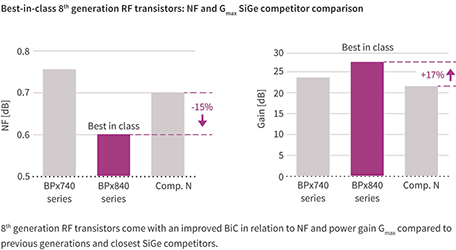
Finally, Infineon’s RF transistor technology – which is now in its 8th generation – is designed to deliver key performance values such as low noise and high linearity throughout the range. Key features of this generation include a high transition frequency (fT) of 80 GHz and low power consumption due to the ability to work with supply voltages as low as 1,2 V.
One of the leading HBT devices is the BFx84x series, which is considered ‘best-in-class’ among discrete RF LNAs. Offering a noise factor of 0,85 dB (at 5,5 GHz) with gain up to 23 dB, this device outperforms many other devices on the market due to a special device geometry. In common with all of Infineon’s SiGe:C RF transistors, the BFx84x offers built-in ESD protection up to 1,5 kV (HBM).
For more information contact Davis Moodley, Infineon Technologies, +27 (0)11 706 6099, davis-moodley.external@infineon.com, www.infineon.com
| Tel: | +44 117 9528 843 |
| Email: | swarna.balupalle@infineon.com |
| www: | www.infineon.com |
| Articles: | More information and articles about Infineon Technologies UK |






© Technews Publishing (Pty) Ltd | All Rights Reserved
 printer friendly version