


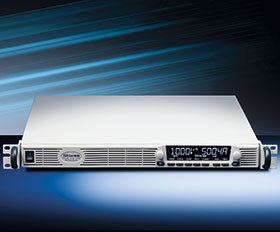
TDK announced the introduction of the TDK-Lambda Genesys+ series of high power density programmable DC power supplies; the 5 kW, 1U model is the first in the series. Utilising digital signal processing technology, these units address a very broad market, including component, aerospace and automotive testing, semiconductor fabrication, water treatment, plating and solar array simulation.
Housed in a 19” (483 mm) wide rack package, the 5 kW model offers high power density and weighs less than 7 kg. Five voltage models are available initially: 0-10 V/ 500 A, 0-20 V/ 250 A, 0-30 V/ 170 A, 0-300 V/ 17 A and 0-600 V/ 8,5 A.
The units can operate in constant current, constant voltage or constant power modes and offer internal resistance simulation. They can accept three-phase 170 to 265 V a.c., 342 to 460 V a.c. or wide range 342 to 528 V a.c. inputs, with active power factor correction. Operating efficiencies are up to 93%.
In addition to doubling the power density over the existing Genesys 5 kW 2U series, the Genesys+ offers many other advancements. These include a high contrast, wide viewing angle LCD display with user controllable brightness and dimming functions for improved readability and display life. Faster up and down programming response times speed up operation with user adjustable voltage and current slew rate control.
Two user programmable output control pins (open drain) are available to activate external devices, such as load disconnect relays. Arbitrary waveform profiles, such as car battery simulation at vehicle startup, of up to 100 steps can be generated. These are stored in four memory cells and activated by commands from the communication ports or the front panel controls.
A new advanced parallel master/slave system, unique to TDK-Lambda, allows a multi PSU system to achieve dynamic response and ripple and noise performance comparable to that of a single power supply. Up to four Genesys+ units can be connected in parallel very simply by connecting a single data link cable between units and connecting the DC outputs in parallel. The master and slave units auto configure by detecting the parallel data connection and set their parameters accordingly. The master unit becomes the single point for programming, measurement and status of the total current of the paralleled system.
The new series is compatible with both the TDK-Lambda Genesys and Z+ models, using the same communication protocols and signals. All functions can be programmed via the front panel or remotely using the LAN (LXI 1.5), USB 2.0 or RS-232/485 communications interfaces, which are provided as standard (SCPI compliant). An isolated analog control and monitoring interface (0-5 V or 0-10 V scale) is also provided, and an optional GPIB (IEEE488) is available.
The Genesys+ design incorporates the Anybus CompactCom interface platform to enable various interface options as they are introduced, e.g. Devicenet, Ethercat, Modbus and Profibus. A full package of software drivers, waveform creator and virtual front panel GUI is provided.
Safety features include safe/auto restart and last setting memory, and built-in protective functions such as over-voltage protection, under-voltage, fold-back protection and over-temperature protection. The series conforms to the industrial environment IEC/EN61326-1 standard for conducted EMI, radiated EMI and EMC immunity.
For more information contact Tobie Muller, Accutronics, +27 (0)11 782 8728, tmuller@accutronics.co.za, www.accutronics.co.za
| Tel: | +27 11 782 8728 |
| Email: | info@accutronics.co.za |
| www: | www.accutronics.co.za |
| Articles: | More information and articles about Accutronics |






© Technews Publishing (Pty) Ltd | All Rights Reserved
 printer friendly version