


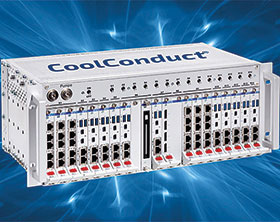
EKF has developed an advanced new liquid cooling system for high-performance computers in the field of autonomous driving and robotics.
The CoolConduct system has three main features: firstly, standard assemblies can be coupled to the cooling technology integrated in the subracks using a special patent-pending technology. This relates to 3 U and 6 U modules of all bus systems, e.g. CPCI-S, VPX, cPCI including EN50155.
Secondly, the new thermal contact technology allows components to be exchanged individually in the field, without special tooling and without dismantling the subrack. And thirdly, the system costs half as much or less compared to conventional technologies, according to EKF.
The hunger for computing power increases year by year with modern applications. Test vehicles in the area of autonomous driving, surveying, cartography, roadway inspection from a moving vehicle or predictive maintenance under adverse conditions require multi-core CPU systems of the current Core i7 class. These systems typically use various high-performance graphics cards for the visualisation of test results as well as fast data storage of raw data, pre-processing results and events.
In such systems, thermal power losses in the range of several hundred watts can occur easily, in extreme cases even the kilowatt limit can be exceeded. If these systems need to be encapsulated due to the environmental conditions (oil drilling platform, refinery) or if several such systems have to share a narrow installation space, the thermal planning of the waste heat is essential.
The CoolConduct system, developed to maturity in cooperation with a German specialist of industrial liquid cooling systems, is based on three coordinated components: The primary heat exchanger is integrated into the subrack. Filled with a coolant, it is the basis of conduction for the components that need to be cooled.
Connected to the subrack is a unit containing the coolant pumps and a coolant reservoir; this can be placed several metres away. Connection of the flexible coolant hoses is by means of blow-back proof bayonet couplings, enabling connection and disconnection in the field without loss of coolant.
Connected to the cooling pump is the secondary cooling circuit with a further heat exchanger, which cools the coolant in the outside area. By means of these two cooling circuits, the system can be operated and cooled independently of the immediate ambient air. Above all, there is no contamination of the subrack caused by the cooling. The entire system monitors itself, and errors are alerted.
The patented innovation is the way in which the modules are connected to the primary heat exchanger in the subrack. The technology used previously utilised so-called wedge locks, which were used mainly in the military field and required specially designed boards that were not always state-of-the-art. In the case of EKF technology, the inverse, three-dimensional image of the assembly side of a COTS board is milled into a copper block, which is connected to the primary heat exchanger with high thermal efficiency by means of a novel contact technology. This means that the modules can be plugged into the subrack or can be removed from it in the field, at any time, without a need for special tools and without having to disassemble the subrack.
| Tel: | +27 21 975 8894 |
| Email: | [email protected] |
| www: | www.ri-tech.co.za |
| Articles: | More information and articles about Rugged Interconnect Technologies |






© Technews Publishing (Pty) Ltd | All Rights Reserved
 printer friendly version