


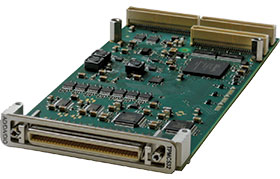
TEWS released a new standard single-wide PCI Mezzanine Card (PMC) compatible module designed for industrial, COTS and transportation applications.
The TPMC532 provides 16 or 8 channels of simultaneous sampling, true differential bipolar 16-bit analog input, 8 or 4 channels of simultaneous update single-ended unipolar/bipolar 16-bit analog output and 14 channels of tri-state 5 V tolerant TTL digital input/output. All signals are accessible through a Mini D Ribbon (MDR68) type front I/O connector. The PMC connectors P11 and P12 provide access to the control logic via a 32-bit, 33 MHz PCI link.
The ADCs offer true differential inputs with software selectable ±5 V and ±10 V bipolar; the maximum sample rate of the ADCs is 200 KSps and they offer an oversampling capability with a digital filter. The DACs offer software selectable 0-5 V, 0-10 V, 0-10,8 V, ±5 V, ±10 V and ±10,8 V output voltage ranges (individual setting for each of the four channels of each DAC). The settling time is typically 10 μs and the DAC channels are able to drive a load of 2 kΩ, with a capacitance up to 4000 pF.
Each TPMC532 is factory calibrated. The correction data is stored in an on-board serial EEPROM unique to each PMC module. These correction values can be used to perform a hardware correction of every analog-to-digital and digital-to-analog conversion. Additionally, a temperature sensor on-board can be used to compensate temperature-dependent errors.
The board provides two sequencers, one for A/D conversions and another one for D/A conversions. To perform periodic simultaneous conversions the conversion rates are programmable and can be output to other modules on PMC back I/O connector P14 or front I/O connector DIO pins for synchronisation purposes. The TPMC532 can also operate as a target which means that the conversion rates can be sourced from P14 or front I/O, created by another module.
A frame trigger signal, which can also either be generated by the TPMC532 and output on P14/front I/O or generated by other modules and input from P14/front I/O, can be used to synchronise ADC frames and DAC frames. The signals on PMC back I/O connector P14 are ESD protected and driven or read by tri-state 5 V tolerant TTL buffers.
The TPMC532 provides input and output FIFOs to be able to collect ADC frames and to output DAC frames. Data transfer on the PCI bus is handled by TPMC532 initiated block transfer mode DMA cycles with minimum host/CPU intervention.
The 14 digital TTL tri-state I/O lines with 4,7 kΩ pull resistors are ESD protected. The voltage the pull-up resistors are connected to is programmable by software and can be 3,3 V, 5 V, GND or floating level (one common setting for all 14 digital I/Os).
All 14 DIOs can be programmed to have their digital I/O transmitters enabled or disabled individually per I/O line. The digital I/O receivers are always enabled, so each DIO level can always be monitored and can generate an interrupt triggered on rising edge, on falling edge or both. Additionally, a debounce filter can be configured to eliminate bounce on the digital I/O lines.
The TPMC532 operates from -40°C to +85°C. In order to support long term programs, the TEWS modules have a 5 year warranty. Extensive software support for major operating systems such as Windows, Linux, VxWorks, Integrity and QNX is available.
| Tel: | +27 21 975 8894 |
| Email: | sales@ri-tech.co.za |
| www: | www.ri-tech.co.za |
| Articles: | More information and articles about Rugged Interconnect Technologies |






© Technews Publishing (Pty) Ltd | All Rights Reserved
 printer friendly version