


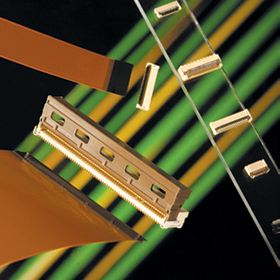
Connector miniaturisation has enabled device manufacturers to respond to consumer demand with products that aggregate processing power, space and weight savings in lightweight and robust devices which are able to operate all day, while being small enough to fit in a shirt pocket.
Users have come to expect thinner cellphones and lighter laptops and tablets that can be easily stowed and retrieved. Demand remains high for portable devices with ever faster processing speeds and longer battery life, at comparable price points to earlier product iterations. Smartphone and other maturing mobile device markets are trending toward feature-rich offerings. As tablets and mini-tablets, or e-readers, proliferate, the mantra ‘smaller is always better’ can no longer be taken for granted.
Commensurate with an upsurge in online video viewing, manufacturers are offering more products with larger screens to provide users with higher-quality viewing experiences. Often featuring vibrant 7” screens, these hybrid devices serve multiple purposes – communications, web surfing and entertainment.
Likewise, in the digital camera sector, point-and-shoot cameras have essentially reached a plateau in terms of size reduction, with most now featuring screens in the 3,5” range. Consumers, who have a wide choice of pocket-sized cameras from which to choose, are shifting focus to value-added features, such as auto flash and zoom.
Reaching mechanical limits of traditional connector technologies
A continual stream of lower-profile and higher-density connector technologies has fuelled the downsizing demands of electronic equipment makers. Connector miniaturisation is all about optimising the value of printed circuit board (PCB) real estate to achieve the densest signal concentration.
However, a number of barriers exist to the continual downsizing of connectors. Terminal thickness is the major barrier to processing. When terminal thickness drops into the 0,10 mm range (0,15 – 0,2 mm when adhered to plastic casing), the connector terminal density can become too tightly packaged, resulting in electrical shorts. Reeling, slicing and other manufacturing issues emerge, and product integrity and electrical signals can deteriorate.
Finished connectors must be robust enough to be board-mounted, soldered and assembled, and to withstand a 1 metre drop test, without loss of mechanical or operational integrity within a millisecond.
In terms of size reduction, traditional connector technologies are reaching a point of diminished returns. Higher alloy metals can yield a stronger connection and produce more current, but require better thermal dissipation strategies. With markets expanding for connectors with very fine pitch and low mated height, the challenge will be to sustain the performance and longevity characteristics that manufacturers and consumers have come to expect.
MEMS technology and FPC connectors
Available in pitches down to 0,2 mm, flexible printed circuit (FPC) connectors are the smallest on the market today. A variety of these exist to meet a range of space and application specifications.
Various fine-pitch FPC options include push- and flip-type actuators, with pre-assembled covers that secure the connection between the FPC and connector terminals. Other features include dual contacts, narrow width versions for further space savings and various cable tab and actuator locking styles to provide additional cable alignment options and retention.
Depending on the application, a higher-profile connector housing design can enable components to be placed under the FPC for added design flexibility and additional PCB space savings. In the 0,25 – 1,0 mm connector pitch ranges, microminiature FPC connectors offer a combination of compact depth, height and length for space savings. Even at these sizes, the connectors deliver secure PCB retention and strain relief, while allowing for repeat cycling with minimum wear.
New capabilities in micro-electromechanical systems (MEMS) technology can enable ultra-low-profile connectors that combine signal and power into one compact connector, while providing cost savings and quality integrity. MEMS manufacturing technology utilises precision etching and masking techniques to create contacts and housings.
Along with enabling extremely low profiles, this technology minimises tooling costs as it requires only a single mask, versus multiple moulds and dies. In consumer electronic and other applications, MEMS connectors include FPC-to-board, board-to-board and camera module applications. FPC-to-battery and other module solutions can provide additional space savings in mobile devices.
Competing technologies include anisotropic conductive film (ACF), which essentially amounts to gluing components like FPC connectors and cables onto surfaces such as LCD screens. The disadvantage of this is its imprecision and single-mating capability – if mating damage occurs, the screen or other costly end unit components must be replaced.
MEMS technology also provides lower insertion force, improved solder joint strength and more pliable FPC for easier insertion and extraction. Furthermore, MEMS solutions eliminate the one-time mating limitation which applies to existing ACF bonding sol-utions.
Markets for very fine-pitch connectors
In higher-volume applications, MEMS provides a cost-effective manufacturing process for saving space and increasing current without sacrificing performance. Prospective markets for very fine-pitch, sub-micron (<100 micrometre) micro-etch, laser-processed or semiconductor/MEMS (micro electromechanical systems) connectors include a range of medical devices, IC packaging and ultra-mobile systems, in addition to automotive airbag accelerometers, positioning and other sensors. Within consumer device markets, the potential exists for MEMS to take a more dominant position.
As connector technologies advance, enabling smaller component sizes, demands rise on flexible cable manufacturers tasked with developing electrical traces for tight circuit connections. The limitations are in metal stamping processes and forming of contacts used in connector manufacturing.
Neither connector nor cable manufacturing processes have yet to bridge the technological gap to sub-micro-miniature circuits. Industry is well on its way, though, with refinements to FPC and the MEMS process, with the potential for optical connectors to take a more prominent role as their price point drops.
For more information contact Roger Young, Molex, +27 (0)72 327 1012, [email protected], www.molex.com






© Technews Publishing (Pty) Ltd | All Rights Reserved
 printer friendly version