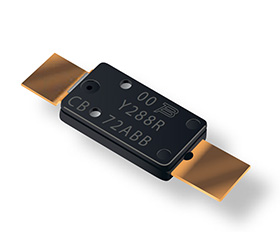
A new addition from Bourns is the Model CB series of miniature resettable thermal cutoff (TCO) devices. These are the smallest TCO devices Bourns has produced and represent the company’s next generation of axial leaded miniature resettable thermal cutoff devices.
The new CB series follows the successful NR series; it is about 26,5 % smaller than the NR series and 64,8 % smaller than the HC Series, yet it does not compromise current carrying capability. With resistance levels as low as 2,2 mΩ, the CB series can carry the same level of current as its larger counterparts in the HC and NR Series.
The CB series is available in four trip temperature options of 72°C, 77°C, 82°C and 85°C with a ±5°C tolerance. This can be further narrowed upon request. It has current capabilities from 6 A up to 11 A at 60°C and a welding projection option. The very low-profile height of 0,8 mm and body width of 2,5 mm make this series ideal for smaller batteries in smartphones and portable electronics, yet its high current carrying capability means it will be suitable for next-generation notebook PC and tablet battery cells.
EMC limits and levels Altron Arrow
Editor's Choice Circuit & System Protection
As soon as electronics and electrical systems started interfering with each other, the world had to come to some consensus. Considering physics is universal and does not care about what country electrical/electronic products are used in, it should be the same everywhere, right? It is nearly there, but not quite.
Read more...Non-contact linear position sensor Electrocomp
Test & Measurement
The Vishay 40 LHE Linear Position Sensor, designed for industrial motion control and automation, delivers robust, non-contact measurement performance using Hall effect technology.
Read more...Safety relay for explosive areas IOT Electronics
Circuit & System Protection
Phoenix Contact has expanded its safety portfolio with the new PSR-MC35-EXI safety relay module, specifically engineered for use in potentially explosive environments.
Read more...Compact 1250 V choke solution Electrocomp
Passive Components
TDK Corporation has introduced a new high-voltage common-mode choke series designed to support more compact and efficient 1250 V DC converter architectures in next-generation power electronics.
Read more...Clearing the Static: Ensuring effective ESD control Actum
Circuit & System Protection
To maintain reliable electrostatic discharge control, regular testing and accurate measurement are essential, with grounding products and ESD testing equipment being vital.
Read more...Clearing the Static: The importance of ESD audits Actum
Circuit & System Protection
An ESD audit is the first step in establishing an effective static control programme in the workplace, and will help identify vulnerable areas and potentially hazardous static zones that require improvement.
Read more...EMI shielding materials application guide
Circuit & System Protection
TE Connectivity’s shielding solutions include electrically conductive elastomers, gaskets, knitted wire mesh, oriented wire, EMI shielding ventilation panels, shielded window, cable shielding and shielding components.
Read more...Clearing the Static: ESD containers and packaging Actum
Circuit & System Protection Vacuum forming ESD
Electronic components can be damaged by electrostatic discharges. To protect against such damage, electronic assembly parts are often transported or stored in vacuum formed component ...
Read more...Electrostatic discharge chairs Actum
Circuit & System Protection
An ESD chair forms an integral part of grounding within the electrostatic discharge protected area to prevent potential damage to products.
While every effort has been made to ensure the accuracy of the information contained herein, the publisher and its agents cannot be held responsible for any errors contained, or any loss incurred as a result. Articles published do not necessarily reflect the views of the publishers. The editor reserves the right to alter or cut copy. Articles submitted are deemed to have been cleared for publication. Advertisements and company contact details are published as provided by the advertiser. Technews Publishing (Pty) Ltd cannot be held responsible for the accuracy or veracity of supplied material.









 printer friendly version