


Shurlok (part of the JSE-listed Control Instruments Group) has, over recent years, carved a niche for itself in the manufacture of electronic modules and components for some of the world’s leading motor vehicle manufacturers.
These include prestigious brands such as BMW, Daimler Chrysler, Lotus, Bentley, and many more. Today, Shurlok is by far the largest local manufacturer of automotive electronics and in recent years acquired two competitors in the form of Dupec Electronics and the automotive division of Conlog. In order to meet the requirements of its customers, Shurlok has been certified to an impressive list of international standards, these including ISO 9000, QS 9000, VDA6, ISO 14001, ISO/TS 16949. In order to keep pace with its growth and the increased demands of the car manufacturers (such as defect rates below 50 parts per million) the company has invested significantly in a new production plant.
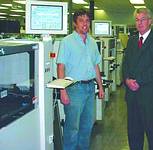
During last year, the need to move further in terms of high-tech production capability was identified, particularly initially to meet the requirement to produce a new critical module for BMW. Staff from Shurlok, under the guidance of technical support engineering manager, Martin Vermaak, visited Productronica 2003 in Munich to have a look at what equipment was available and to see it in operation. Following that, the company spent a significant amount of time looking at various options, before deciding that what local distributor Hawker Richardson had to offer, would place them in an even stronger competitive position and meet all their criteria for reliability, precision and local support. In rapid response to Shurlok's requirements, Hawker Richardson commissioned the full line during June this year.
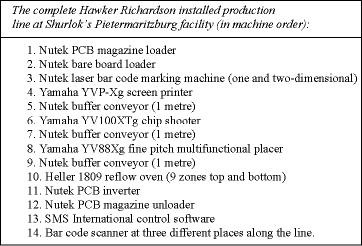
A complete breakdown of the multimillion rand plant installed is provided in the Table. In addition to this, Shurlok also acquired from Hawker Richardson two new Omron automatic testing machines which are located in a different area. They will be used for inspection of all types of boards. Some of the equipment installed possesses some very unique features, many of which are a first in the local electronic industry and some of the more significant attributes will now be considered. It is notable that this complete line is fully compliant with lead-free technology although this is not yet mandatory for automotive electronics.
The laser bar coding machine is the first in the country. Rather than applying labels which could later be removed, a laser is used to etch the bar code permanently onto the board itself. This ensures full traceability for that board throughout its lifetime using the control software also installed by Hawker Richardson. The bar coding system can apply both one and two dimensional bar codes, the smaller size of the latter being critical with densely populated PCBs.
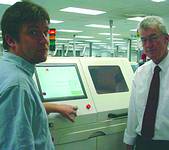
The Yamaha YVP-Xg screen printer is also the first in South Africa with a printing accuracy of ±25 µm and positioning repeatability of ±5 µm. It is a fully-configured 8-axis controlled screen printer and is fully automatic. Also included is a two dimensional solder paste inspection system while the machine incorporates automatic stencil cleaning with both chemical cleansing and vacuuming of the solder masks.
The Yamaha chip shooter is a single gantry system with two heads each having eight nozzles. This allows for eight nozzles to be picking up components while the other eight are doing the placement. The machine is also equipped with flying nozzle changing heads and incorporates digital video cameras. In full operation the chip shooter can place some 22 000 components per hour to the IPC 9850 specification. The machine offers ultra-high-speed mounting of 0,135 seconds per chip and can accommodate a wide range of components from 0201 to ±31 mm QFP with continuous all-ball recognition of CSP/BGA including judgement of flaws and defects.
On the other hand, the Yamaha YV88Xg is a two head system with six on-the-fly nozzle changers on each head. On both this and the YV100XTg, Yamaha's unique multiple accuracy compensation system (or MACS) is installed. This has been incorporated to make the machine usable with lead-free solder and to achieve the high accuracy required for 0201 components when mounted with a narrow interval. Typically an absolute accuracy of 30 µm before compensation can be reduced to in the order of 10 µm. MACS operates effectively even in the case where there is environmental changes in temperature (eg, day to night or morning to afternoon).
When it comes to the reflow oven, Heller is a world-renowned supplier and was the winner of the 2001 and 2002 Vision Award for Innovation as well as being the recipient of the 2003 Frost & Sullivan Award for Worldwide Market Leadership. The 1809 system was specifically designed to accommodate a reduced footprint saving floor space while providing the same throughput of larger systems. Also on board this oven is Heller's exclusive Generation 5.1 flux separation system which makes the machine fully ISO 14001 compliant as all the flux is removed from the exhaust. Generation 5.1 can be used in both air and nitrogen ovens and uses an innovative cooling technique to remove the flux. The Heller ovens are prepared to meet the lower DT and higher temperature requirements of the lead-free process. The oven responds in less than half a second to temperature changes of less than 0,1°C and uneven heating is minimised with temperature gradients of less than 2°C.
Nutek is renowned for its high quality PCB handling equipment. Its PCB inverter offers smooth inversion of the PCB with the option of a by-pass mode for single sided boards. The function of the inverter is to turn over the boards when placing of SMDs is required on the reverse side, and it accomplishes this task in less than 10 seconds. The Nutek bare board loader offers a large PCB stock of 170 pieces with a cycle time of 10 seconds. Suction is used to lift the PCBs and a high suction force is provided. Their automatic loader/unloader has a PCB feed time of a mere 6 seconds with magazine change over time of 30 seconds which with a special optional module can be reduced to 20 seconds. It accommodates two and three magazines respectively for the upper and lower conveyors. The Nutek conveyors are telescopic up to 1 m with easy width adjustment and a conveyor speed of 10 m/min offers a maximum cycle time of 20 seconds.
The SMS networked line control software (including Line Check, Line Reader and Line Viewer) used by Hawker Richardson is a third party product that was developed specifically for the local company by a New Zealand venture called SMS International. Besides being used in the Shurlok application it is also being used to run the multiple Yamaha installations around this country. The traceability provided gives the manufacturer total information about the specific PCB ranging from the operator on duty to the specific components used and their supplier.
While the line was specifically installed for a critical module for BMW, Yamaha feeder trolleys were also supplied. These allow for very quick turnaround on the job moving down the line and allow the manufacturer to change product throughput according to demand.
Hawker Richardson is also the sole distributor for a number of other companies, and has supplied systems to many of this country's leading electronic system manufacturers operating in various market niches.
Shurlok, through the installation of this state-of-the-art production line continues its outstanding record of being one of the highest quality manufacturers of electronic products. While electronic requirements for defence applications are often considered as more demanding than those for the automotive industry, the significantly higher volumes required with the latter demand the most sophisticated automated production and test equipment. The latest high-tech expansion in its production capability should see significant growth in the business of the Control Instrument's Group.






© Technews Publishing (Pty) Ltd | All Rights Reserved
 printer friendly version