


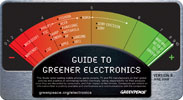
Greenpeace has released the latest issue of its ‘Guide to Greener Electronics’ report, which ranks global electronics manufacturers based on their environmental policies.
Criteria include the cleaning up of products by elimination of hazardous substances, responsible take-back and recycling of products upon obsolescence, and corporate policies and practices with respect to climate and energy.
With expanded and tougher criteria on toxic chemicals, electronic waste and new criteria on climate change, only Sony and Sony Ericsson score more than five out of 10 in the latest report. Nintendo and Microsoft remain rooted to the bottom of the rankings.
First launched in August 2006, the Guide is now on its 8th edition. It ranks the top market leaders of the mobile phone, computer, TV and games console markets according to their policies and practices on toxic chemicals and take-back. It has been a key driving force in getting many of the companies to make significant improvements to their environmental policies. New to this edition are criteria to assess the performance of electronics companies on tackling climate change.
Companies are scored on disclosure of their greenhouse gas emissions, commitment for absolute cuts in their own emissions and support for the mandatory global emission reductions that are needed to tackle climate change. On energy efficiency, a selection of each company's product range is assessed to see how far they exceed the current de-facto global standard, the US Environmental Protection Agency's Energy Star, which sets minimum standards for energy efficiency for many types of electronic products. The overall percentage of renewable energy in a company's total energy use is also assessed.
The information and communications technology (ICT) sector currently accounts for 2% of global greenhouse gas emissions, equal to the aviation industry. As one of the most innovative and fastest growing industries, the biggest electronics companies are expected to show leadership in tackling climate change by reducing both their direct and indirect climate change footprint.
Greenpeace's international toxics campaigner Iza Kruszewska noticed stark contrasts while compiling the Guide: "Electronics giants pay attention to environmental performance on certain issues, while ignoring others that are just as important. Philips, for example, scores well on chemicals and energy criteria, but scores a zero on e-waste since it has no global take-back polices."
Many companies score well on energy efficiency as their products comply and exceed Energy Star standards. The best performers on energy efficiency are Sony Ericsson and Apple, with all of their models meeting, and many exceeding, Energy Star requirements. Sony Ericsson stands out as the first company to score almost top marks on all of the chemicals criteria. With all new Sony Ericsson models being PVC free, the company has also met the new chemicals criterion in the ranking, having already banned antimony, beryllium and phthalates from models launched since January 2008.
Apple missed a big chance to advance its score by not improving the environmental performance of the new version of the iPhone.
Some companies that promote their 'green' policies come up short when measured against global standards of measuring impacts on climate change. Dell scores relatively poorly while Toshiba, Samsung and LGE score close to, or zero, on climate change criteria.
Real green leaders?
With most companies now scoring less than 5/10, only a company that rises to the challenge of phasing out toxic chemicals, increasing the recycling rate of e-waste, using recycled materials in new products and reducing their impact on climate change can seriously hope to make the claim of being green.
For more information visit www.greenpeace.org






© Technews Publishing (Pty) Ltd | All Rights Reserved
 printer friendly version