Teams build robots that walk like humans
9 March 2005
News
Three independent research teams have built walking robots that mimic humans in terms of their gait, energy-efficiency and control. The work, which is described in a recent issue of the journal, Science, could change the way humanoid robots are designed and controlled. It also has potential applications for robotic prostheses and it could aid scientists' understanding of the human motor system.
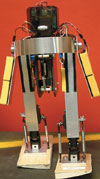
The MIT passive-dynamic powered robot. (Credit: Massachusetts Institute of Technology)
Developed at MIT, Cornell and Holland's Delft University of Technology, the three robots are all based on the same principle - they are an extension of several years of research into 'passive-dynamic walkers' that walk down a shallow slope without any motors. Passive-dynamic walkers were inspired by gravity-driven walking toys that have been around since the 1800s.
The control programs are said to be extremely simple, because a large portion of the control problem is solved in the mechanical design. The MIT robot uses customised learning software to exploit this, allowing the robot to teach itself to walk in less than 20 minutes, or about 600 steps. Dubbed 'Toddler' because it learns to walk and because it toddles when it does so, the robot "is one of the first walking robots to use a learning program, and it is the first to learn to walk without any prior information built into the controller," said Russ Tedrake, a postdoctoral associate at MIT's Department of Brain and Cognitive Sciences.
The robots are quite energy-efficient because energy is only used to push off. The walking robots move like humans, falling and catching themselves as they move forward. This essentially is the same movement people use - a motion toddlers must master to walk. Other robots needlessly use energy to absorb work, for example in moving the limbs forward more slowly than they would naturally swing under gravity power. With these new robots, the researchers simply substituted small motors for gravity power.
For more information see http://hebb.mit.edu/people/russt/robots/
Further reading:
From the editor's desk: Inspiring the next generation
Technews Publishing
News
Welcome to the August issue of
Dataweek. Peter Howells is still on leave, so I am back for this issue. I hope you enjoy the content and find value in it.
August is Women’s Month in South Africa,
...
Read more...
Procurement is becoming a competitive advantage
RS South Africa
News
As mining, manufacturing and industrial businesses continue to navigate rising costs, supply chain disruption and increasing pressure to improve operational performance, procurement and inventory management have become strategic business priorities rather than simply administrative functions.
Read more...
Powell Electronics signs partnership agreement with IOT Electronics
IOT Electronics
News
Powell Electronics has entered into a partnership agreement with IOT Electronics to strengthen its presence across southern Africa.
Read more...
Omniflex delivers ICCP systems across London
Omniflex Remote Monitoring Specialists
News
Omniflex has supplied impressed current cathodic protection (ICCP) systems for a range of prominent buildings across London, helping to protect reinforced concrete structures from corrosion and extending their service life.
Read more...
New appointments for Würth Electronics South Africa
Würth Electronics South Africa
News
New appointments for Würth Electronics South Africa
Read more...
MTN celebrates 80 Western Cape digital graduates
News
Eighty unemployed young people from across the Western Cape have successfully completed MTN South Africa’s Digital Skills for Digital Jobs (DS4DJ) programme, earning accredited qualifications in Data Analytics, Systems Development and Cybersecurity.
Read more...
GirlCode Hackathon 2026 kicks off across South Africa and Botswana
News
GirlCode, in partnership with Absa Group, Truecaller, MTN, SAP Fioneer, RS South Africa and other ecosystem partners, successfully hosted the first leg of the 2026 GirlCode Hackathon.
Read more...
Rooibos heads to space
News
A South African scientific initiative linking agriculture and space research has officially launched today with the Rooibos in Space programme at Parklands College’s Innovation Centre in Cape Town.
Read more...
From the editor's desk: Local can be international
Technews Publishing
Editor's Choice News
Welcome to the July 2026 issue of
Dataweek. As you can see from this introduction,
Dataweek’s regular editor, Peter Howells, is on extended leave and I am filling the void in his editor’s column – hopefully without being too boring.
Read more...
Landis+Gyr EMEA introduces new company name: EYKON
News
EYKON is the new company name of Landis+Gyr EMEA, formerly part of the Landis+Gyr Group. The company supports electricity, gas, water and thermal utilities in managing increasingly complex networks, improving operational efficiency and enabling more sustainable use of resources.
Read more...









 printer friendly version