MOSFETs have 'fast body diode characteristics'
23 April 2003
Power Electronics / Power Management
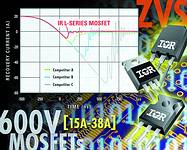
International Rectifier's new 600 V HEXFET power MOSFET family with fast body diode characteristics is tailored for soft switching applications such as the zero voltage switching (ZVS) circuits. ZVS is a technique used to maximise efficiency and enable higher power output in switch mode power supply (SMPS) circuits in today's high speed, broad bandwidth telecommunications and data communications systems where efficiency and reliability is of the greatest importance, says IR.
The fast body diode characteristic in the L Series HEXFET MOSFETs eliminates the need for additional Schottky and HV diodes in ZVS circuits. This reduces component count and the space required. The devices enhance system reliability since the internal body diode is active and carries current for a portion of the duty cycle, unlike bridge or power factor correction circuits where the devices are usually hard-switched. The turn on losses are virtually eliminated in ZVS power supply designs by turning-on the MOSFETs when its integral body diode is conducting. The maximum reverse recovery time for the L series devices is less than 250 ns, and even shorter for lower-current devices.
For more information contact Avnet Kopp, 011 809 6100, sales@avnet.co.za, www.avnet.co.za
Further reading:
High-precision current transducer
Power Electronics / Power Management
Danisense announces its new high-precision DP12IP current transducer designed for isolated DC and AC current measurement in demanding PCB-mounted power electronics applications.
Read more...
Secure holder for protected 18650 batteries
Power Electronics / Power Management
Designed for protected 18650 batteries up to 70 mm long, the holder offers secure retention for portable, industrial, and embedded applications.
Read more...
More room to scale
Altron Arrow
Power Electronics / Power Management
With the latest STM32H5 lines from STMicroelectronics, you can now scale within the same platform, from a compact 1 Mbyte device to higher-memory MCUs for graphics-rich and feature-heavy designs.
Read more...
Surface mount power amplifier for high-power applications
RF Design
Power Electronics / Power Management
The GNA-63-5W+, from Mini-Circuits, is a GaN MMIC Power Amplifier (PA) designed for demanding RF applications requiring high efficiency, excellent linearity, and a compact footprint.
Read more...
1200 V QSiC modules
Power Electronics / Power Management
SemiQ Inc has launched the QSiC Dual3, a family of 1200 V half-bridge MOSFET modules for motor drives in data centre cooling systems, grid converters in energy storage systems, and industrial drivers.
Read more...
MCOTS transient filter for military applications
RFiber Solutions
Power Electronics / Power Management
SynQor has announced the new MCOTS-F-28-T-HE transient half-brick filter, the latest addition to its MCOTS product family.
Read more...
Expanded range of high-thermal-performance QSiC modules
Power Electronics / Power Management
SemiQ’s half-bridge series for data centre power converters and industrial motor drives features low RDSON SiC MOSFETs and parallel SBD diodes for best-in-class power density and conversion efficiency.
Read more...
Transporting lithium batteries and IoT devices
Power Electronics / Power Management
With billions of rechargeable and non-rechargeable lithium cells and batteries powering most of the world’s consumer and industrial electronic devices, shipping them to customers through vast global logistics chains is often an overlooked topic.
Read more...
Setting a new benchmark for high-power DC load testing
Conical Technologies
Test & Measurement Power Electronics / Power Management
The new ITECH IT8900G/L high-speed, high-power DC electronic load offers a powerful combination of speed, scalability, precision and high-power density.
Read more...
Quality batteries are critical for IIoT
Uniross Batteries
Power Electronics / Power Management
Batteries intended for use in industrial operations must indeed offer complete reliability under extreme environmental conditions, resistance to vibration and harsh environments.
Read more...









 printer friendly version