Standalone Li-Ion battery charger
7 May 2003
Power Electronics / Power Management
Access Control & Identity Management
Products & Solutions
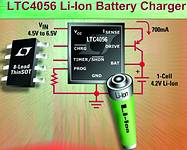
Linear Technology's LTC4056, is a linear Li-Ion battery charger controller is designed to provide a microcontroller-free solution, as well as faster charging from a poorly regulated or a sagging input supply such as a wall adapter or USB port. The total solution occupies an area of less than 75 mm2 and has a height of only 1 mm. Whereas traditional ICs inhibit charging or pull down on an input power supply when the input voltage source sags, the LTC4056 continues charging the battery by limiting the charge current until the input power source recovers. As a result, uninterrupted battery charging reduces the charging time. The IC also includes all the necessary functions for charging, charge termination and protection. The device targets systems that need to charge a 4,2 V Li-Ion battery from a 4,5 to 6,5 V input source with charge currents ranging from 200 to 700 mA. The user can easily adjust the charge current and charge termination time with an off-the-shelf resistor and capacitor, respectively. Precision 1-cell Li-Ion battery charging is guaranteed with the LTC4056's preset 4,2 V ±0,5% accurate float voltage. The LTC4056 also features automatic recharge, charge conditioning, status output signal, and AC adapter detection.
Further reading:
40 W and 75 W railway DC/DC converter
Brabek
Power Electronics / Power Management
RECOM has announced two new cost-efficient DC/DC converters for the rail market with an ultra-wide 11:1 input range to cover all nominal input voltages from 24 to 110 V DC.
Read more...
SanDisk MAX ENDURANCE microSD card
Technews Publishing SMART Security Solutions
Smart Home Automation Products & Solutions
SMART Security Solutions received a 128 GB SanDisk microSD card for the video surveillance market to put to the test. The storage card is designed for edge-recording cameras, dashcams, and more.
Read more...
Keenfinity creates two security businesses
News & Events Access Control & Identity Management Perimeter Security, Alarms & Intruder Detection
The Keenfinity Group, today announced the creation of two dedicated businesses from its former Intrusion & Access portfolio. Radionix will focus exclusively on intrusion alarm systems, while MiCOS will become a dedicated access control company.
Read more...
Lightweight body-worn camera
Axis Communications SA
Surveillance Products & Solutions
Axis releases new lightweight body-worn camera designed to perform throughout the day. Built on open standards, it integrates seamlessly with AXIS Camera Station and third-party on-premises or cloud-based VMS solutions.
Read more...
High-precision current transducer
Power Electronics / Power Management
Danisense announces its new high-precision DP12IP current transducer designed for isolated DC and AC current measurement in demanding PCB-mounted power electronics applications.
Read more...
Secure holder for protected 18650 batteries
Power Electronics / Power Management
Designed for protected 18650 batteries up to 70 mm long, the holder offers secure retention for portable, industrial, and embedded applications.
Read more...
More room to scale
Altron Arrow
Power Electronics / Power Management
With the latest STM32H5 lines from STMicroelectronics, you can now scale within the same platform, from a compact 1 Mbyte device to higher-memory MCUs for graphics-rich and feature-heavy designs.
Read more...
Surface mount power amplifier for high-power applications
RF Design
Power Electronics / Power Management
The GNA-63-5W+, from Mini-Circuits, is a GaN MMIC Power Amplifier (PA) designed for demanding RF applications requiring high efficiency, excellent linearity, and a compact footprint.
Read more...
1200 V QSiC modules
Power Electronics / Power Management
SemiQ Inc has launched the QSiC Dual3, a family of 1200 V half-bridge MOSFET modules for motor drives in data centre cooling systems, grid converters in energy storage systems, and industrial drivers.
Read more...
MCOTS transient filter for military applications
RFiber Solutions
Power Electronics / Power Management
SynQor has announced the new MCOTS-F-28-T-HE transient half-brick filter, the latest addition to its MCOTS product family.
Read more...









 printer friendly version