

Passive Components


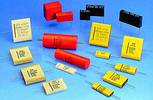
Plastic film capacitors offer electrical and mechanical stability

24 September 2003 Passive Components Integrated Solutions

Eurofarad designs and manufactures film capacitors using a wide range of technologies depending on environmental considerations. In general, Eurofarad impregnates these capacitors with solid thermoset resin such as epoxy, polyester or composites. These technologies result in extremely stable mechanical and electrical properties at temperatures ranging from -55 to +125°C/+155°C and even up to +200°C if required.

Eurofarad's high voltage capacitors are especially recommended because their performance offers optimum results for energy storage, delay lines or low impedance circuits. For these applications, their life expectancy depends on several different factors: form and mode of discharge, frequency of recurrence, mode of operation, climatic condition, etc.

In addition to their standard capacitors, the company's extensive expertise in this field lets it offer capacitors with made-to-order characteristics such as: partial discharge-free capacitors; specific test voltage capacitors; capacitors to individual technical specifications.

The use of plastic film as a dielectric has the following advantages: high electrical and climatic performance; homogenous; consistant repeatability; very thin film which allows smaller size components.

The metallised dielectric technique replaces the metal foil of the armatures of traditional capacitors with a very thin coating of metal on the dielectric film deposited in a high vacuum. This allows further reduction in size and has the additional benefit of an original and important characteristic.

* Self-healing: breakdown due to ageing or overstrain of the dielectric would be permanent in traditional foil armature capacitors. In metallised dielectric capacitors this is a short term phenomenon, as the current of the short circuit volatilises the metallisation at the defective spot and the capacitor is again insulated - hence self-healing.

* Dielectric metallisation: several metals can be used for metallisation of the film. Eurofarad only uses aluminium because of its inherent characteristics. These are: aluminium is a very good conductive material which favours a low loss angle; the residue of self-healing is alumina, which is a very good insulating substance and consequently is non-polluting within the capacitor.

* Foil armature capacitors: for use in particular cases when this technique is necessary (very small capacitors, high current, etc.) the company manufactures traditional foil armature capacitors.

* Composite dielectric capacitors: the use of two different dielectrics in the same capacitor sometimes proves interesting and allows the advantages of two dielectrics. For example, in the case of the metallised composite capacitors this technique makes impregnation easier, avoids ionisation and gives excellent long term stability in all environmental conditions.


Credit(s)


Share this article:
Share via emailShare via LinkedInPrint this page

Further reading:

Integrated layers offer dependable security
OPTEX SMART Security Solutions Technews Publishing Perimeter Security, Alarms & Intruder Detection Integrated Solutions
A layered approach to security tightens protection and minimises downtime and operational risk. Moreover, integrating all the parts of a solution and proving they can do the job before spending money are critical.

Read more...
Cooling solutions for modern electronics
Future Electronics Passive Components
As electronic systems become more compact and powerful, effective thermal management has become a critical aspect of product design.

Read more...
DC-link capacitors with ultra-low inductance
Electrocomp Passive Components
TDK Corporation recently released its new series of MKP DC high-frequency film capacitors, a high-performance DC link capacitor platform for next-generation SiC-based power electronics.

Read more...
Generating negative voltages from a positive supply
Altron Arrow Editor's Choice Passive Components
It is common for IoT devices, industrial sensors, meters, and medical equipment to require both a positive and negative voltage, and this article explains the options available to produce a negative rail from a positive rail supply.

Read more...
High-precision thick-film resistors
Avnet Silica Passive Components
The new Panasonic ERJPC high precision thick-film resistors series deliver accuracy levels previously only achievable with thin film technology, offering customers higher power density and cost-effective performance.

Read more...
Semi-shielded power inductors
RS South Africa Passive Components
The SDCx family from Eaton includes the SDCL and SDCH series of semi-shielded power inductors designed for reliable performance in consumer, industrial, energy, and medical applications.

Read more...
Impro announces Primo update
News & Events Access Control & Identity Management Integrated Solutions
Impro Technologies recently held a launch event in which it introduced a series of new products, from new readers through to its updated Primo access management software.

Read more...
Compact high-current power inductor
EBV Electrolink Passive Components
Vishay’s IHLP series power inductors deliver high current capability in an ultra-low profile, magnetically shielded design.

Read more...
Tiny noise suppression filters
RS South Africa Passive Components
TDK Corporation recently announced its latest noise suppression filters of the MAF0603GWY series, which measure only 0,6 x 0,3 x 0,3 mm.

Read more...
Compact 1250 V choke solution
Electrocomp Passive Components
TDK Corporation has introduced a new high-voltage common-mode choke series designed to support more compact and efficient 1250 V DC converter architectures in next-generation power electronics.

Read more...


While every effort has been made to ensure the accuracy of the information contained herein, the publisher and its agents cannot be held responsible for any errors contained, or any loss incurred as a result. Articles published do not necessarily reflect the views of the publishers. The editor reserves the right to alter or cut copy. Articles submitted are deemed to have been cleared for publication. Advertisements and company contact details are published as provided by the advertiser. Technews Publishing (Pty) Ltd cannot be held responsible for the accuracy or veracity of supplied material.


© Technews Publishing (Pty) Ltd | All Rights Reserved

