


The design of systems with multiple supply voltages is commonplace today. In such systems as Internet routers, digital subscriber-line access multiplexers (DSLAMs), base stations, and servers, the sequencing and supervision of their multiple supplies has grown in importance.
This article shows how the ADM1060 supervisor/sequencer from Analog Devices greatly simplifies this task by providing multiple supply supervisors, sequencing logic, and multiple-output drivers, in a single 28-lead TSSOP device. Also, the configuration of these multiple functions is easily programmed using the company's intuitive graphical user interface (GUI).
User demands is making the design task increasingly difficult. Customers want more channels at higher data rates for less money. They also require a much higher level of reliability: An uptime of 99,999%, commonly known as 'five-9's reliability' (analogous to two minutes of downtime per year), is now a basic requirement.
Additional bandwidth, expressed in both channel count and speed, has resulted in a proliferation of many new-generation devices. The cores of these devices run at much lower voltages than the traditional 3,3 V or 5 V (for example, 1,2, 1,5, 1,8, and 2,5 V are common core-supply levels). Yet I/O protocols dictate that 3,3 and 5 V supplies still be provided. In fact, some designs may require a 12 V supply; others need termination voltages as low as 0,75 V; and there are even cases where negative supplies are required for op-amp rails.
It is not uncommon for many, if not all, of these supplies to be required on a single board - easily for six, seven, or more supplies. The sequence in which the supplies turn on can be critical to the reliable operation of the system. A good rule of thumb might be to start with the highest supply first and work downwards; but this is not always the case. For instance, some DSP manufacturers recommend that the core of their device be powered up before the I/O, while others recommend the opposite. Given the PCB complexities now, the truth is that it may be difficult to determine what the optimal power-up sequence is without first designing, building, and testing. But this 'trial-and-error' is costly.
The current discrete approach to supply sequencing, using reset generators, FET drivers, and RC time constants (Figure 1 shows a typical implementation) - while adequate for a system requiring two or three supplies, it becomes very cumbersome when the number rises to six or seven. Another problem is that accurate reset generators have fixed threshold voltages. If - as can be the case with ASICs - a supply voltage must be tweaked to a nonstandard value for maximum performance. Also, such designs require the power designer's best guess (albeit an educated one) as to the sequence required. If the wrong guess, it is difficult to rectify without a board spin. Further, as the PCB population density increases, real estate becomes an issue and a multicomponent discrete solution becomes unattractive. Finally, it is not easy to design the power-down sequence, using the same simple reset generators with fixed timeouts and open-drain outputs.
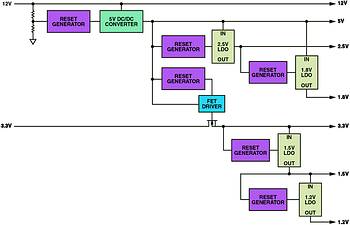
The solution described here is a single IC, which provides a total voltage-management solution and encompasses all of the functionality of the discrete design shown in Figure 1. The device also goes further, however, in providing the flexibility to change its configuration easily as required. If the alteration of a reset threshold, the power-up sequence, the power-down sequence, and the watchdog timeout on a processor clock can be altered without laying out the hardware again, the power designer's task is made infinitely easier. Naturally, a single IC (minimal external components) also addresses the key issue of board real estate. Also, the design is quicker and if necessary, it can be altered later without a change in hardware.
The Analog Devices ADM1060 multisupply supervisory circuit is such a device. A total voltage-management solution in a single small 28-lead package, it requires as few as two external parts (decoupling capacitors), making it ideal for applications where board space is at a premium.
The ADM1060 can supervise up to seven supplies. All of the supervisors on the chip use window comparators, so that both overvoltage and undervoltage supply faults can be detected on each of the supply fault input pins. One of the supply fault detectors can supervise a supply up to 14,4 V (analogous to a 12 V supply being overranged by +20%). Four of the supervisors can detect faults from 0,6 to 6 V (a 5 V supply being overranged by +20%). The other two supervisors can be used to monitor negative supplies down to -6 V. If supervision of a negative supply is not required, these two pins can be used to monitor supplies up to +6 V. Any threshold voltage within the above ranges can be programmed with 8-bit resolution. Thus, if an ASIC runs optimally with a nonstandard voltage ie, not 1,2, 1,5, 1,8 V, etc, the ADM1060 can be programmed around the modified supply voltage with an accurate fault-detection window. The hysteresis of these comparators is programmable digitally, allowing the user to control the level of noise immunity required.
The ADM1060 does not need a dedicated power pin. The device uses an arbitration scheme to power itself from any one of five of the supply-fault input pins. The highest is used, and if this should fail, the ADM1060 seamlessly switches over to the next highest supply to power itself. Thus, even in a failing system, the device continues to be powered, maintaining supervision for as long as possible.
The ADM1060 also provides four general-purpose inputs (GPIs). These are logic inputs (TTL- or CMOS-compatible) that enable the user to apply control signals, such as POWER_OK, RESET, or MANUAL RESET, and use these to control the sequence in which the supplies turn on. Note that these inputs can also be used to take signals from external supervisory chips, if more than seven supplies need to be supervised and included in the sequencing. A watchdog timer is also included that ensures that a processor clock continues to toggle.
The logical core of the device is the programmable logic-block array (PLBA), combined with the programmable delay block (PDB). These blocks enable the ADM1060 to sequence the turn-on of the supplies' programmable time delays in the chosen order. A set of different time delays can be programmed for a power-down sequence. For instance, a supply may be required to power up 100 ms after the previous supply - but to turn off instantly if a fault occurs.
The ADM1060 makes available nine output drivers. These programmable driver outputs (PDOs) can be used as logic-control signals, such as chip-enable, LDO- (DC/DC brick-) output enable, or simply as status signals. The output pins all have an open-drain configuration, allowing the user to connect an external resistor to pull the pin up to the desired voltage. However, it is likely that the pull-up voltage is one that is being supervised at one of the inputs of the device and is available on-chip. Therefore, the ADM1060 features a bank of internal pull-up resistors, which can be connected to the pull-up voltage without external components. This is of course significant where minimal board space is available. Four of the output drivers can also provide a high-voltage gate drive to turn on an NMOS FET, which may be placed in a supply path. In this option, a 12 V charge-pump voltage is provided at the output pin.
Communication with the ADM1060 is via an industry-standard 2-wire interface (SMBus). The user can set up the features described using the intuitive GUI provided by Analog Devices. This programming can be done offline, using the evaluation kit, or in-system, using a 3-pin header cable. Once satisfied with the configuration, the user can store this in nonvolatile memory, so that each time the device is subsequently powered up, the same configuration is downloaded and set up in the device.
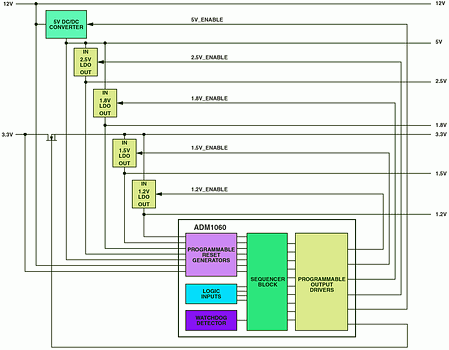
Providing the same seven supplies outlined in the discrete design of Figure 1, a sequence could be implemented using a single ADM1060 as shown in Figure 2.
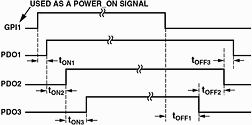
Another very powerful feature of the ADM1060, not easily replicated in a discrete design, is the ability to configure a controlled power-down sequence. Again, using the software provided, a sequence like that shown in Figure 3 can be configured.
Conclusion
The requirement for multiple voltages on a single PCB has resulted in a difficult supply sequencing problem for power designers. With six, seven, or more voltages required, discrete solutions are unwieldy and impractical. The ADM1060 from Analog Devices provides a powerful and flexible solution, making the configuration of supply thresholds, logic inputs, and supply sequencing a straightforward software design-rather than a costly and error-prone hardware design.
For more information contact Analog Data Products, a division of Avnet Kopp, 011 809 6100.






© Technews Publishing (Pty) Ltd | All Rights Reserved
 printer friendly version