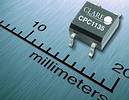
The CPC1130N, CPC1135N and CPC1231N OptoMOS solid-state relays (SSR) from Clare are optically coupled, normally closed relays that use depletion mode MOSFETS to achieve a 1 Form B relay contact configuration. All are packaged in the miniature 4 pin SOP package, which remains the smallest package in the industry for high voltage SSRs (area of 15,5 mm2 and a height of only 2,2 mm).
The blocking voltage for all three products is 350 V and the load current handling is 120 mA. The maximum on-resistance for the CPC1130N and CPC1231N is 30 Ω, while the CPC1135N is 35 Ω. The depletion mode MOSFETs and the configuration used means that, in the absence of power, the relay will retain the normally closed configuration. This is critical for a variety of lifeline, power down and fail safe telephony and security applications. In particular, a normally closed SSR can be used in Voice-over-IP telephony equipment to provide a backup lifeline connection to the PSTN in case power is lost.
Clare's 1 Form B relays (CPC1130N, CPC1135N) and 1 Form A relays (CPC1030N, CPC1035N) are complementary with matching voltage, current and on-resistance specifications, a critical performance requirement for many telephony applications.
Microchip expands maXTouch M1 touchscreen controller Altron Arrow
DSP, Micros & Memory
Microchip Technology has again expanded its maXTouch M1 family of touchscreen controllers, now covering free-form widescreen format displays up to 42 inches down to small compact screens in the 2 to 5 inch range.
Read more...ToF sensor with 6 m range Altron Arrow
Test & Measurement
Specifically designed for long-range, multitarget measurements, the VL53L4CX from ST Microelectronics provides very accurate distance measurements up to 6 m with excellent results over short distances.
Read more...Microchip expands its Arm Cortex-M0+ portfolio Altron Arrow
DSP, Micros & Memory
PIC32CM PL10 MCUs feature a rich set of Core Independent Peripherals, 5 V operation, touch capabilities, integrated toolsets, and safety compliance.
Read more...More room to scale Altron Arrow
Power Electronics / Power Management
With the latest STM32H5 lines from STMicroelectronics, you can now scale within the same platform, from a compact 1 Mbyte device to higher-memory MCUs for graphics-rich and feature-heavy designs.
Read more...Multi-constellation GNSS module in a legacy-compatible footprint Altron Arrow
Telecoms, Datacoms, Wireless, IoT
Telit Cinterion has announced the SE869eK2L, a single-frequency L1 GNSS module designed to help device manufacturers upgrade legacy positioning designs with improved performance and cost efficiency, while preserving design continuity.
Read more...Compact SSI family for industrial automation Altron Arrow
Passive Components
Infineon Technologies has introduced the ISSI20BxxF Solid State Isolator (SSI) family, bringing solid-state isolation technology into high-volume applications traditionally served by photovoltaic isolators (PVIs), photovoltaic relays (PVRs), and electromechanical relays (EMRs).
Read more...Rev 2.0 PolarFire FPGA ethernet sensor bridge Altron Arrow
Computer/Embedded Technology
Smaller, multi-camera platform enables scalable Ethernet architectures for NVIDIA Edge AI systems, while lowering power, cost and integration complexity.
Read more...Universal IR receiver module Altron Arrow
Telecoms, Datacoms, Wireless, IoT
Vishay Intertechnology has introduced a new series of infrared (IR) receiver modules for IR remote control applications, which feature a wide modulation frequency acceptance from 30 kHz to 68 kHz.
Read more...Low profile SMD antenna Altron Arrow
Telecoms, Datacoms, Wireless, IoT
The Havok PCS.06.A antenna, from Taoglas, is a low profile SMD LTE/cellular 4G/3G/2G embedded antenna designed for direct SMD mount on a device PCB.
Read more...Accelerate development of physical AI deployments Altron Arrow
DSP, Micros & Memory
With Avocado OS now available on the HummingBoard RZ-V2N-
AIoT and SolidSense AIoT V2N from SolidRun, teams can move from prototype to deployed fleet in weeks.
While every effort has been made to ensure the accuracy of the information contained herein, the publisher and its agents cannot be held responsible for any errors contained, or any loss incurred as a result. Articles published do not necessarily reflect the views of the publishers. The editor reserves the right to alter or cut copy. Articles submitted are deemed to have been cleared for publication. Advertisements and company contact details are published as provided by the advertiser. Technews Publishing (Pty) Ltd cannot be held responsible for the accuracy or veracity of supplied material.









 printer friendly version