


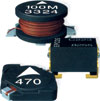
RF inductors cover a wide variety of applications such as EMC, RF filtering, impedance matching and, to a growing extent, energy storage in DC/DC converters. According to Ralph Lutsche, Epcos product marketing director for RF inductors, customer demands for miniaturisation, maximised current-handling capacity, high operating temperatures and impeccable quality are pushing development of inductive components.
He says Epcos has extended its product range specifically to meet these requirements. "Typical representatives are inductors of the SIMID 1210-H series, whose current-handling capacity of up to 1 A is at present the highest on the world market in this size," explains Lutsche.
"What is more, their maximum inductance has more than doubled from 330 to 680 μH. So these chokes cover an important part of the standard 1812 range and represent a more compact and economical alternative to it," he continues. "Thanks to their laserwelded windings, these chokes can also withstand a maximum continuous ambient temperature up to 150°C. Volume production is scheduled for mid-2005."
Mobile communications and entertainment electronics as well as some computer peripherals, such as hard disks, DVD drives and graphics cards, need ultracompact DC/DC converters that can handle currents of more than 1 A despite miniaturisation. Epcos has developed a low-profile power inductor for these applications. It has an insertion height of only 1,2 mm for a footprint of 4,8 x 4,8 mm, with impressive electrical figures to boot. It can withstand continuous currents up to 1,5 A and features a maximum inductance of 47 μH. Epcos manufactures this component in China, because major electronic manufacturing service (EMS) providers located in Asia make up the largest customer segment.
The trend toward decentralised power supplies with various voltage levels is spreading to the automotive electronics industry too. Processors, controllers and memory chips operate on lower and lower voltages, but draw correspondingly higher currents. Local DC/DC converters must be designed accordingly. Lutsche describes this progress: "EPCOS has specially developed a new series of power inductors for the tough demands of the automobile industry. Although their footprint is only 6 x 6 mm, they can handle currents up to 3,4 A."
Made on a highly automated production line, the new components are available with insertion heights of 2,5 and 3 mm. Shielded variants have also been developed to cope with EMC problems even where space is at a premium.
The CAN bus has now emerged as the controller networking standard for automotive electronics. Just a few years ago, this bus technology was only designed into European upmarket automobiles. It has now found its way into midrange and even compact cars. The CAN bus is also being used on a growing scale in new vehicles developed by Asian and American manufacturers. "To satisfy the growing demand for CAN bus chokes in small sizes in particular," says Lutsche, "we have developed a competitively-priced current-compensated version in size 1812. Based on an I core, it features inductances up to 100 μH at maximum continuous ambient temperatures up to 150°C as well."
RF inductors - benefits:
* High current handling capacity up to 10 A.
* SMDs with inductances up to 10 mH.
* SMD sizes 0402 to 2220.
* Lowest insertion height for power inductors: 1,2 mm.
* Laser-welded windings.
* Extended ambient temperature range to 150°C.
* Lead-free.
| Tel: | +27 11 458 9000 |
| Email: | sales@electrocomp.co.za |
| www: | www.electrocomp.co.za |
| Articles: | More information and articles about Electrocomp |






© Technews Publishing (Pty) Ltd | All Rights Reserved
 printer friendly version