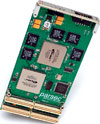
Parsec's latest addition to its range of commercial off-the-shelf (COTS) PCI mezzanine cards (PMC), the PM431, is a single PMC module that makes use of two Altera Stratix FPGAs and five ZBT memories to provide a high-speed, high-bandwidth processing platform. It is ideally suited for software defined radio (SDR), WiMAX, radar, video and other computation and bandwidth intensive applications.
An EP1S25 Altera Stratix device (upgradeable to an EP1S40) implements a processing FPGA that provides a superior combination of logic and memory resources, DSP performance and I/O flexibility. Five 256Kx36 (9 Mb) ZBT memories (upgradeable to 18 Mb) individually connect to the processing FPGA, yielding 2,66 Gbytes/sec of memory bandwidth. From P4, 64 PMC user I/Os connect to the processing FPGA and are completely user configurable.
An EP1S10 Stratix FPGA implements a PCI-to-local-bus bridge that provides a 64-bit 66 MHz PCI bus interface and a versatile 66 MHz local bus. The PCI-to-local-bus bridge supports maximum PCI bandwidth (533 Mbytes/sec) to and from the processing FPGA via the target and DMA buses, eliminating the need for traditional front panel interfaces. The PM431 front panel contains four status LEDs and a JTAG header.
The EP1S10 Stratix FPGA firmware is factory programmed, while the processing FPGA is available to the user for custom firmware development.
The PM431 is shipped with local bus teference design firmware and example software that provide a starting point for custom user firmware and software development.
A Flash programming utility and optimised device driver for Windows 2000/XP is also included as part of the PM431 development suite. A Matlab API is available on request, with a DSP Builder interface currently undergoing development. Parsec provides custom firmware and software development services.
The unique dual FPGA design and versatile local bus of the PM431 provides a firmware development platform targeted at applications requiring high-speed processing, as well as high-bandwidth data throughput. Typical examples are DSP and communication functions like FFT, FIR filtering, digital up and down conversion, Viterbi and Turbo decoders, etc. The PM431 forms part of Parsec's StarFabric cPCI and PMC product range.
From idea to intelligent product TRX Electronics
Computer/Embedded Technology
Mouser Electronics has announced a new eBook in collaboration with Arduino – From Blink to Think: How Arduino UNO Q Helps Designers Go from Idea to Intelligent Product.
Read more...Think Diamond Long-life COM-based SBCs Electronic Products Design
Computer/Embedded Technology
A COM-based SBC combines the flexibility of a standard computer-on-module (COM) with a baseboard offering additional I/O, expansion sockets, power supplies, and I/O connectors. The result is a highly flexible, highly expandable, feature-dense product that can be adapted to the widest range of applications, offering maximum product lifetime.
Read more...Next-Gen Min-ITX motherboard Vepac Electronics
Computer/Embedded Technology
Adding to AAEON’s extensive industrial motherboard portfolio, the Next-Gen MIX-Q870A1 is the company’s most advanced Mini-ITX board to date.
Read more...Rev 2.0 PolarFire FPGA ethernet sensor bridge Altron Arrow
Computer/Embedded Technology
Smaller, multi-camera platform enables scalable Ethernet architectures for NVIDIA Edge AI systems, while lowering power, cost and integration complexity.
Read more...Intelligent video processing Rugged Interconnect Technologies
Computer/Embedded Technology
The CHARM150AGX is based on a NVIDIA AGX Orin embedded processor, which incorporates a multicore ARM processor and powerful AI/ML accelerator.
Read more...Nordic expands nRF Cloud with firmware vulnerability scanning RF Design
Computer/Embedded Technology
nRF Cloud identifies vulnerabilities in firmware and shows exactly which deployed devices are affected, empowering device manufacturers to address EU Cyber Resilience Act requirements.
Read more...Arrival of the Epic-PTH9 Vepac Electronics
Computer/Embedded Technology
AAEON introduces the EPIC-PTH9, a compact 4-inch industrial single-board computer powered by Intel Core Ultra Series 3 (formerly Panther Lake) processors.
While every effort has been made to ensure the accuracy of the information contained herein, the publisher and its agents cannot be held responsible for any errors contained, or any loss incurred as a result. Articles published do not necessarily reflect the views of the publishers. The editor reserves the right to alter or cut copy. Articles submitted are deemed to have been cleared for publication. Advertisements and company contact details are published as provided by the advertiser. Technews Publishing (Pty) Ltd cannot be held responsible for the accuracy or veracity of supplied material.









 printer friendly version