100 A in a standard quarter-brick package
26 January 2005
Power Electronics / Power Management
Surveillance
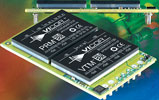
New high performance DC-DC converters that conform to the industry-standard quarter-brick footprint and pin outs, have been announced by Vicor. Said to leapfrog existing ¼-brick offerings in the areas of power density, efficiency, transient response, and cost, the superior performance of the new VICBricks is enabled by the company's V·I Chip technology.
Each VICBrick consists of two V·I Chips: a 36-75 V d.c. input pre-regulator module (PRM) that is paired with an appropriate voltage transformation module (VTM) chosen to provide the desired output voltage. While the ultra-low profile package conforms to industry-standard ¼-brick footprint (36,8 x 57,9 mm), it stands only 6,4 mm high and achieves 100 A of output current.
Efficiency at 86% for a 1,2 Vout model enables higher output currents for the same airflows and ambient temperatures. With a switching frequency of over 3 MHz, the already low level of output noise is easily filtered to negligible levels - and the transient response inherent in the VTM makes the VICBrick one of the fastest DC-DC converters in the industry.
Available standard outputs include 1,0 and 1,2 V at 100 A, 1,5 V and 1,8 V at 80 A, 2,5 V at 60 A, 3,0 and 3,3 V at 45 A, and 5 V at 30 A.
Further reading:
Genetec global leader in video management software
Genetec
News & Events Surveillance
Independent analyst firms rank Genetec as global leader in video management software. Research shows continued market share gains for Genetec as both the VMS and VSaaS markets continue to expand worldwide.
Read more...
DeepAlert Launches COMMAND
News & Events Surveillance
Cloud-based, AI-powered surveillance monitoring platform cuts operator alert fatigue and response times, and becomes DeepAlert's primary monitoring platform for security companies and control rooms worldwide.
Read more...
Retailers expanding physical security beyond loss prevention
Genetec
Facilities & Building Management Surveillance Retail (Industry)
Genetec released retail-specific findings from its 2026 State of Physical Security Report. The research shows retailers increasingly view physical security as a business function that supports operations, employee safety, and modernisation efforts.
Read more...
High-precision current transducer
Power Electronics / Power Management
Danisense announces its new high-precision DP12IP current transducer designed for isolated DC and AC current measurement in demanding PCB-mounted power electronics applications.
Read more...
Secure holder for protected 18650 batteries
Power Electronics / Power Management
Designed for protected 18650 batteries up to 70 mm long, the holder offers secure retention for portable, industrial, and embedded applications.
Read more...
More room to scale
Altron Arrow
Power Electronics / Power Management
With the latest STM32H5 lines from STMicroelectronics, you can now scale within the same platform, from a compact 1 Mbyte device to higher-memory MCUs for graphics-rich and feature-heavy designs.
Read more...
Surface mount power amplifier for high-power applications
RF Design
Power Electronics / Power Management
The GNA-63-5W+, from Mini-Circuits, is a GaN MMIC Power Amplifier (PA) designed for demanding RF applications requiring high efficiency, excellent linearity, and a compact footprint.
Read more...
1200 V QSiC modules
Power Electronics / Power Management
SemiQ Inc has launched the QSiC Dual3, a family of 1200 V half-bridge MOSFET modules for motor drives in data centre cooling systems, grid converters in energy storage systems, and industrial drivers.
Read more...
MCOTS transient filter for military applications
RFiber Solutions
Power Electronics / Power Management
SynQor has announced the new MCOTS-F-28-T-HE transient half-brick filter, the latest addition to its MCOTS product family.
Read more...
Expanded range of high-thermal-performance QSiC modules
Power Electronics / Power Management
SemiQ’s half-bridge series for data centre power converters and industrial motor drives features low RDSON SiC MOSFETs and parallel SBD diodes for best-in-class power density and conversion efficiency.
Read more...









 printer friendly version