Solid-state relays are radiation-hardened for high reliability systems
4 May 2005
Switches, Relays & Keypads
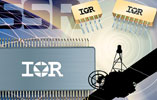
International Rectifier has introduced four devices in a new line of radiation-hardened solid state relays (SSRs) for high reliability applications. These SSRs are hermetically-sealed, all-electronic devices, characterised for total dose levels of up to 100 k rad (Si) or higher. They are designed to improve reliability by replacing electro-mechanical relays in power bus switching, heater control circuits, battery charging and other hi-rel applications.
"Solid-state relays have switching times that are similar to electro-mechanical relay switching times, but are immune to vibration and shock, increasing reliability. Also, because they have no contact bounce, filters can be removed from the system, reducing size and weight," said Rick Furtney, IR vice president, HiRel Sector Business Unit.
The first SSR is the RDHA710SE10A2Q (SMD mount) dual SSR, with current handling capabilities of 20 A (10 A when properly de-rated) and a breakdown voltage capability of 100 V, which is high enough to allow normally applied de-rating. The second and third devices are the RDHA701FP10A8Q and '8C, containing eight SPST, NO, 1,5 A, 100 V SSRs with selectable input actuation methods and a choice of rise/fall time control. They are housed in a 64-pin surface mount package. The fourth SSR is the RDHA720SF06A1N, a single 20 A, 60 V device, also in an SMD package.
"The new SSRs have buffered inputs, so they can be driven directly from logic circuits, simplifying overall design and reducing parts count," Furtney adds.
The SSRs are available in single, dual or octal SPST NO (single pole, single throw, normally open [Form A]) type with current ratings of 1,5 A to 20 A at 60 V to 100 V. In addition, some have internal circuitry to control output transition times for lower dV/dt and dI/dt, minimising system RFI/EMI. Most of these devices are available in alternate style packages for flange mounting.
Further reading:
iCorp brings BeeLee’s compact switch and sensor components to local designers
iCorp Technologies
Switches, Relays & Keypads
BeeLee’s product catalogue includes (among others) vibration sensors, tilt ball switches, reed switches, hall sensors, optocoupler (photo interrupter) devices, and liquid level switches.
Read more...
LED indicators
Brabek
Switches, Relays & Keypads
The Dual Icon series from APEM is an LED indicator that presents two distinct visual signals within a single unit.
Read more...
Reed relay upgraded to 200 W
Switches, Relays & Keypads
Engineers gain 200 W switching power in Pickering’s Series 68 HV relays with flying leads, ideal for demanding test, medical, and energy applications.
Read more...
Industrial hand controller
Brabek
Switches, Relays & Keypads
The HC Series hand controller from APEM is a pre-qualified solution for use in demanding industrial environments.
Read more...
Customisable high-voltage reed relay
Switches, Relays & Keypads
Pickering Electronics has introduced its Series 600 relays, the company’s most customisable range of high voltage reed relays to date.
Read more...
Stainless steel panel switch
Brabek
Switches, Relays & Keypads
The new cap has a stainless-steel front offering an aesthetic look and provides excellent halo illumination.
Read more...
Tuning knobs in modern designs
Phoenix Contact
Switches, Relays & Keypads
Teaser: OKW’s latest tuning knobs, include optional LED illumination, flush-fitting installation, and a main body which is slightly inclined towards the internal axis.
Read more...
High-voltage isolation reed relay
Switches, Relays & Keypads
Pickering recently announced its new and improved Series 104 high-voltage isolation reed relays which are designed to stand-off up to 5000 V
Read more...
Compact switching joystick
Brabek
Switches, Relays & Keypads
The MHS Series from Ruffy Controls is a momentary four-way or eight-way switching joystick with an optional pushbutton validation feature.
Read more...
Schlegel switches available from TME
Switches, Relays & Keypads
The range of Schlegel products available at TME comprises contact blocks, compatible switches, and accessories.
Read more...









 printer friendly version