Low voltage-driven ioniser
13 July 2005
Passive Components
More and more appliances are being manufactured, such as air-cleaners, airconditioners, humidifiers, dehumidifiers, etc, that have a 'negative ion generation' feature. Negative ions are negatively charged molecules that are said to produce 'refreshing' sensations in people.
The generation mechanism is as follows: with conventional negative ion generation, a high voltage (around -5,0 kV d.c.) is applied to a needle-shaped terminal. Since the voltage is high there are safety issues. Also, ozone tends to be generated as well.
Murata has applied high power technology and printing technology from its power durable product line to develop products that it says can generate negative ions at a voltage one half of the conventional models. It also suppresses ozone generation by controlling leakage current.
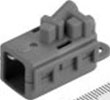
The MHM Series ioniser unit has the construction of a grounding electrode on a ceramic substrate with 70 μm diameter thick ultra-fine wire attached. This enables low voltage negative ion generation at -1,8 kV d.c. and less than 0,01 ppm ozone generation. In tests, the amount of negative ions generated at
-2,5 kV is 500 000 ions/cc (3 m/s wind velocity, 50 cm away from the sample), while the amount of ozone generated is less than 0,01 ppm (1 cm away from the sample).
The unit measures 13 x 23 x 12 mm, and the lead wire can be attached to it by a self-locking terminal without soldering.
Further reading:
Tiny power inductor for low noise applications
iCorp Technologies
Passive Components
With the evolution of Bluetooth, chips, sensors and other technologies, the design of TWS earphones is becoming smaller and thinner, and the performance and size requirements of integrated inductors need to follow suit.
Read more...
High-endurance polymer tantalum capacitors
Passive Components
Panasonic Industry TDC Series POSCAP polymer tantalum capacitors deliver high endurance and reliable performance in demanding, high-temperature environments.
Read more...
Thin-film inductors for optical transceivers
RS South Africa
Passive Components
TDK has expanded its PLEC69B series (1,2 x 0,6 x 0,95 mm – L x W x H) of thin-film inductors, used for separating the data signal from the power in optical transceivers in AI data centres.
Read more...
Low-resistance MLCCs
RS South Africa
Passive Components
TDK Corporation has expanded its CN series of low-resistance soft-termination multilayer ceramic capacitors; achieving 22 nF capacitance in the 3225 case size.
Read more...
Ferrite cores with different shapes
RS South Africa
Passive Components
TDK Corporation has introduced a variety of new large-size ferrite cores with different core shapes, making this the industry’s largest lineup of shapes, sizes, and materials for such large cores.
Read more...
Vibration-resistant axial capacitors
RS South Africa
Passive Components
TDK Corporation has unveiled the B41699 and B41799 series of ultra-compact aluminium electrolytic capacitors, engineered to withstand operating temperatures of up to 140°C.
Read more...
Capacitors for demanding industrial applications
Passive Components
TDK Corporation has announced its X1 capacitors of the EPCOS B3291xH/J4 series for power line filtering of electromagnetic interferences in demanding automotive and industrial applications with a rated AC voltage of up to 480 V.
Read more...
Wide frequency range inductors
RS South Africa
Passive Components
TDK Corporation has expanded its ADL4524VL series
(4,5 x 2,4 x 2,6 mm – L x W x H) of wire-wound inductors for automotive power-over-coax.
Read more...
Cutting-edge hybrid capacitors
Avnet Silica
Passive Components
Panasonic Industry recently announced the launch of the ZVU Series Hybrid Capacitors, a cutting-edge solution tailored to meet the escalating demands of advanced electronic systems.
Read more...
Low-profile tantalum chip capacitors
Electrocomp
Passive Components
These general-purpose tantalum capacitors from Kyocera AVX are available in multiple case sizes with low profile options.
Read more...









 printer friendly version