


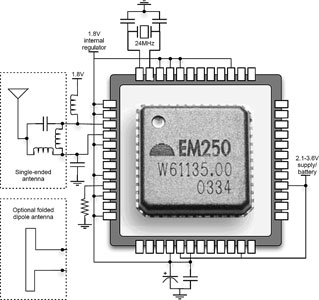
Ember's recently-unveiled next-generation of wireless semiconductors and software aims to help companies create ZigBee-compliant wireless products faster, easier and more profitably than first-generation offerings.
These products include the EM250, said to be the world's first ZigBee 'system-on-a-chip'; Ember's 2nd-generation ZigBee software stack called EmberZNet 2.0 (its fifth-generation mesh networking stack); as well as new software tools for rapid application development and debugging.
ZigBee is a wireless network standard that solves unique needs of remote monitoring and control, and sensor network applications.
Conceived at Massachusetts Institute of Technology's (MIT) research labs a decade ago, Ember is a wireless semiconductor solutions company enabling the next generation of embedded ZigBee/802.15.4 applications. Its technology has emerged as the ZigBee platform of choice for OEMs seeking to tap into this explosive market. This, it says, is because it offers the industry's most advanced full ZigBee system solution, architected from the ground up.
EM 250 highly integrated
The Ember EM250 is the first 802.15.4-based semiconductor system built to be ZigBee-compliant that integrates a programmable microprocessor, RF radio, network protocol stack and memory into a tiny, single-chip solution. Until now, ZigBee systems have only been available as multichip solutions, although multichip solutions will still play a role in certain larger, processor-intensive ZigBee applications.
Measuring smaller than a shirt button (7 mm on a side), the 2,4 GHz EM250 offers OEMs and systems integrators building ZigBee-enabled products large reductions in component size, cost and power consumption. With the chip's diminutive size and low power needs, ZigBee capabilities are now able to be embedded into products not previously possible.
The EM250 solution set also enables for the first time, a ZigBee-compliant network node with 'location awareness,' which allows for easier commissioning, management and network sub-segmentation. According to the company, the EM250 also has the highest RF output and Rx sensitivity for power consumed compared to other ZigBee products.
New ZigBee network processor
Ember also introduced the EM260, a next-generation ZigBee network processor targeted at OEMs seeking a choice in microcontrollers. The Ember EM260 network processor provides all of the advanced ZigBee wireless networking features and functionality as the company's EM250 ZigBee-on-a-chip, but in conjunction with application microcontrollers from Atmel, Texas Instruments and others.
ZigBee-compliant networking stack
EmberZNet 2.0 complements Ember's new hardware. This is a major new release of Ember's networking stack featuring a number of enhancements that extend ZigBee functionality, simplicity and performance. Beyond full ZigBee support, EmberZNet 2.0 supports application profiles for home controls as well as user-defined network applications. It also features an Ember transport layer to provide more reliable wireless communications between nodes and enable distributed bindings.
The Ember transport layer, along with Ember's API, also makes it easy for Ember's existing customers to port their EmberNet applications to the new ZigBee platform. Using the same familiar API they have already mastered, they can migrate their applications to a ZigBee-compliant version with minimal changes and development costs. Future upgrades to their products can be easily deployed with EmberZNet's over-the-air bootloader.
For example, Raymarine, an Ember customer, is porting its family of wireless autopilot systems for sports boats to the new Ember platform to create a novel ZigBee-compliant solution that lets fishermen control their vessels wirelessly, even while away from the helm.
New tools
In addition to the single-chip ZigBee solution, the company has fortified its development kit with a number of unique software tools. Ember WorkBench provides a suite of tools for developing and debugging embedded ZigBee applications. It combines an integrated development environment (IDE) with distributed network debugging and visualisation tools. Developers can connect to their target devices, easily control their application, upload firmware and collect debugging information across multiple devices simultaneously. Built-in protocol analysis and traffic visualisation engines allow developers to correlate events occurring on their devices with network communication events. This cuts development times significantly.
Ember's new single-chip platform enables self-organising, self-healing wireless networks upon which ZigBee applications can be easily built and deployed. According to Harbor Research analyst, Glen Allmendinger, ZigBee-based technology like Ember's will transform public and private life more than any computing development since the PC: "ZigBee is a major advance over earlier approaches to wireless device networking, and will be a crucial enabler throughout this decade, not only in the home, but in many other markets as well. Ember's ability to shrink an entire ZigBee system on to a tiny, low power chip will accelerate the ubiquity of the technology by making it easier and inexpensive for manufacturers to ZigBee-enable their products."
Ember says that its ZigBee system is designed to be particularly well suited for low-power, low-data-rate applications that help buildings consume less energy, improve industries' environmental impact, and make homes safer and more comfortable. The EM250/EmberZNet platform is already being designed into applications for home control and monitoring, asset tracking, automatic meter reading, and personal healthcare monitoring, to name a few applications.
For more information contact Christo Keyser, CST Electronics, +27 (0)11 452 0706.
| Tel: | +27 11 608 0070 |
| Email: | natasha@cstelectronics.co.za |
| www: | www.cstelectronics.co.za |
| Articles: | More information and articles about CST Electronics |






© Technews Publishing (Pty) Ltd | All Rights Reserved
 printer friendly version